 Bellingham Siding
 Blaine's Exterior Climate: Salt Air, Wind, and a Long Wet Season
Blaine sits right on the water at the northern edge of Whatcom County, close enough to the Strait of Georgia and Semiahmoo Bay that salt-laden air is simply part of daily life. That's a different exposure than what a house a few miles inland deals with. Homes near the shoreline take on airborne salt, near-constant marine humidity, and wind-driven rain that doesn't just fall on a house — it gets pushed sideways into every seam, joint, and gap in the exterior envelope.
Add in the broader Pacific Northwest pattern of long, grey, wet winters, and Blaine homes spend a large share of the year with damp exterior surfaces that rarely get a real chance to dry out. That combination — salt exposure plus sustained moisture plus wind — is one of the tougher exterior environments in Whatcom County, and it shapes almost every decision we make about materials and installation on a Blaine job.
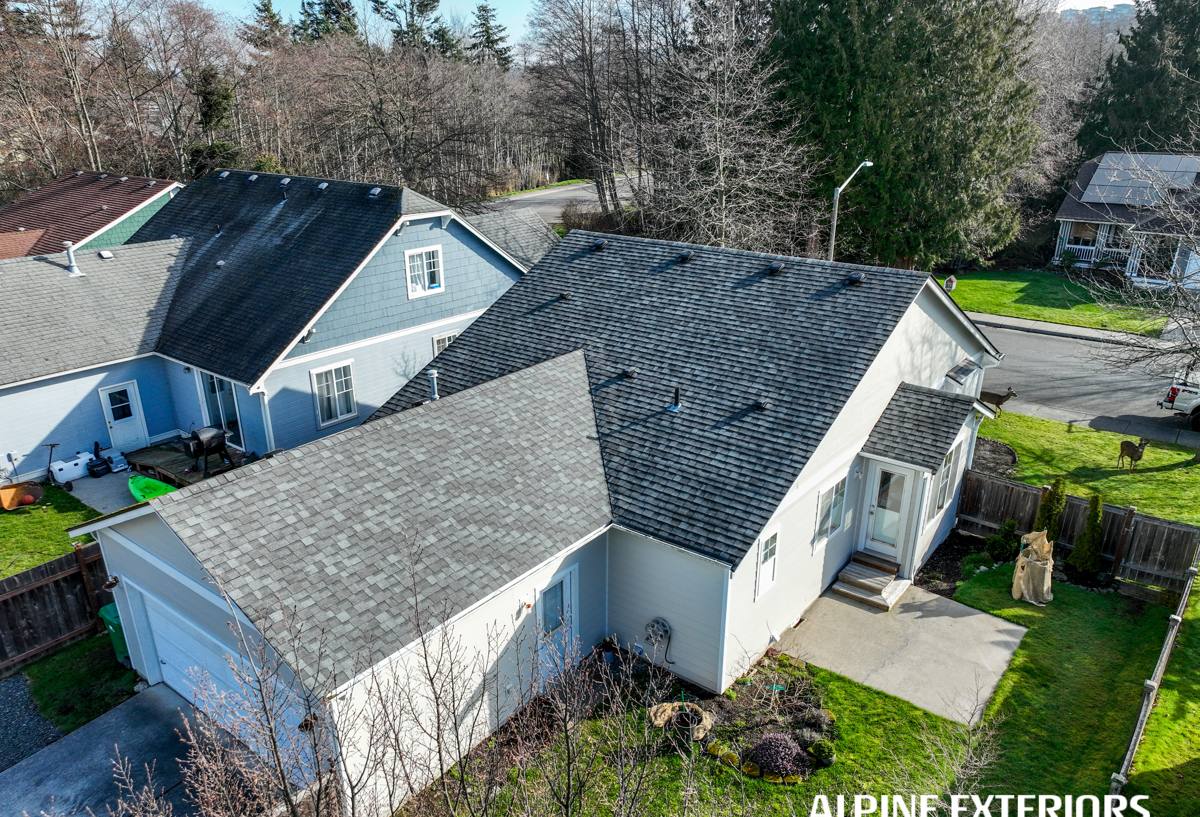
What That Climate Does to Siding, Trim, and Paint
Salt air is corrosive to exposed metal fasteners and hardware, and it accelerates the breakdown of paint films and caulking faster than you'd see in a drier, inland climate. Wind-driven rain finds any weak point in a siding system — a poorly lapped joint, a gap at a window return, a fastener that wasn't set right — and pushes water behind the cladding instead of letting it run off the surface.
Then there's moss and mildew. Whatcom County's wet season runs long, and any siding material that holds moisture, has a porous surface, or lacks a factory-cured finish is going to show it: green-black staining in shaded and north-facing areas, soft or swollen spots where water has been sitting, and paint that starts peeling well before it should. We see this pattern on Blaine homes more consistently than almost anywhere else we work in the county, simply because of how close so many properties sit to the water and how much wind exposure they get.
Why We Install Only James Hardie Fiber Cement Siding
Given that climate, we made a decision a while back to stop installing several common siding products — not because they're bad products in general, but because they aren't the right match for what a Blaine exterior actually has to survive.
Vinyl
Vinyl is inexpensive and easy to install, but it's a thin material that expands and contracts with temperature swings, and in sustained wind it can rattle, warp, or pull loose at the fastening points over time. It also isn't something you can realistically repaint to refresh a faded or salt-dulled finish — when the color goes, your options are limited.
LP SmartSide, Cemplank, Allura, Primed Spruce, and Cedar
Engineered wood products like LP SmartSide perform reasonably well in moderate climates, but wood-based substrates are more vulnerable to swelling, delamination, and rot when they're exposed to sustained moisture and salt air the way Blaine siding is. Cemplank and Allura are fiber cement competitors to Hardie, but we've standardized on one manufacturer so we can guarantee installation detail, product consistency, and warranty coverage across every job. Primed spruce and cedar are traditional, attractive materials, but they require an ongoing maintenance commitment — re-staining or repainting on a cycle, checking for rot at end grain and joints — that most homeowners in a marine environment find hard to keep up with.
Why James Hardie
James Hardie fiber cement is non-combustible, dimensionally stable, and doesn't swell or rot the way wood-based siding can. The ColorPlus factory finish is baked on under controlled conditions, which holds up far better against salt air and UV than field-applied paint, and it comes with a real, transferable warranty backing it. Hardie also makes climate-engineered HZ product lines specifically formulated for different exposure conditions, which matters in a place like Blaine where wind and moisture are a bigger factor than in a typical inland neighborhood.
| Factor | Vinyl | Wood / Engineered Wood | James Hardie Fiber Cement |
|---|---|---|---|
| Salt air resistance | Fair — can chalk and fade | Poor to fair — moisture-sensitive | Strong — factory finish, cement core |
| Wind-driven rain performance | Depends heavily on install | Vulnerable at joints and end grain | Strong when flashed and lapped correctly |
| Repaintable | Not really | Yes, but needed often | Yes, rarely needed |
| Fire resistance | Low | Low | Non-combustible |
| Typical maintenance cycle | Low effort, limited lifespan | Frequent — staining/painting | Low — occasional wash and caulk check |
What Correct Installation Looks Like on a Blaine Home
Fiber cement siding is only as good as the installation behind it. In a wind and salt-air environment, the details matter more than they would somewhere drier.
Flashing and Drainage
Every window, door, and horizontal trim transition needs proper flashing and a drainage plane behind the siding so any water that does get past the surface has somewhere to go besides the wall sheathing. We pay particular attention to this on Blaine jobs given how much wind-driven moisture the siding is exposed to.
Fastening and Clearances
Hardie has specific fastener spacing, penetration depth, and clearance requirements — including clearance from grade, roofing, and decks — that are there for a reason. Skipping them is one of the most common ways an otherwise good product fails early.
Caulking and Field Painting
ColorPlus finishes need touch-up caulk and paint at cut edges and joints, using products compatible with the factory finish. Done right, this is a small maintenance item. Done wrong, or skipped, it becomes the entry point for the exact moisture problems we're trying to avoid.
Roofing for Blaine's Wind and Rain
Roofing near the water deals with the same wind and moisture load as the siding below it. Ventilation, underlayment quality, and flashing at valleys, penetrations, and roof-to-wall transitions all carry more weight in a climate where wind pushes rain uphill under shingle edges and where moss growth on a shaded slope can trap moisture against the roof deck if it isn't managed. A roof and siding system installed together, by the same crew, means fewer gaps at the transitions where the two meet — one of the more common failure points on coastal homes.
Windows: Sealing Out Salt Air and Driving Rain
Window replacement in Blaine isn't just about energy efficiency, though that matters too. It's about making sure the flashing and sealant details around each window can handle sustained wind-driven rain without letting water track into the wall cavity. Older windows with degraded seals or outdated flashing are a common source of hidden moisture damage in coastal Whatcom County homes, often showing up as soft trim or staining well before anyone notices a leak indoors.
Decks in a Marine Environment
Decks in Blaine face their own version of the same problem: salt air accelerates corrosion on exposed hardware and fasteners, and constant damp conditions shorten the life of untreated or poorly maintained wood. Composite decking with corrosion-resistant, marine-rated fasteners tends to hold up better here than standard-grade materials, and proper ledger flashing where a deck attaches to the house is just as important as the flashing details on siding and roofing.
Why a Local Crew Matters
A crew that works Whatcom County regularly knows the difference between a job a few miles inland and one right on the water in Blaine. That means anticipating wind exposure, building in extra attention to flashing and sealant details, and recommending the HZ Hardie product line suited to the specific exposure rather than treating every job the same. It also means being available for warranty support, touch-up work, or questions after the install — not a crew that did one job in the area and moved on.
A Homeowner's Exterior Checklist for Blaine
- Check siding for staining, soft spots, or peeling paint, especially on north-facing and shaded walls
- Look at caulking around windows, doors, and trim joints for cracking or gaps
- Inspect exposed fasteners and hardware for rust or corrosion
- Check for moss buildup on roofing, siding, and decking surfaces
- Look for soft or discolored trim near rooflines, deck ledgers, and window sills
- Confirm gutters and downspouts are directing water away from siding and foundation
- Ask any contractor bidding your job what specific flashing and fastening details they follow for wind-driven rain exposure
If you're weighing a siding, roofing, window, or deck project on a Blaine property, we're happy to take a look and walk through what we're actually seeing on the house — no pressure, no hard sell. A free estimate is a good way to get a straight answer on condition and options before you decide anything.