 Bellingham Siding
 Why Fairhaven Homes Face a Different Set of Problems
Fairhaven sits close enough to the water that salt air is a real factor in how a home's exterior ages, not just a talking point. Add in Bellingham's long, wet fall-through-spring stretch and the moss and moisture pressure that comes with it, and you've got a combination that's harder on siding, trim, and roofing than most inland Whatcom County neighborhoods see. Homes here need materials and installation details that were actually built for this kind of exposure, not just materials that happen to be available at the local lumber yard.
We work on homes throughout Fairhaven and the rest of Bellingham, and we see the same failure patterns over and over: paint that's failed years early on the weather-facing side of a house, trim that's soft at the bottom edge, moss lines creeping up north-facing walls, and caulk joints that opened up faster than they should have. None of that is bad luck — it's what happens when a product or an installation wasn't matched to this climate.
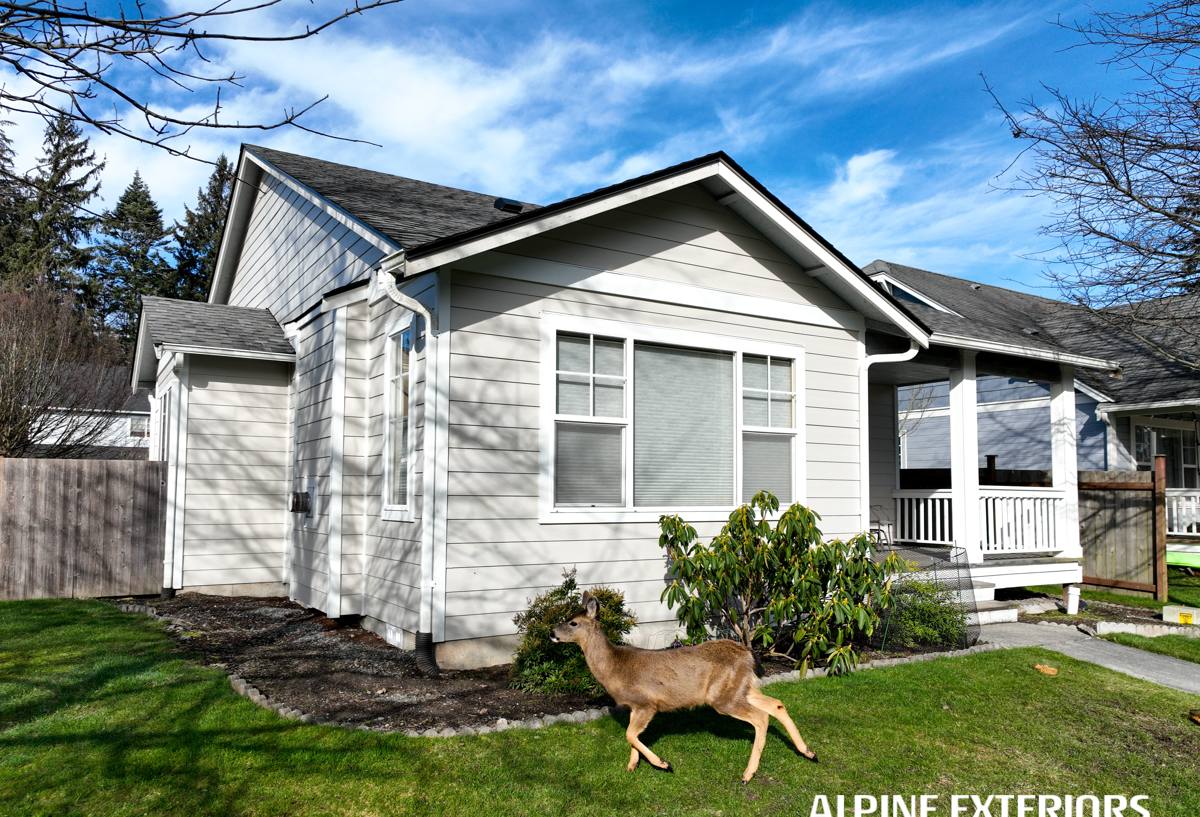
What Salt Air, Driving Rain, and Moss Actually Do to a House
Salt Air
Proximity to Bellingham Bay means airborne salt settles on exterior surfaces more than homeowners further inland realize. It accelerates corrosion on exposed fasteners and metal trim, and it can work against certain paint and coating systems over time, leading to earlier chalking and fading on the weather side of a home.
Driving Rain
Storms coming off the water don't just fall straight down — wind-driven rain gets pushed sideways into wall assemblies, siding laps, and window and door openings. If flashing details, house wrap, and siding overlaps aren't done correctly, water finds its way behind the cladding, and that's where rot and hidden damage start. This is a bigger deal in Fairhaven's more exposed spots than it is in a sheltered inland yard.
Moss and Sustained Moisture
Whatcom County's moss season isn't a few weeks — it's a big chunk of the year. Moss and algae need shade and sustained dampness to take hold, and north- and east-facing walls, areas under trees, and anywhere airflow is blocked are the first to show it. Moss holds moisture against a surface far longer than open air would, which is exactly the wrong thing to have happening against wood-based siding or trim.
Why We Only Install James Hardie Fiber Cement Siding
We made a decision as a company to install James Hardie fiber cement siding exclusively — not vinyl, not LP SmartSide, not Cemplank, not Allura, not primed spruce or cedar. That's not a marketing angle; it's a standard we hold ourselves to because of what we've seen play out on real houses in this exact climate.
Fiber cement is fundamentally a cement-and-sand composite reinforced with cellulose fibers. It doesn't absorb and swell with moisture the way wood-based products do, and it isn't vulnerable to the softening and expansion issues that engineered wood siding can face when it stays wet for extended periods — which is a real concern in a region with Bellingham's rain totals and moss season. It's also non-combustible, which matters to insurers and to homeowners thinking about long-term risk, not just curb appeal.
James Hardie's ColorPlus factory-finish coating is baked on and cured under controlled conditions, rather than field-applied paint drying in whatever weather shows up that week. That matters directly for salt air and UV exposure — a factory finish holds its color and resists fading and chipping longer than most site-applied paint jobs, and it comes with its own finish warranty separate from the substrate warranty.
What We're Not Installing, and Why
- Vinyl siding: lightweight and inexpensive, but it can warp or distort in temperature swings, and it doesn't offer the same fire resistance or high-end appearance profile as fiber cement.
- LP SmartSide and other engineered wood products: treated to resist moisture, but they're still wood-based at the core — if a seal is compromised or maintenance lapses, moisture intrusion can lead to swelling and rot over time. In a region with our rain and moss pressure, that margin for error is thinner than we're comfortable with.
- Cemplank and Allura: other fiber cement brands with reasonable products, but we've standardized on Hardie for consistency of finish quality, product line depth for our climate, and the strength and clarity of its transferable warranty.
- Primed spruce or cedar: real wood, real character, but it needs an ongoing maintenance commitment — repainting, caulking, moisture monitoring — that most homeowners underestimate until they're a few years in.
None of these are "bad" products across the board. They just come with trade-offs we're not willing to install and then walk away from, especially on homes exposed to salt air and sustained wet weather the way Fairhaven properties often are.
Matching the Right Hardie Product Line to the House
James Hardie makes climate-engineered product lines, and part of doing this job right is picking the correct one for the exposure a given home actually faces — not just defaulting to whatever's cheapest or most common.
| Product Line | Best Suited For | Why It Fits |
|---|---|---|
| HardiePlank HZ10 | Coastal, wetter, marine-influenced climates | Engineered for high-moisture, humid, salt-air exposure — the right baseline for water-adjacent Bellingham neighborhoods |
| HardiePanel | Modern/vertical siding designs, accent walls | Clean vertical lines, often paired with board-and-batten detailing |
| HardieTrim | Fascia, corners, window and door trim | Matches the durability of the field siding instead of mixing in a weaker wood trim product |
| HardieShingle | Accent gables, Craftsman-style detailing | Fiber cement durability with a traditional shingle look |
For most Fairhaven homes, given the salt air and rain exposure, we lean toward the HZ10 formulation as the default starting point, then adjust based on the specific site — sun exposure, tree cover, wind exposure, and how sheltered or open the lot actually is.
Roofing, Windows, and Decks — The Same Climate Logic Applies
Siding is our focus, but we also handle roofing, windows, and decks, and the same regional pressures show up there too.
Roofing
Moss on a roof isn't cosmetic — sustained moss growth holds moisture against shingles and can shorten their service life. Roof flashing details around chimneys, valleys, and penetrations are exactly where wind-driven rain finds its way in if they weren't done carefully the first time.
Windows
Window flashing and integration with the siding plane is one of the most common places we find hidden water damage on older homes. A window replacement or new install done without proper flashing integration to the wall assembly can undo the benefit of even the best siding.
Decks
Decks take the moss-and-moisture problem head-on since they're horizontal, shaded in spots, and directly exposed to standing water and debris buildup. Material choice, ledger flashing, and proper drainage all matter more here than most homeowners expect.
Why a Local Crew Matters for This Kind of Work
A lot of exterior problems in this region trace back to installation details that work fine in a drier climate but fail here — insufficient flashing overlap, house wrap installed without accounting for wind-driven rain, or fastener spacing that doesn't account for our humidity swings. A crew that works Whatcom County homes regularly has already seen where those details go wrong, because they've had to go back and fix them.
That local pattern-recognition is worth more than a generic install crew moving through on a broader multi-region schedule. We know what north-facing walls in shaded Fairhaven lots tend to do, we know how far wind-driven rain can push water sideways in an exposed spot, and we plan the installation around that instead of finding out after the fact.
What a Siding Project Actually Looks Like, Start to Finish
- On-site assessment of the existing siding, sheathing condition, and any moisture or rot already present
- Identification of problem areas — moss-prone walls, poorly flashed windows, exposed corners
- Removal of old siding and inspection/repair of sheathing and house wrap underneath
- Correct flashing and water-management detailing at windows, doors, and penetrations before any siding goes up
- Installation of the matched James Hardie product line, with manufacturer-specified fastening and clearances
- Trim, caulking, and finish work completed to Hardie's installation specifications to keep the warranty intact
- Final walkthrough so you understand what was done and why
What This Costs, in General Terms
Every home is different, and we won't throw out a number without seeing the house, but the broad cost factors are consistent from project to project.
| Factor | Why It Matters |
|---|---|
| Home size and wall complexity | More corners, dormers, and cutouts mean more labor and trim work |
| Condition of the sheathing underneath | Hidden rot or water damage found during tear-off adds repair scope |
| Product line selected | HZ10 and specialty profiles differ in material cost from standard lines |
| Trim and detail level | Extensive trim, shingle accents, or custom detailing adds time and material |
| Site access and exposure | Difficult access or height can affect labor and equipment needs |
Get a Straight Answer About Your Home
If you're dealing with moss buildup, failing paint, soft trim, or you're just planning ahead for a Fairhaven home that's been through a few too many wet winters, it's worth having someone look at it who actually understands what this climate does to an exterior. We're happy to walk the property, point out what we see, and explain the options honestly — no pressure, no hard sell. Reach out for a free estimate using the form below.