 Bellingham Siding
 What LP SmartSide Actually Is
LP SmartSide is an engineered wood siding product made from wood strands, resins, and waxes pressed together under heat, then coated with a proprietary treatment called SmartGuard and finished with a resin-saturated overlay. It's manufactured to look like traditional wood lap siding or panel siding, and it's sold as a more moisture-resistant, insect-resistant alternative to old-school OSB or hardboard products that gave engineered wood a bad reputation in the 1990s. LP has made real improvements to that formula over the years, and we want to be upfront about that before we explain our position.
We're a Bellingham-based siding contractor working across Whatcom County, and we install James Hardie fiber cement exclusively. We don't install LP SmartSide, vinyl, Cemplank, Allura, primed spruce, or cedar. This page explains the trade-offs that led us to that standard, specifically as they apply to homes here — not as a takedown of LP as a company or a claim that every SmartSide installation fails.
What LP SmartSide Gets Right
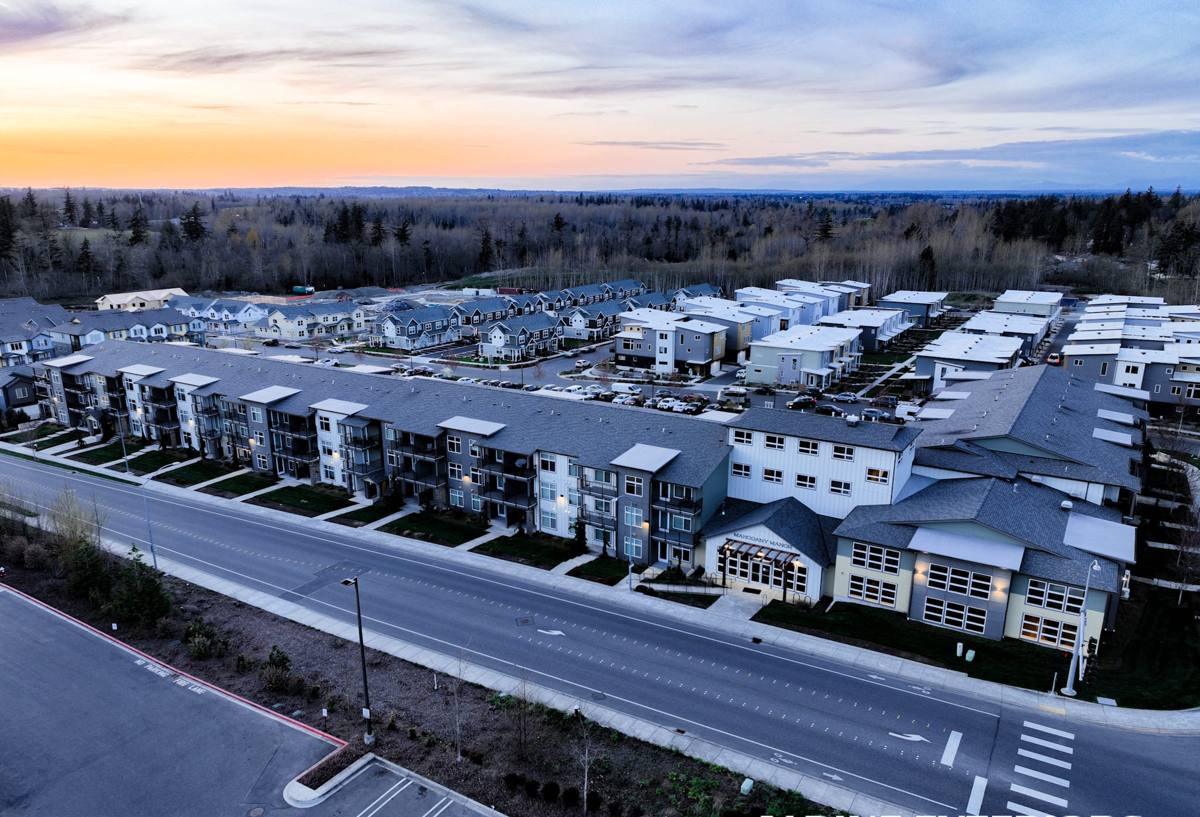
To be fair to the product: SmartSide is lighter and easier to cut and nail than fiber cement, which can translate to lower labor costs on a straightforward installation. It holds paint reasonably well when properly primed and sealed, it takes an impact better than vinyl (no cracking in cold weather from a stray baseball or hail), and it comes in profiles that mimic cedar lap and board-and-batten convincingly at a lower material cost than real wood. For a builder working on a tight budget in a dry climate, it can be a reasonable choice.
The problem is that "dry climate" qualifier. Whatcom County is not that climate.
Why Bellingham's Climate Is a Different Conversation
Bellingham sits on the Salish Sea, which means homes here deal with salt-laden air moving off the water, long stretches of driving rain pushed in by Pacific storm systems, and a moss season that can run eight months out of the year on shaded north- and west-facing walls. None of that is exotic — every siding product sold in the Pacific Northwest is marketed as able to handle it. But wood-based products, even engineered ones with a factory coating, respond differently to sustained moisture exposure than fiber cement does, and that difference matters more here than it would in a drier region.
Salt air accelerates the breakdown of exterior coatings and finds its way into any gap, seam, or fastener penetration faster than plain fresh-water rain does. Driving rain, meaning rain that hits a wall horizontally rather than falling straight down, pushes water into laps, joints, and butt seams that a vertical-rain climate would never test. And moss doesn't just sit on the surface — it holds moisture against the substrate for weeks at a time on shaded walls, which is exactly the condition any wood-based product is least equipped to handle indefinitely.
Whatcom County's Wall-by-Wall Exposure
We see this most clearly on homes with mixed exposure — the south and west walls that catch direct sun and dry out quickly hold up differently than the north walls tucked under eaves or tree cover that stay damp for days after a storm. On a wood-based product, that uneven exposure can mean uneven long-term performance on the same house, which is a hard thing to warranty or predict at the time of installation.
The Core Issue: Wood Substrate and Long-Term Moisture
Fiber cement is made from cellulose fiber, sand, and Portland cement. It doesn't rot, it doesn't feed insects, and it doesn't swell and delaminate the way a wood-strand product can if moisture gets past the factory coating. LP SmartSide's SmartGuard treatment is a real engineering improvement over older engineered wood, and it significantly reduces (not eliminates) the product's vulnerability to moisture and insects. But the underlying material is still wood, and wood-based sidings share one structural reality: their long-term performance depends heavily on the coating and sealant layer staying intact, and on installation details that keep water from reaching the substrate at all.
That's not a knock on the manufacturer — it's just the physics of the material. Fiber cement doesn't have that same dependency, because there's no organic material underneath to protect in the first place. In a climate with Bellingham's rain totals and moss pressure, that difference compounds over a 20- or 30-year ownership horizon.
Installation Sensitivity: Where Things Go Wrong
Every siding product has installation requirements. The issue with wood-based siding is that the margin for error is smaller, and the consequences of a missed detail show up as substrate damage rather than just a cosmetic flaw. The table below summarizes where we see the biggest gap between "installed to spec" and "installed the way it usually gets installed on a production schedule."
| Detail | Why It Matters for Wood-Based Siding | Fiber Cement's Position |
|---|---|---|
| Ground clearance | Requires strict clearance from soil, decks, and roof lines to avoid wicking moisture | Also required, but consequences of a shortfall are far less severe |
| Caulking and sealing cut edges | Every field cut exposes raw substrate that must be sealed immediately or it becomes an entry point | Cut edges don't require sealing to prevent rot |
| Panel and lap gaps | Manufacturer-specified gaps must be maintained for expansion or seams can trap water | Gaps matter for movement, not moisture intrusion into the material |
| Flashing at penetrations | Critical — a missed flashing detail behind a light fixture or hose bib can go unnoticed for years | Still important, but a lapse doesn't lead to substrate failure |
| Recoating and maintenance cycle | Finish coat needs periodic inspection and touch-up to keep the moisture barrier intact | Factory ColorPlus finish is warrantied for decades with minimal recoat expectation |
The Maintenance Burden Homeowners Don't Always Hear About Upfront
SmartSide is often sold on lower material cost, but that comparison rarely accounts for the maintenance time and expense a homeowner takes on over the life of the siding. Here's what we tell people to actually budget for, in a climate like ours:
- Annual inspection of caulk joints, especially around windows, doors, and trim boards, since PNW freeze-thaw and moisture cycling breaks down sealant faster than it does in drier regions
- Repainting or recoating on a cycle far shorter than a factory-finished product, particularly on sun-exposed south and west elevations
- Moss and algae treatment on shaded north-facing walls, which in Whatcom County can mean multiple applications a year rather than one
- Prompt repair of any impact damage or gap, since a delay of even one wet season can allow moisture to reach the substrate
- Watching gutter and downspout performance closely, since overflow or splashback onto the siding face is one of the most common causes of localized substrate damage we're asked to look at
None of this means SmartSide is a bad product installed elsewhere in the country. It means that in a marine climate with heavy annual rainfall and a real moss season, the ongoing maintenance commitment is meaningfully higher than most homeowners expect when they're comparing sticker prices at the estimate stage.
Warranty Structure: What's Actually Being Promised
LP's warranty on SmartSide is a real, honored warranty, and it has improved over the product's history. But like most siding warranties, it typically prorates over time, carries specific exclusions around installation and maintenance compliance, and places the burden on the homeowner to document that caulking, painting, and clearance requirements were followed. If a moisture issue shows up in year twelve and the finish hadn't been touched up on schedule, that maintenance gap can become the basis for a denied or reduced claim.
James Hardie's warranty structure, by contrast, is built around a non-combustible material with no organic substrate to protect and a factory-applied ColorPlus finish that doesn't depend on the homeowner keeping up a recoat schedule to remain intact. That's a meaningfully different risk profile to hand a homeowner, and it's a large part of why we made Hardie our standard rather than offering both products and letting price alone decide.
Why We Standardized on James Hardie Instead
We install James Hardie fiber cement exclusively because it removes the moisture-dependency problem at the material level rather than managing around it. Hardie's HZ5 product line is engineered specifically for climates like ours — freeze-thaw cycling, sustained damp weather, and coastal exposure — and the ColorPlus factory finish holds its color and integrity without the recoat cycle a wood-based product requires. It's non-combustible, which matters increasingly for insurance conversations in Washington, and it carries a strong transferable warranty that isn't riding on a homeowner's caulking schedule.
We're not installing Hardie because it's the cheapest option on a bid sheet — it isn't always. We're installing it because after years of doing exterior work in Whatcom County's specific mix of salt air, driving rain, and moss pressure, it's the product we're comfortable standing behind for the long haul, and the one we'd choose for our own homes.
What Correct Installation Looks Like, Regardless of Product
If you're evaluating bids that include SmartSide, vinyl, or any other siding product, the installation details matter more than the brand name on the piece being nailed up. Ask any contractor, regardless of product, to walk you through these points before you sign anything:
- Documented ground clearance and clearance from decks, patios, and roof-to-wall intersections
- A written flashing plan for every penetration — light fixtures, hose bibs, vents, and utility penetrations
- Manufacturer-specified fastening pattern and gap tolerances, not "however the crew normally does it"
- A moisture barrier / weather-resistive barrier detail that's inspected before siding goes on, not assumed
- A clear answer on who's responsible for sealing field cuts and what product they'll use
A well-installed lower-tier product will usually outperform a poorly installed premium one. That's true of every material on this list, including the one we install.
Get an Honest Estimate
If you're weighing siding options for a home in Bellingham or anywhere else in Whatcom County, we're happy to walk your property, talk through what your specific exposure looks like — sun, shade, wind direction, moss history — and give you a straight answer on what we'd recommend and why. There's no pressure and no charge for the estimate.