 Bellingham Siding
 Siding Repair in Blaine: A Different Job Than a Repair Inland
Blaine sits at the northern tip of Whatcom County, close enough to Semiahmoo Bay and Drayton Harbor that salt air is a daily condition for most homes in town, not just the ones with a water view. We're based in Bellingham, about twenty minutes south down the water, and Blaine is regular territory for our crew rather than an occasional stretch. That matters for a repair call specifically, because repair work lives or dies on correctly diagnosing why a section of siding failed in the first place, and the failure patterns we see on Blaine homes aren't identical to what shows up on a similar house set further inland.
This page is about one thing: repairing James Hardie fiber cement siding on a Blaine home. Not a full re-side, not roofing or windows, just what it actually takes to fix a section of siding correctly in a town that gets this much direct salt exposure, wind-driven rain, and a moss season that barely lets up. A repair done right here should hold for years. A repair done as a quick patch usually shows up as a callback within a season or two.
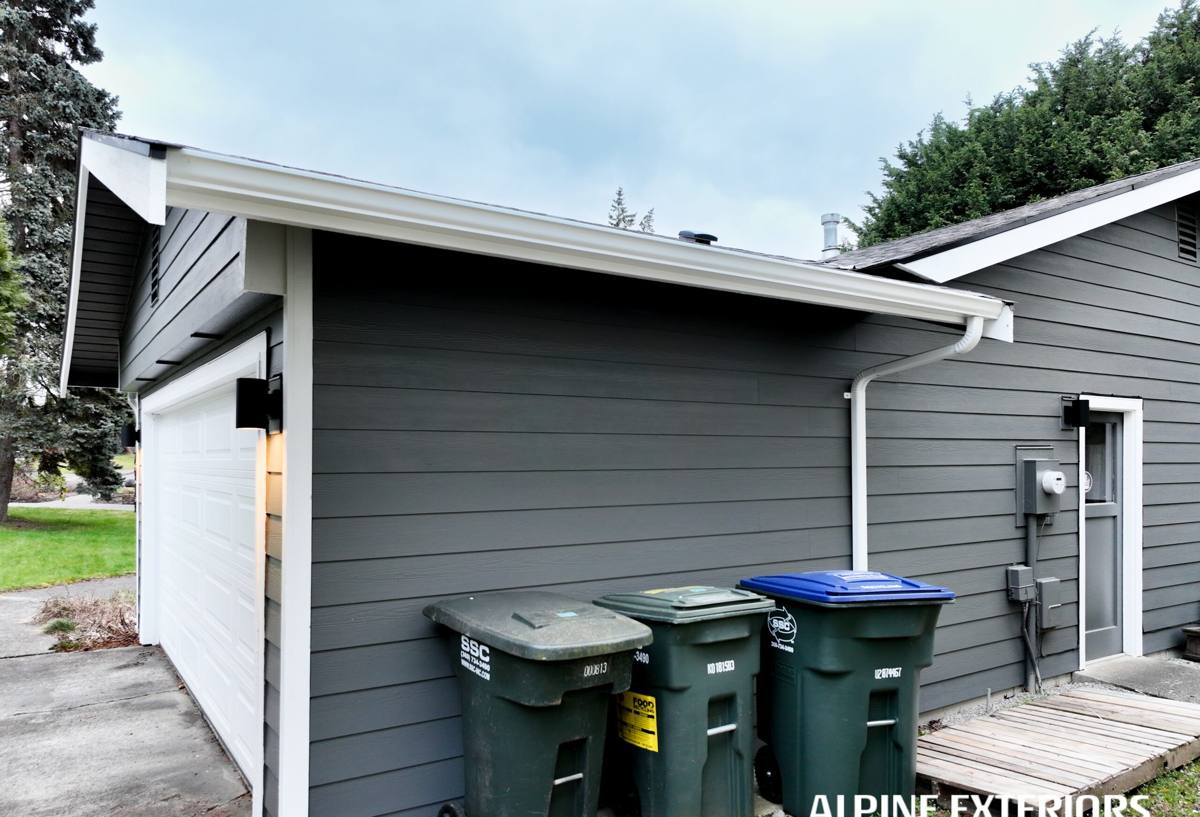
What Blaine's Climate Does to a Repair Job
Salt Air and Corrosion
Homes anywhere near the bay or harbor in Blaine take a steadier dose of salt-laden air than towns set further inland, and that air works on fasteners, flashing, and trim hardware year-round, not just during storms. A repair that goes back in with standard fasteners instead of corrosion-resistant ones is often the reason a "fixed" section starts loosening or streaking with rust again within a couple of years. It's one of the more common shortcuts we find undoing a previous repair.
Wind-Driven, Sideways Rain
Storms coming off the water in Blaine don't fall straight down; wind pushes rain sideways into lap joints, trim seams, and anywhere flashing wasn't properly integrated the first time. This is the single biggest reason a siding problem that looks small on the surface, a few inches of soft board around a window, often turns out to involve water that's been tracking behind the wall for longer than the visible damage suggests. A repair that only addresses what's visible and skips the flashing behind it tends to fail again in the same spot.
A Moss Season That Barely Lets Up
Mild temperatures and near-constant moisture give moss and mildew a growing season that can run most of the year on shaded or north-facing walls in Blaine. Moss itself doesn't destroy fiber cement the way it can rot wood trim, but it holds moisture against the surface for longer stretches, and any spot where that moisture is also finding its way behind the siding through a failed joint or fastener will deteriorate faster than a dry wall ever would.
Repair or Replace? How We Actually Make That Call
Not every siding problem in Blaine means a full tear-off, and we're not going to tell you it does just to sell a bigger job. The honest answer depends on how contained the damage is and what's actually happening behind the boards, which is something we check before giving you a recommendation either way.
When a Repair Makes Sense
Isolated impact damage from storm debris or a falling branch, a section that's failed around a single window due to a specific flashing gap, or trim that's worked loose can usually be repaired and matched into the surrounding Hardie siding without touching the rest of the house. If the sheathing underneath is still sound once we open up the affected area, a targeted repair is the right call, and it's the option we'll recommend.
When a Repair Just Delays a Bigger Job
If moisture has been tracking behind the wall assembly for a long stretch, if the siding involved is an older, non-Hardie material that's simply reached the end of its service life, or if what looks like one bad section turns out to be symptomatic of house wrap or flashing that's failing more broadly, patching that one spot usually just buys a year or two before the next repair call. We'll tell you plainly which situation you're in rather than quoting a patch job we don't think will hold.
Common Siding Repair Situations We See in Blaine
| Situation | Likely Cause | Typical Repair Approach |
|---|---|---|
| Cracked or dented board, isolated spot | Storm debris, falling branches, accidental impact | Cut back to the nearest support, replace with matched board and color, reseal joints |
| Soft or spongy siding low on a wall | Moisture wicking from grade, splash-back, or failed caulk at the bottom course | Remove affected boards, inspect and repair sheathing if needed, correct grade clearance, reinstall |
| Rust streaking or a loose board | Corroded fasteners after sustained salt air exposure | Replace with corrosion-resistant fasteners at correct spacing, refasten to spec |
| Trim pulling away at a window or door | Flashing that was never properly lapped, or has failed over time | Remove trim, correct the flashing and house wrap integration, reinstall and seal |
| Moss or dark staining that returns fast after cleaning | Shaded wall sections holding moisture longer than they should | Clean or replace affected boards, address the underlying moisture retention, not just the surface |
What a Correct Hardie Repair Actually Involves
Fixing a section of James Hardie siding takes more than caulking a gap and painting over it. Done correctly, a repair follows the same installation spec the original siding should have been installed to, applied to a much smaller area.
Color and Board Matching
Hardie's ColorPlus finish is baked on at the factory, and a board that's spent years in Blaine's sun and salt air will have weathered slightly from a brand-new board off the same color line. We factor that in when sourcing replacement material and placing it on the wall, so a repaired section reads as a repair job well done rather than an obvious patch. On older or discontinued colors, that sometimes means a broader conversation about the closest realistic match rather than a guaranteed exact one.
Reintegrating Flashing and House Wrap
Pulling a damaged board without disturbing the house wrap and flashing behind it is tempting because it's faster, but it's also how a repair ends up covering the same problem back up instead of fixing it. We treat the area behind a repair the same way we'd treat it on a full install: house wrap lapped correctly, flashing directed to shed water outward and down, and any gaps sealed before the new board goes back on.
Fastener Type and Spacing
Hardie specifies fastener type and placement for a reason, and it's not optional on a repair just because the area is small. Corrosion-resistant fasteners set at the correct spacing are part of what keeps a repaired section from becoming the next callback, especially this close to the water.
Our Repair Process
- Inspection: we look at the damaged area and enough of the surrounding wall to understand whether the problem is truly isolated or points to something bigger.
- Diagnosis: we open up the affected section if needed to check the sheathing, house wrap, and flashing behind it before recommending a scope of work.
- Honest scope: we tell you plainly whether a targeted repair will hold or whether a larger section needs attention, and why.
- The repair itself: matched Hardie board, correct fasteners, properly integrated flashing and house wrap, sealed joints.
- Walkthrough: we show you what was found and fixed, and flag anything else on the wall worth watching going forward.
Signs a Blaine Home Needs Siding Repair Now
- Soft or spongy siding, especially low on the wall or around window and door trim
- Rust staining or a fastener that's backing out or corroded
- A cracked, dented, or missing board section after a storm or wind event
- Trim or J-channel that's visibly pulling away from the wall
- Moss or dark staining that comes back quickly after cleaning
- Visible gaps at seams, corners, or trim joints where water can track in
- A room that's suddenly drafty or a wall that feels damp to the touch on the inside
Any one of these on its own might be minor. Two or three showing up in the same area of the house is usually a sign that water has been getting in longer than it's been visible.
Repair Cost Factors in Blaine
| Factor | What It Affects | Coastal Consideration |
|---|---|---|
| Size of the affected area | Material and labor for the repair itself | Hidden moisture damage found once boards come off can extend the scope |
| Color and board matching | Sourcing the closest match to weathered existing siding | Salt air and sun exposure weather ColorPlus finishes over time, affecting how closely a new board matches |
| Condition of sheathing behind the siding | Whether structural repair is needed before new boards go on | Wind-driven rain that's tracked behind a wall for a while is common on exposed, water-facing walls |
| Access and height | Staging, scaffolding, or ladder work required | Second-story and gable-end repairs are common where wind exposure is highest |
These are general drivers, not a quote. We walk the property and, where needed, open up the affected section before putting a real number on the work, since a repair that looks small from the ground sometimes isn't once the boards come off.
Why a Bellingham Crew That Already Works Blaine Matters for Repair
A repair call is a diagnostic job as much as an installation job, and that's exactly where local experience shows up the most. A crew that regularly works Blaine's water-facing lots knows which walls tend to stay wet the longest, which fastener grades hold up and which ones don't, and how a moss-covered, shaded section behaves differently than a sun-exposed one on the same house. That's not something you can pick up from a spec sheet. It comes from opening up enough Blaine walls to see the actual pattern, and it's what keeps a repair from becoming a repeat visit two winters later.
Being based in Bellingham and working this stretch of Whatcom County regularly also means we're not treating Blaine as a special trip. It's part of our normal territory, which is part of why we can give a straight, unrushed answer about what a repair actually needs rather than a quick patch to get off the roof.
If a section of siding on your Blaine home needs attention, we're happy to take a look and give you an honest read on whether it's a straightforward repair or something bigger. Reach out using the form below to schedule a free, no-pressure estimate.