 Bellingham Siding
 Exterior Work Built for York's Older Bellingham Housing Stock
York is one of Bellingham's established close-in neighborhoods, with a housing mix that runs from early-20th-century homes to mid-century additions and everything renovated in between. That mix matters when it comes to exterior work. A house built decades ago wasn't sided, roofed, or trimmed with today's materials or today's building science, and the cladding on it now is often a patchwork of the original material plus at least one prior remodel. Before we talk about siding, roofing, windows, or decks, we look at what's actually on the house — not what's supposed to be there.
Working a neighborhood like York regularly means we've seen how older wall assemblies in this part of Whatcom County actually perform after fifty or more Bellingham winters. That's different from reading a spec sheet. It shapes how we approach tear-off, flashing details, and what we recommend replacing versus repairing.
What Bellingham's Climate Does to a House Over Time
Bellingham sits close enough to Bellingham Bay and the Salish Sea that salt-laden air is a real factor on exterior materials, not just a coastal talking point. Add Whatcom County's driving rain — wind-blown rather than straight-down — and a moss and algae season that can run most of the year on shaded north- and west-facing walls and roof planes, and you get a combination that's tough on anything that isn't built to handle sustained moisture exposure.
A few specific ways this shows up on York-area homes:
- Paint and caulk failure on wood trim and siding, usually starting at butt joints, window returns, and anywhere water can sit
- Moss and algae growth on north-facing siding and roof sections that don't get much direct sun
- Soft or delaminating wood siding and trim where moisture has been getting behind the surface for years, often hidden until a repaint or inspection reveals it
- Roof moss buildup that holds moisture against shingles and shortens roof life if it isn't managed
- Wind-driven rain finding its way past aging window flashing and worn caulk lines, especially on walls that face the prevailing weather
None of this is unique to York specifically — it's the reality for most of Bellingham and unincorporated Whatcom County near the water. But it's exactly why we treat every exterior project here as a moisture-management project first, and a cosmetic project second.
Why This Changes How We Build the Wall
The visible siding or roofing is the last layer, not the only layer. Underneath it, the house needs a water-resistive barrier, correctly lapped and sealed flashing at every penetration and transition, and a way for any moisture that does get in to dry out rather than get trapped. On an older York home, that drainage plane may be missing, degraded, or installed in a way that made sense decades ago but doesn't meet current best practice. We address that at the wall assembly level before we ever talk about which siding product goes on top.
Siding: Why We Install James Hardie Only
We install James Hardie fiber cement siding exclusively. We don't install vinyl, LP SmartSide, Cemplank, Allura, or wood products like cedar or primed spruce, and that's a deliberate standard, not a limitation on what we're capable of installing.
In a climate like Bellingham's, the reasons come down to how each material actually behaves over years of wet exposure:
- Wood siding (cedar, primed spruce) looks great new but needs consistent recoating and caulk maintenance to keep moisture out. Miss a maintenance cycle in a wet climate like ours and rot can set in at joints and end cuts before it's visible from the ground.
- Vinyl siding is affordable and low-maintenance, but it's a cladding, not a moisture-managed system in the same sense — it relies almost entirely on what's behind it, it can warp in temperature swings, and its factory color isn't as durable long-term as a baked-on finish.
- LP SmartSide is an engineered wood product with a resin-treated strand substrate. It performs reasonably well when installed and maintained exactly to spec, but it's still wood-based, meaning cut edges, seams, and any coating failure are places moisture can get in and cause swelling over time — a real concern in a market with our rainfall totals.
- Cemplank and Allura are also fiber cement, and fiber cement as a category is the right call for our climate. Where we draw the line is on the specific system: James Hardie's ColorPlus factory finish, their HZ5 product engineering for cold and moisture-heavy climates, and the depth of their installer network and warranty backing are what we've standardized on for consistency across every job we do.
James Hardie fiber cement is non-combustible, dimensionally stable in wet-dry cycling, and doesn't feed moss and mildew growth the way wood substrates can. The ColorPlus finish is factory-baked, which holds color and resists the fading and chalking that field-applied paint eventually shows — especially relevant on a wall that's getting driving rain and salt-tinged air for a good chunk of the year.
James Hardie Product Lines We Use
| Product | Best Use | Notable Feature |
|---|---|---|
| HardiePlank Lap Siding | Most common wall application, all home styles | Traditional lap look, multiple textures and exposures |
| HardiePanel Vertical Siding | Modern or mixed-material facades, accent walls | Clean vertical lines, often paired with board-and-batten trim |
| HardieShingle | Craftsman and cottage-style homes | Staggered or straight-edge shingle profiles without the maintenance of cedar shingle |
| HardieTrim | Window and door surrounds, fascia, corner boards | Matches siding durability at high-exposure edges |
All of it carries a strong, transferable manufacturer warranty backed by a company with decades in fiber cement — which matters if you sell the home before the siding's functional life is up.
Roofing in a Moss-Heavy Climate
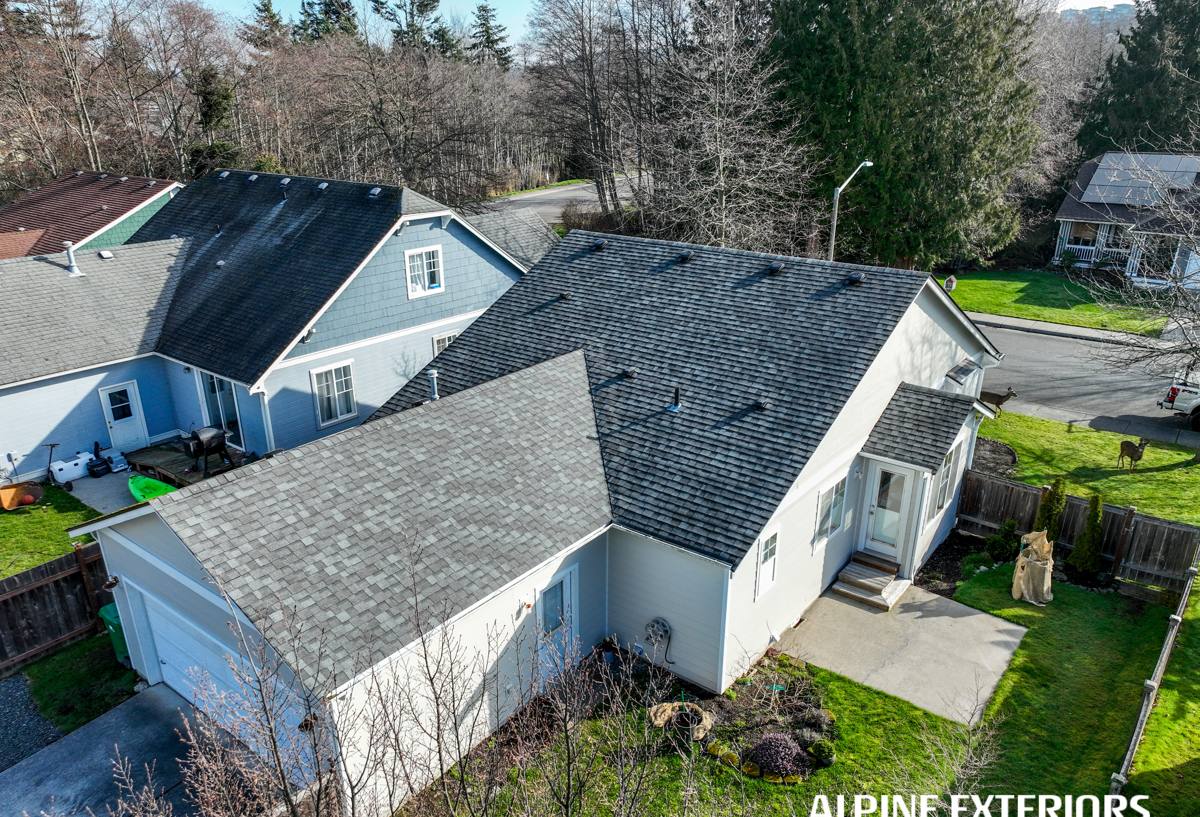
Roofing and siding failures are connected more often than homeowners expect. A roof that's shedding water poorly, or holding moss against the shingles, pushes moisture toward the top courses of siding and the trim underneath the roofline. When we're on a York roof, we're looking at flashing condition at valleys, chimneys, and wall transitions, ventilation at the ridge and soffits, and how much moss has built up on north- and shade-facing slopes. Moss doesn't just look bad — it holds water against the roofing material and accelerates wear, and left unaddressed it works its way toward the decking underneath.
A roof replacement or repair on an older Bellingham home is also a chance to correct flashing at any wall-to-roof intersection before new siding goes up against it — doing both in sequence avoids sealing new siding against old, already-compromised flashing.
Windows: Where a Lot of Older Homes Lose the Battle
On older homes in this area, original or early-replacement windows are frequently where water intrusion actually starts, even when the siding above looks fine. Old flashing tape, or none at all, degraded sill pans, and caulk that's done its job but is now past its service life all let wind-driven rain track behind the window frame and into the wall cavity. When we replace siding around existing windows, we check and correct flashing at each opening as part of the job — new siding installed tight against poorly flashed windows just relocates the problem, it doesn't solve it.
Decks: A Different Moisture Problem, Same Climate
Decks in Whatcom County face near-constant damp conditions for months at a stretch, plus the same moss and algae growth that affects north-facing walls and roofs. Ledger board attachment, proper flashing where the deck meets the house, and gap spacing for drainage and airflow underneath all matter more here than they would in a drier climate. A deck built or repaired without attention to those details tends to show rot at the ledger and framing well before the decking boards themselves wear out.
What a Project Typically Involves
Every home is different, but most siding, roofing, window, or deck projects in the York area follow a similar sequence:
- On-site inspection — assessing the existing material, wall assembly, flashing, and any moisture damage already present
- A clear written scope covering what's being removed, what's being repaired, and what's being installed, with material selections
- Tear-off or removal, with a close look at sheathing and framing condition once the old material is off
- Repair of any rot, damaged sheathing, or compromised flashing found during tear-off — addressed before new material goes on, not after
- Installation of the water-resistive barrier and flashing details at every window, door, and penetration
- Final material installation — siding, roofing, windows, or decking — to manufacturer specification
- Walkthrough so you know what was done and what to watch for going forward
Questions Worth Asking Any Contractor Before You Hire
- Are you licensed and insured to work in Washington state, and can you provide proof?
- Who will actually be on the crew doing the work — your own employees or subcontractors?
- What's your plan if you find rot or moisture damage once the old siding or roofing comes off?
- What warranty covers the installation itself, separate from the manufacturer's material warranty?
- Can I get the scope of work and material selections in writing before anything starts?
Cost Factors to Understand Before You Budget
| Factor | Why It Matters |
|---|---|
| Extent of hidden damage | Rot or compromised sheathing found during tear-off adds scope that can't be accurately quoted until the old material is off |
| Home size and wall complexity | Multiple stories, dormers, and cut-up wall lines take more labor per square foot than a simple rectangular facade |
| Product line and profile | Lap width, texture, and trim details all affect material cost and installation time |
| Access and site conditions | Tight lots, mature landscaping, or limited staging area can add time and equipment cost |
| Scope bundling | Combining siding with window or trim replacement in one project often costs less than doing them as separate jobs later |
Why a Local Crew Matters Here
A contractor who works Whatcom County homes regularly has already seen how the local climate plays out on real houses over real years — not just in a manufacturer's data sheet. That means knowing which wall orientations tend to hold moisture the longest, what condition to expect when opening up an older wall in this area, and how to sequence a project around our wet season rather than fighting it. It also means being reachable after the job is done, not just during the sale.
If you're in the York neighborhood and thinking about siding, roofing, windows, or a deck, we're happy to take a look and give you a straightforward, no-pressure estimate — including an honest read on what your home's exterior actually needs versus what can wait.