 Bellingham Siding
 Homeowners researching a siding replacement in Bellingham eventually run into the same fork in the road: fiber cement or engineered wood. Both are marketed as upgrades over vinyl. Both claim to handle Pacific Northwest weather. Both show up on contractor estimates across Whatcom County. But they are not the same product, they do not age the same way, and they do not carry the same risk profile once they're on a wall that faces Bellingham Bay, the Guide Meridian corridor, or a shaded lot up toward Lake Whatcom. We install one of these products. This page explains the actual differences so you can see why.
What Each Product Actually Is
Fiber cement siding is a composite of Portland cement, sand, and cellulose fiber, cured under pressure and heat into a rigid, dense board. It's manufactured by a handful of companies; James Hardie is the one we use, in their HardiePlank and HardiePanel product lines. Because the core material is mineral-based, it does not burn, it does not feed insects, and its dimensional response to moisture is minimal.
Engineered wood siding — the category that includes LP SmartSide and similar products — is a wood-strand product. Wood fibers or strands are bonded with resin under heat and pressure, then coated with a resin-saturated overlay and factory primer. It looks and installs a lot like solid wood siding, and it's priced to compete with both wood and fiber cement. The core material, though, is still wood. Treated, engineered, resin-bonded wood — but wood.
Why That Distinction Matters Here
In a dry climate, the difference between a mineral-based board and a treated wood-strand board is mostly academic. In Whatcom County, it isn't. Bellingham gets roughly 35 inches of rain a year spread across nine or more wet months, on top of salt-laden air off the Sound and a moss season that can run from October into June on shaded north- and west-facing walls. Any product with an organic core is going to be tested harder here than it would be in Spokane or Boise.
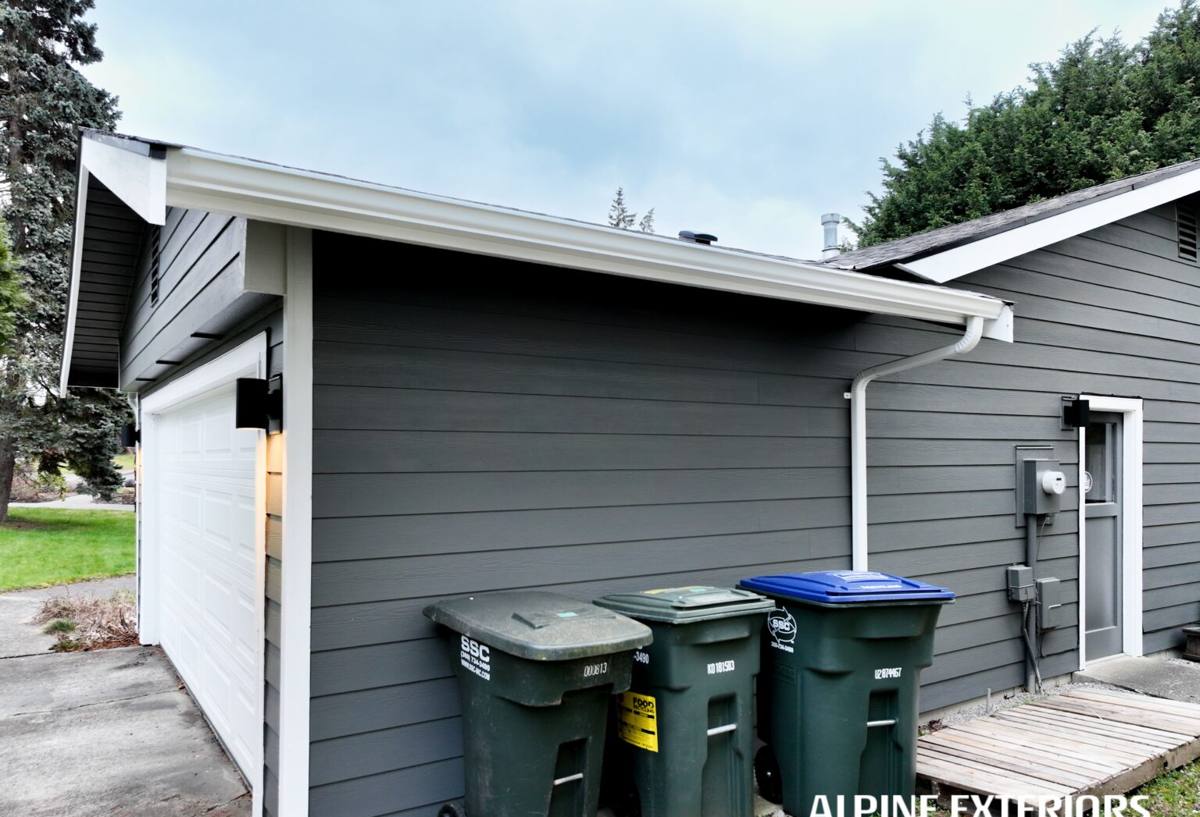
Moisture: The Core Issue
Engineered wood siding is engineered specifically to resist moisture better than solid wood — that's the entire point of the resin treatment and overlay. It performs reasonably well when installed correctly and maintained on schedule. The catch is the word "maintained." The resin barrier is a coating, not a change to the underlying material. If that coating is compromised — a cut edge left unsealed, a fastener hole not primed, caulking that fails at a butt joint, or years of not staying current on repainting — moisture reaches the wood-strand core. Once that happens, the same swelling, delamination, and edge softening that affects any wood product can start, just on a longer timeline than untreated wood.
Fiber cement doesn't have that failure mode. Cellulose fiber reinforces the cement matrix, but the board itself doesn't absorb and swell the way wood does. It can get wet and dry out without losing structural integrity. That's a meaningful difference on a coastal property where driving rain off the Sound hits the same wall for days at a time, or on a shaded elevation where moss and mildew keep siding damp well after a storm has passed.
Fire Behavior
This isn't a wildfire-corridor market the way parts of Eastern Washington are, but it's still worth stating plainly: fiber cement is non-combustible. It carries a Class A fire rating without needing any additional treatment. Engineered wood, even with fire-retardant treatment options available from some manufacturers, still has a combustible wood core. For homeowners who factor fire risk into their insurance conversations or simply want one less combustible material on the exterior, that's a real, non-marketing difference.
Maintenance Reality Over Time
Every siding product needs some maintenance. The honest question is how much, how often, and what happens if you fall behind.
- Engineered wood: Needs repainting on a schedule (manufacturer guidance typically points toward inspecting and refreshing paint every several years), caulk joints checked annually, and cut edges field-sealed at installation and again if the board is ever cut or damaged later.
- Fiber cement with factory finish (ColorPlus): The color coat is baked on at the factory under controlled conditions, not applied on-site. It's warrantied separately from the board itself and typically holds color and integrity far longer between repaints than a field-applied or factory-primed finish.
- Fiber cement, primed only: Still needs field painting, but the board underneath isn't at risk from a coating failure the way a wood-strand core is.
The gap isn't that one product needs zero maintenance and the other needs constant attention — it's that a missed maintenance cycle on engineered wood has a higher ceiling of consequence, because the thing protecting the core is a coating on top of an organic material.
Side-by-Side Comparison
| Factor | Fiber Cement (Hardie) | Engineered Wood |
|---|---|---|
| Core material | Cement, sand, cellulose fiber | Resin-bonded wood strand |
| Combustibility | Non-combustible, Class A | Combustible (treated options exist) |
| Moisture response | Minimal swelling/absorption | Resistant when coating intact; vulnerable if breached |
| Insect/rot exposure | Not a food source | Treated, but still an organic core |
| Factory finish option | ColorPlus baked-on finish available | Factory primer; field paint typical |
| Cut-edge handling | Sealer recommended, lower consequence if missed | Field-sealing critical to warranty and performance |
| Typical warranty | Long-term, transferable (product-dependent) | Manufacturer-specific, often maintenance-conditional |
Cost, Honestly
Engineered wood siding is generally priced lower than fiber cement on a per-square-foot material basis, and that price gap is real — it's not a myth contractors use to upsell. Where the comparison gets more complicated is lifecycle cost: repainting cycles, caulk maintenance, and the potential cost of addressing moisture intrusion at a core level if maintenance lapses for a few years. We won't quote you a made-up "20-year savings" number, because it depends heavily on how diligently any homeowner keeps up with upkeep. What we will say is that the upfront price difference is one input, not the whole decision, especially on a home that's going to sit through a lot of Bellingham winters.
Why We Standardized on Fiber Cement
We used to field questions about installing engineered wood alongside fiber cement, and we made a deliberate call to stop offering it. Not because it's a bad product in the abstract — it has real advantages in dry climates and for budget-conscious projects where the owner is committed to staying on top of maintenance. Our decision came down to what we see repeatedly in this specific climate: an organic-core product depends on an intact coating to perform, and Whatcom County's rain, salt air, and moss season put sustained pressure on that coating year-round. We'd rather install a product whose core material doesn't depend on a coating to stay structurally sound. That's James Hardie fiber cement, installed to their climate-specific HZ10 specifications for our zone, with factory ColorPlus finish where it fits the project.
It also lets us stand behind the work with one system we know thoroughly rather than juggling installation details, fastener requirements, and warranty terms across multiple product lines.
Questions Worth Asking Before You Decide
- How exposed is this wall to driving rain, salt air, or prolonged shade and moss growth?
- Am I committed to a repainting and caulk-inspection schedule for the life of the siding, or do I want a factory-finished, lower-maintenance system?
- Does the warranty on the product I'm considering require documented maintenance to stay valid?
- What happens at cut edges, corners, and butt joints — is field-sealing required, and by whom?
- Is the installer proposing manufacturer-specified fasteners, clearances, and flashing details for this specific product?
What This Means for Your Project
If you're comparing bids and one includes engineered wood at a lower price, that's not automatically a bad bid — it may reflect a legitimate product choice for the right situation. But ask the installer how they handle cut-edge sealing, what the maintenance schedule looks like, and what voids the warranty. If you're leaning toward fiber cement, ask whether they're using HZ5 or HZ10 product engineered for our climate zone, and whether the finish is factory ColorPlus or field-applied paint. The right questions matter more than the brand name on the estimate.
If you'd like to see how this plays out on your specific home — sun exposure, wall orientation, existing substrate, and budget — we're happy to walk the exterior with you and give a straight answer, not a sales pitch. Reach out for a free, no-pressure estimate using the form below.