 Bellingham Siding
 Two Very Different Materials, One Big Decision
If you're replacing siding in Bellingham, you'll eventually land on the same fork in the road almost every homeowner in Whatcom County faces: fiber cement or vinyl. Both are common, both are sold by reputable manufacturers, and both can look good on a showroom sample. The difference shows up ten, fifteen, twenty years later, once the marine air, the winter rain, and the moss season have had their say.
We're going to lay out the honest trade-offs of each material — not sales talk, not scare tactics. Then we'll explain why, after weighing all of it against what this climate does to a house, we made the decision to install only James Hardie fiber cement and stopped installing vinyl altogether.
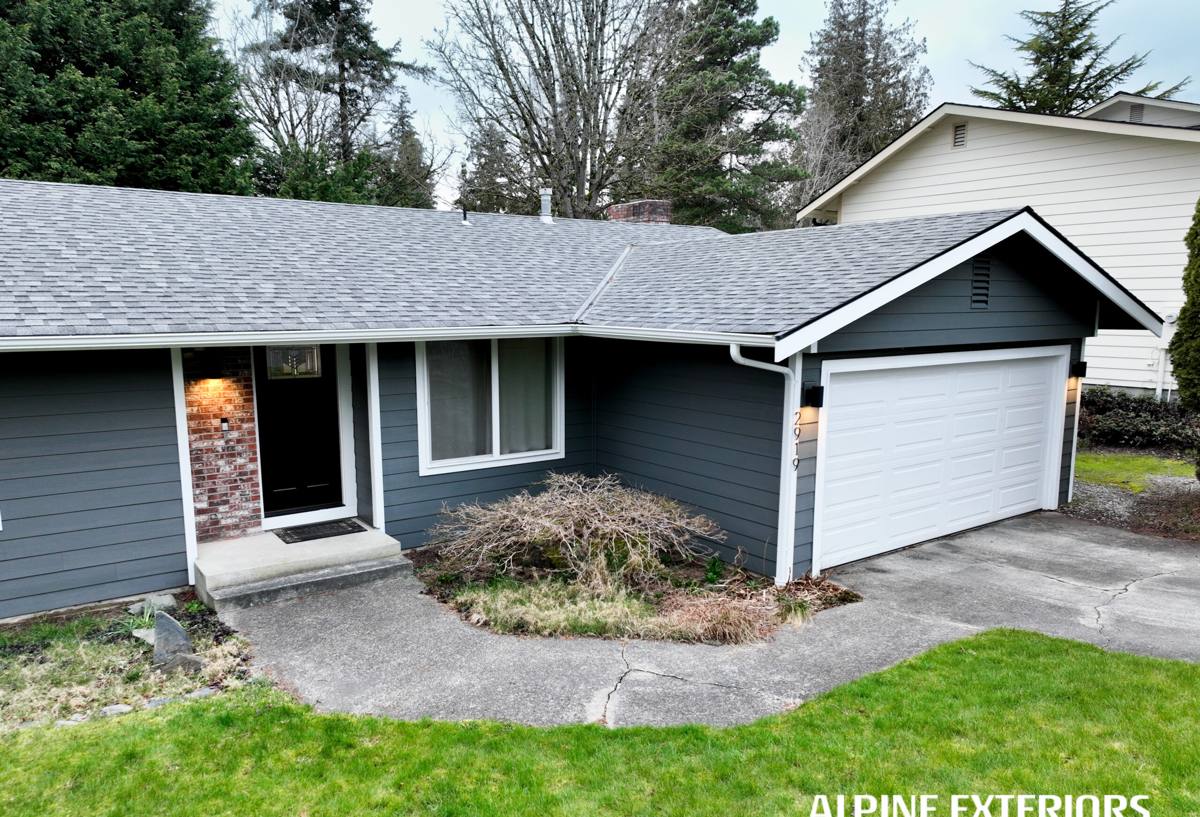
What Bellingham's Climate Actually Does to Siding
This isn't a generic "siding matters" pitch. Bellingham and the rest of Whatcom County have a specific combination of conditions that stresses exterior materials in specific ways:
- Salt air off Bellingham Bay and the Strait accelerates corrosion of fasteners and trim, and it degrades certain finishes faster than inland climates.
- Driving rain off the water, pushed sideways by wind, tests every seam, lap joint, and butt joint on a wall — not just the field of the siding.
- A long moss and mildew season, thanks to shade, moisture, and mild temperatures for much of the year, means anything organic-adjacent on a wall (dirt, pollen, algae) has months to take hold before a good drying stretch shows up.
Any siding material can survive a dry, sunny climate with a wide margin for error. Few materials get tested the way this one does.
Vinyl Siding: What It Gets Right
We'll give vinyl its due. It's inexpensive relative to most other cladding options, it installs quickly, it never needs painting, and modern vinyl has genuinely improved over what was sold decades ago — thicker panels, better locking systems, and UV-stabilized color formulas that fade more slowly than older generations. For a homeowner on a tight budget who needs a functional, weathertight exterior, vinyl is not a scam or a bad product. It does what it's designed to do.
Where vinyl holds up reasonably well
Vinyl doesn't rot, it doesn't need staining, and it sheds water off its surface without absorbing moisture into the material itself. In a moderate climate with reasonable maintenance, a mid-grade vinyl installation can look acceptable for a decade or more.
Vinyl Siding: The Trade-Offs We Couldn't Get Past
It moves with temperature — a lot
Vinyl expands and contracts significantly across temperature swings, which is why it's installed with loose nailing and slotted holes rather than fastened tight. Get that installation detail wrong — and it's a surprisingly easy detail to get wrong — and you end up with buckling, waviness, or panels that pop off their track in a hard wind. Bellingham gets enough wind events off the water that this isn't a hypothetical.
Seams are where water gets in
Vinyl panels overlap rather than form a continuous plane, and every horizontal seam is a place water can work its way behind the cladding during driving rain. The material itself doesn't absorb water, but the wall assembly behind it can still take on moisture through those laps if house wrap, flashing, and J-channel details aren't executed precisely — and vinyl's installation forgives sloppy flashing work far more than it should.
Impact resistance is limited
Vinyl is a thin plastic product. It cracks or shatters on hard impact, especially in cold weather when it becomes more brittle — a real consideration during a Whatcom County cold snap. Hail, a thrown rock, a ladder bump, or a wind-driven branch can crack a panel that then has to be matched and replaced, and older color runs are notoriously hard to match years later.
Color and finish age differently than advertised
Vinyl's color is baked through the material, which sounds like an advantage — but it also means dark colors absorb heat and can warp in direct summer sun, which is why vinyl manufacturers restrict which colors can be used in full-sun exposures. Over years, all vinyl fades to some degree, and because color runs vary by manufacturing batch, a repaired section rarely matches a fifteen-year-old wall.
Combustibility
Vinyl is a petroleum-based plastic product. It melts and deforms at relatively low heat and will burn under sustained flame exposure. For a lot of homeowners this is a minor factor; for others, especially those thinking about insurance and wildfire-adjacent risk even in a wetter region like ours, it's a real consideration.
Fiber Cement: What It's Actually Made Of
Fiber cement siding is a composite of Portland cement, sand, and cellulose fiber, cured under controlled factory conditions. It's dense, heavy, and dimensionally stable — it doesn't expand and contract with temperature the way vinyl does, and it doesn't soften or sag in heat. It's manufactured to be nailed tight to the wall, which means the installation is more forgiving of the kind of driving, wind-loaded rain this region sees regularly.
How it handles this climate specifically
Because fiber cement is dense and dimensionally stable, it holds paint and factory finishes far longer than wood-based products, and it doesn't provide the organic food source that wood siding does for the moss and mildew that thrive here. It's also non-combustible, which matters for insurance conversations and for peace of mind generally.
Fiber Cement vs. Vinyl: Side-by-Side
| Factor | Vinyl Siding | Fiber Cement (James Hardie) |
|---|---|---|
| Typical lifespan | 15–25 years before visible fading, warping, or brittleness | 30–50+ years when installed to spec |
| Impact resistance | Cracks/shatters on hard impact, especially in cold weather | Resists denting, cracking, and impact damage |
| Behavior in heat/cold | Expands, contracts, can warp in dark colors or sun exposure | Dimensionally stable across temperature swings |
| Moisture/rot risk | Panel itself won't rot, but seams can let water behind the wall | Engineered to resist moisture intrusion; won't rot |
| Fire behavior | Combustible plastic, melts/deforms under heat | Non-combustible material |
| Finish/color | Color molded through material; fades over time, hard to match later | Factory-baked ColorPlus finish, warrantied against fading/peeling |
| Upfront cost | Lower material and labor cost | Higher upfront investment |
| Resale perception | Viewed as a budget/utility upgrade | Generally viewed as a premium, durable upgrade |
The Maintenance Reality, Not the Brochure Version
Neither material needs painting on day one, and both manufacturers will tell you their product is "low maintenance." The honest picture over a 20-year window looks different:
Vinyl over time
Vinyl needs regular washing to prevent mildew buildup in the laps and seams — more frequent here than in a drier climate — and any cracked or faded panel is a mismatch problem, not a quick touch-up. Sun-facing walls fade unevenly compared to shaded walls, which becomes obvious after a decade.
Fiber cement over time
Factory-finished fiber cement holds its color for a long stretch under its warranty and doesn't provide the same food source for moss and algae that wood or dirt-catching seams do. It still needs periodic washing and caulk-joint inspection, but it isn't fighting the material's own tendency to move, fade unevenly, or crack.
Cost: What You're Actually Paying For
Vinyl will almost always be the lower number on a bid. That's real, and for some budgets it's the deciding factor, full stop. But the comparison isn't really "cheap material vs. expensive material" — it's "replace once every 15-20 years vs. install once and maintain." Fiber cement's higher upfront cost is spread over a service life that, installed correctly, can be double or more that of vinyl, with a manufacturer warranty that's transferable if you sell the house.
Questions worth asking before you commit to either material
- What does the manufacturer's warranty actually cover — materials only, or labor too?
- Is the warranty transferable if you sell the home within the coverage period?
- What's the contractor's specific plan for flashing, house wrap, and seams in wind-driven rain?
- How is color/finish handled — field-painted, or factory-cured finish?
- What's the realistic maintenance schedule the contractor expects you to follow?
- Does the installer carry manufacturer certification for the product they're proposing?
Why We Standardized on James Hardie
We used to quote both materials. Over time, the pattern was consistent: the homes with vinyl needed panel replacement, re-caulking, and seam repair on a shorter cycle, and color-matching an aging vinyl repair in Bellingham's fading light was a recurring headache for homeowners who called us back years later. The homes with quality fiber cement, installed correctly, simply weren't generating those calls.
That's why we install only James Hardie fiber cement products. Hardie's HZ5 and HZ10 formulations are climate-engineered for wet, humid regions like ours, the ColorPlus factory finish is backed by a strong finish warranty against fading and peeling, and the material itself is non-combustible and dimensionally stable — it doesn't fight the wind, rain, and moss that define a Whatcom County exterior. We're not installing it because it's the only option on the market; we're installing it because, after years of watching both materials age on real houses in this specific climate, it's the one we're willing to put our name behind.
If you're weighing fiber cement against vinyl for your own home, we're glad to walk through both honestly, look at your specific house and exposure, and give you a straightforward, no-pressure estimate.