 Bellingham Siding
 Exterior Work in Happy Valley: What the Neighborhood Actually Deals With
Happy Valley sits close enough to Bellingham Bay and the surrounding hillside tree cover that its homes take on a particular mix of exterior stress most inland neighborhoods don't see in the same combination. You've got salt-tinged air moving up off the water, long stretches of driving rain that come in sideways off Pacific storm systems, and enough mature tree canopy in and around the neighborhood to keep siding, trim, and roofing shaded and damp for weeks at a stretch through fall, winter, and spring. That shade is part of what makes Happy Valley a pleasant place to live — it's also exactly the condition moss, algae, and mildew need to take hold on an exterior.
None of this is unique to Happy Valley specifically — it's the Bellingham and Whatcom County pattern generally — but the density of tree cover and proximity to the bay tend to concentrate the effects here more than in some of the more open, wind-swept parts of the county. Homes in this kind of setting need siding, trim, and roofing that can shed water fast, resist moss colonization, and hold their finish without constant intervention.
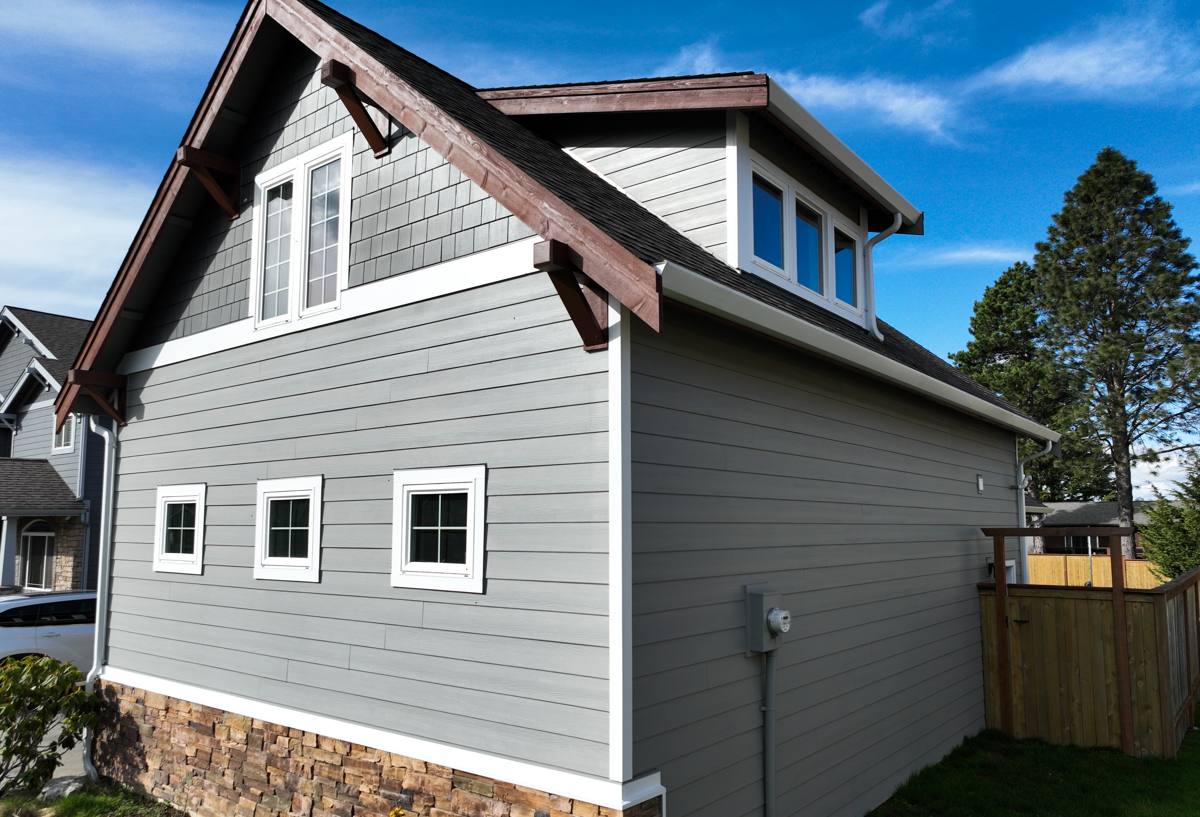
Why Siding Material Choice Matters More Here Than It Looks
A lot of siding failure in a climate like this doesn't show up as a dramatic problem — it shows up slowly, as a green tint creeping up from the bottom edge of a wall, as paint that needs recoating every few years instead of every decade, or as soft spots at butt joints and corners where moisture has been sitting against the material longer than it should. Wood products (cedar, primed spruce) and wood-based composites (LP SmartSide) can all perform reasonably well when detailed and maintained correctly, but they all share a vulnerability that matters a lot in a shaded, damp, salt-air neighborhood: their long-term performance depends heavily on caulking, painting, and moisture management staying ahead of the weather, year after year, without a gap.
Vinyl siding avoids the rot question but brings its own limitations in this exact setting — it expands and contracts with temperature swings, can become brittle over time, and doesn't hold a factory finish the way a baked-on coating does, so it tends to look tired well before the underlying material actually fails.
Why We Install Only James Hardie Fiber Cement Siding
We made the decision years ago to standardize on James Hardie fiber cement siding for every siding project we take on, including here in Happy Valley. That's not a marketing position — it's a practical one, built around what actually holds up in this exact climate.
- Non-combustible core. Fiber cement doesn't burn, which matters given regional wildfire smoke seasons and general fire-code trends across Western Washington.
- Engineered for the Pacific Northwest. Hardie's HZ5 product line is formulated specifically for wetter, more humid climate zones like ours, rather than being a one-size-fits-all product.
- ColorPlus factory finish. The color is baked on in a controlled environment before the boards ever reach your house, which holds up far longer against UV and moisture than field-applied paint, and it comes with its own dedicated finish warranty.
- Moisture stability. Fiber cement doesn't swell, warp, or rot the way wood and wood-composite products can when they stay damp for extended periods — a real factor in a shaded, tree-covered area like Happy Valley.
- Strong, transferable warranty. Hardie backs its siding with a warranty that's meaningful in practice, not just on paper, and it transfers if you sell the home.
We won't install LP SmartSide, vinyl, Cemplank, Allura, primed spruce, or cedar — not because those products can't be installed well by someone, but because we've chosen to build our business around one system we trust completely and can stand behind for the life of the warranty. That means every crew we send out knows one product system inside and out, rather than juggling installation details across five different materials.
What a Siding Project Looks Like on a Happy Valley Home
Assessment and Planning
We start by walking the exterior with you, looking specifically at the sides of the house that get the least sun and the most tree shade, since those are usually where moss and moisture problems concentrate first. We check trim, flashing, window and door transitions, and the condition of the existing siding or sheathing underneath before ever talking product selection.
Installation Detailing
Fiber cement performs exactly as well as its installation. That means correct fastener placement, proper clearances at grade and roof lines, sealed and flashed openings, and butt joints detailed to shed water rather than trap it. In a neighborhood with Happy Valley's tree cover and rain exposure, these installation details are the difference between siding that looks the same in fifteen years and siding that needs early attention.
Cleanup and Finish
We finish with a full site cleanup and a walkthrough so you understand what was done and what, if anything, to keep an eye on going forward — though with Hardie installed correctly, ongoing homeowner maintenance is minimal.
Beyond Siding: Roofing, Windows, and Decks
Siding is only one piece of a home's exterior envelope, and in a climate that throws salt air, sideways rain, and a long moss season at a house, the pieces work together or they fail together. We also handle roofing, windows, and decks, which means we can look at a Happy Valley home holistically rather than fixing one component while ignoring water intrusion points elsewhere.
- Roofing — flashing details and moss-resistant material choices matter as much as the shingle itself in a shaded, damp neighborhood.
- Windows — proper flashing integration with new siding is one of the most common places older homes leak; replacing windows and siding together lets us solve it once, correctly.
- Decks — outdoor living structures take the same rain and moss exposure as the house itself and benefit from materials and detailing chosen for the same climate.
What Drives the Cost of a Siding Project
Every home is different, but a few factors consistently move the price on a Happy Valley siding job:
| Factor | Why It Matters |
|---|---|
| Home size and wall complexity | More corners, gables, and dormers mean more cutting, flashing, and labor time |
| Existing siding removal | Tear-off and disposal of old wood, vinyl, or composite siding adds labor and haul-away cost |
| Sheathing and moisture damage | Rot or water damage found underneath old siding needs repair before new siding goes on |
| Trim and detail work | Window trim, corner boards, and fascia detailing add material and installation time |
| Hardie product line and profile | Lap width, panel type, and finish selections carry different material costs |
| Access and site conditions | Tree cover, slope, and tight lot lines around a Happy Valley home can affect staging and labor time |
We give straightforward, itemized estimates so you know exactly what you're paying for and why — no vague lump-sum numbers.
Maintenance: What Happy Valley Homeowners Should Actually Watch For
Correctly installed Hardie siding is low-maintenance, not zero-maintenance. In a climate like this, a little seasonal attention goes a long way:
- Rinse siding down once or twice a year, especially on shaded or tree-covered sides of the house where moss and algae are more likely to establish
- Keep gutters clear so water isn't overflowing and running down the siding face
- Trim back tree branches and shrubs that are keeping siding in constant shade and moisture contact
- Check caulking at trim, window, and door transitions annually and re-seal if it's cracked or pulling away
- Look at ground-level siding clearance after landscaping work — mulch and soil piled against siding traps moisture
- Note any soft spots, discoloration, or unusual staining and have them checked before they spread
Why a Local Crew Matters for Happy Valley Homes
A crew that works across Whatcom County regularly knows how a Bellingham house actually weathers — not from a manual, but from having reworked older siding jobs and seen firsthand where moss, rot, and water intrusion tend to start in this specific climate. That local familiarity shows up in small decisions: where to add extra flashing attention, which sides of a house need closer inspection before the old siding comes off, and how to sequence a project around our rainy season rather than fighting it.
If you're weighing a siding project for your Happy Valley home — or want a second opinion on roofing, windows, or a deck while we're already looking at your exterior — we're happy to walk the property with you and give you a straightforward, no-pressure estimate. There's a form below to get that started.