 Bellingham Siding
 Why Blaine's Climate Is Rougher on Siding Than It Looks
Blaine sits close enough to the water that salt-laden air is a daily fact of life, not an occasional weather event. Add Whatcom County's long stretch of driving rain each fall and winter, plus a moss season that can run for months on shaded or north-facing walls, and you have a combination that quietly wears down siding that wasn't built for it. None of these forces are dramatic on their own. A little salt in the air, a little more moisture than the siding can shed, a little moss creeping up from the bottom courses. But over five, ten, fifteen years, that combination is exactly what separates a wall system that still looks tight from one that's cupping, staining, or rotting behind the surface.
Most siding failures we see in this area aren't sudden. They're the slow result of a product or an installation that couldn't keep up with constant moisture exposure and salt air corrosion. That's the lens we use when we talk about siding for a Blaine home specifically, not a generic "Pacific Northwest" pitch, but what this particular stretch of coastline actually does to a wall over time.
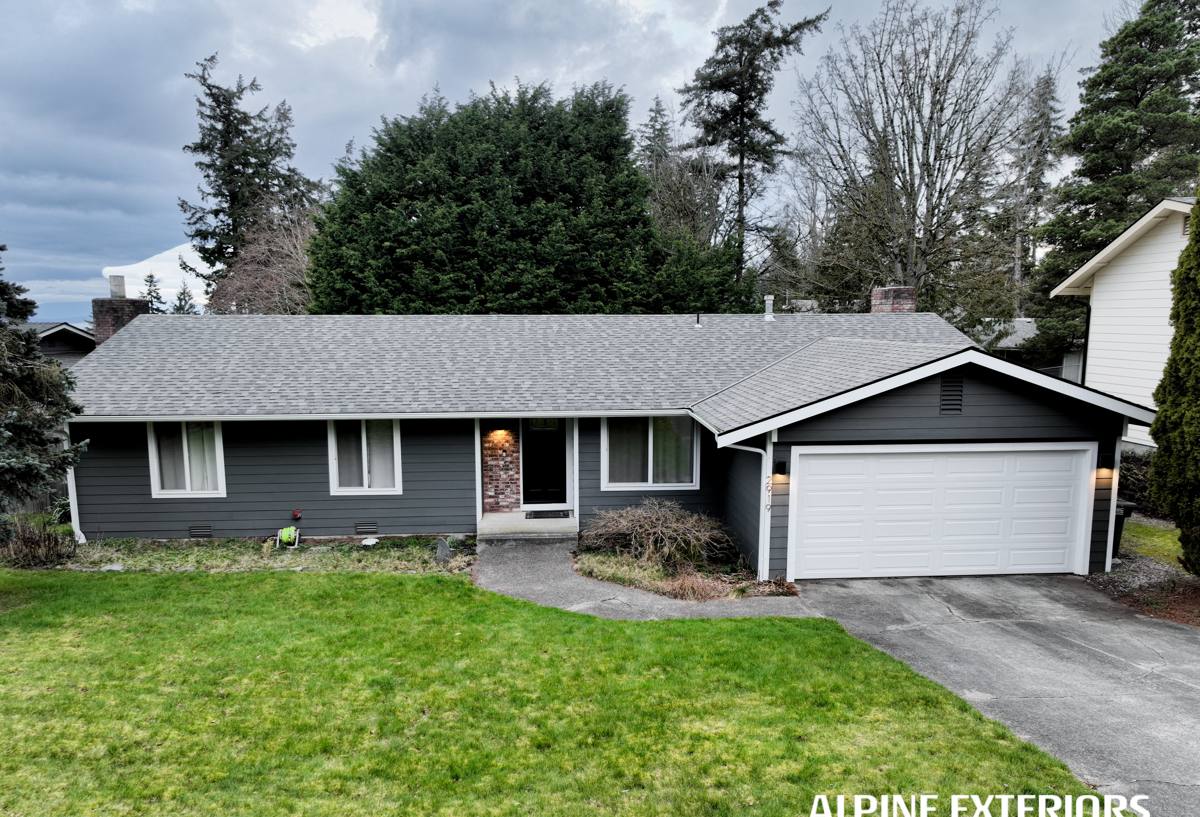
What Local Homes Actually Need From Their Siding
A siding system doing its job in Blaine needs to manage three things at once:
- Moisture shedding — driving rain doesn't just fall straight down here; wind pushes it sideways into wall assemblies, so laps, flashing, and drainage matter more than they would in a drier climate
- Salt exposure resistance — airborne salt accelerates corrosion on fasteners and trim, and it can degrade paint and finish coatings faster than inland exposure would
- Moss and biological growth resistance — shaded elevations and areas with poor sun exposure stay damp longer, which is exactly what moss and algae need to take hold
A product that only handles one or two of these well will eventually show it. That's the core reason we standardized on James Hardie fiber cement rather than offering a menu of siding options: it's the product we've found actually holds up to all three demands together, provided it's installed correctly, which we'll get to below.
Why James Hardie Fits This Environment
Fiber Cement's Basic Advantage
James Hardie siding is fiber cement, not wood, wood composite, or vinyl. That matters in a moist, salty coastal climate because fiber cement doesn't absorb moisture the way wood-based products do, and it doesn't expand and contract with temperature swings the way vinyl does. It also won't feed the rot and insect problems that come with wood siding sitting in a chronically damp environment. It's also non-combustible, which matters given how dry Washington summers have become even in traditionally wet regions.
ColorPlus Factory Finish
James Hardie's ColorPlus finish is baked on at the factory under controlled conditions, rather than field-applied paint that has to cure in whatever weather shows up that week. In a climate where you might get a narrow dry window before the next rain system rolls in, a factory finish removes a huge variable. It also holds color and resists fading better over time than most field-applied coatings, which matters on south and west-facing walls that take direct sun between rain systems.
Climate-Engineered HZ Product Lines
James Hardie makes different formulations for different climate zones. Homes in wetter, more humid regions get products engineered specifically for moisture and freeze-thaw performance, rather than a one-size-fits-all formulation. For Blaine, that means the product going on the wall was designed with this kind of weather in mind, not adapted from a version built for a drier climate.
What a Correct Installation Actually Involves
James Hardie siding is only as good as the installation behind it. This is where we see the most variation between a job that lasts decades and one that causes problems within a few years, and it's also why we don't treat installation as an afterthought to the material choice.
Flashing and Drainage Come First
Before a single piece of siding goes up, the walls need proper flashing around windows, doors, and any penetrations, along with a drainage plane that lets any moisture that does get behind the siding find its way back out. In a climate with sustained driving rain, this is not optional detail work. It's the difference between a wall that manages incidental moisture and one that traps it.
Correct Gaps and Fastening
Fiber cement needs specific gaps at butt joints, corners, and transitions to allow for the material's minor expansion and to keep water from wicking into end grain. Fasteners need to be corrosion-resistant and placed according to Hardie's specifications, not just "close enough." In a salt-air environment, using the wrong fastener is an invitation for corrosion staining and eventual failure at the fastening point.
Caulking and Sealant Placement
Hardie's installation guidelines are specific about where sealant is needed and where it isn't. Over-caulking traps moisture just as effectively as under-caulking lets it in. Correct placement, paired with the drainage plane behind it, is what actually keeps water out over the long run.
How Materials Compare in This Environment
| Material | Moisture Behavior | Salt Air Durability | Moss/Algae Resistance | Typical Finish Longevity |
|---|---|---|---|---|
| James Hardie Fiber Cement | Does not absorb or swell; sheds water when installed correctly | Strong when installed with corrosion-resistant fasteners | Good; factory finish resists biological staining better than field paint | Long-lasting factory ColorPlus finish |
| Cedar / Wood Siding | Absorbs moisture; prone to swelling and rot without diligent upkeep | Moderate; needs regular sealing | Poor without frequent treatment | Field-applied stain/paint needs recoating every few years |
| Vinyl Siding | Sheds water but can warp or buckle with temperature swings | Moderate; can become brittle over time | Moderate; grooves and laps can trap grime | Color is molded in, but fades and chalks over decades |
| LP SmartSide / Wood Composite | More moisture-resistant than raw wood but still wood-based | Moderate; edge sealing is critical | Moderate; dependent on coating quality | Field or factory finish, variable longevity |
This isn't a claim that every alternative product fails, plenty of them perform reasonably well when installed and maintained diligently. It's why, after years of installing and repairing siding in this climate, we made fiber cement our standard and stopped offering the alternatives.
Our Process for a Blaine Siding Project
- On-site assessment — we look at existing siding, sheathing condition, and any signs of past moisture intrusion before quoting anything
- Moisture and damage check — where old siding comes off, we check the sheathing underneath for rot or hidden damage before installing anything new over it
- Drainage plane and flashing installation — this happens before any Hardie board goes up, not as an afterthought
- Siding installation to Hardie spec — correct gaps, fasteners, and sealant placement throughout
- Final walkthrough — we go over the finished job with the homeowner, including what routine maintenance looks like going forward
Living With Moss Season: What Upkeep Actually Looks Like
Even the best siding still needs basic homeowner upkeep in a climate that grows moss for months at a stretch. The good news is that upkeep on properly installed James Hardie siding is straightforward and infrequent compared to wood or poorly finished alternatives.
- Rinse siding periodically with a garden hose, focusing on shaded and north-facing walls where moss and algae are most likely to take hold
- Keep gutters clear so overflow doesn't run down the siding face and stay damp longer than it should
- Trim back vegetation and tree cover that keeps a wall section shaded and slow to dry after rain
- Check caulking at trim and penetrations every year or two, since sealant is the one component that does wear out over time
- Address any small paint chips or fastener corrosion spots promptly rather than letting them spread
Why a Crew That Already Works This Coastline Matters
Installation guidelines are the same on paper everywhere, but judgment calls, how much gap to leave on a hot dry day versus a damp one, where drainage details need extra attention on a wall that catches wind-driven rain, how to handle an older home's sheathing that's been dealing with decades of coastal moisture, come from having done this work repeatedly in this specific environment. A crew that installs Hardie siding across a range of climates knows the general rules. A crew that installs it regularly in Blaine's salt air and rain patterns knows which of those rules matter most here, and where the real risk points are on a coastal wall versus an inland one.
Warranty and Long-Term Value
James Hardie backs its siding with a strong, transferable product warranty, which matters both for your own peace of mind and for resale value down the line. That warranty is worth the most when the installation itself was done to spec, since improper installation is the most common reason a warranty claim gets complicated. Pairing the right product with correct installation is what actually delivers the decades of performance the material is capable of, rather than treating the warranty as a substitute for doing the job right the first time.
If you're weighing a siding replacement or repair for a Blaine home and want a straight answer about what your walls actually need given the exposure they get, we're glad to take a look. Fill out the form below for a free, no-pressure estimate.