 Bellingham Siding
 Siding Installation in Blaine: A Different Climate Than Most of Whatcom County
Blaine sits right on the water at the top of Whatcom County, and that location changes what siding has to deal with compared to homes even a few miles inland. Salt air off Semiahmoo Bay and Drayton Harbor works differently on exterior materials than plain rain does — it accelerates corrosion on fasteners and trim, and it settles into porous or poorly sealed siding surfaces year-round, not just during storms. Add in the driving rain that comes off Georgia Strait weather systems and a moss season that can run eight or nine months out of the year in shaded, north-facing exposures, and you have a coastal environment that punishes generic siding installation work.
We install siding for homeowners in Blaine as part of our regular Bellingham-area service area, not as an occasional out-of-town trip. That matters because coastal siding failures usually aren't dramatic — they're slow. A house that looks fine from the street can have moisture tracking behind the cladding at window heads, corroding fasteners at the coast-facing wall, or moss holding dampness against the surface in the shaded side yard. Catching and preventing that requires knowing what Blaine's specific exposure does to a wall assembly, not just knowing how to install siding in general.
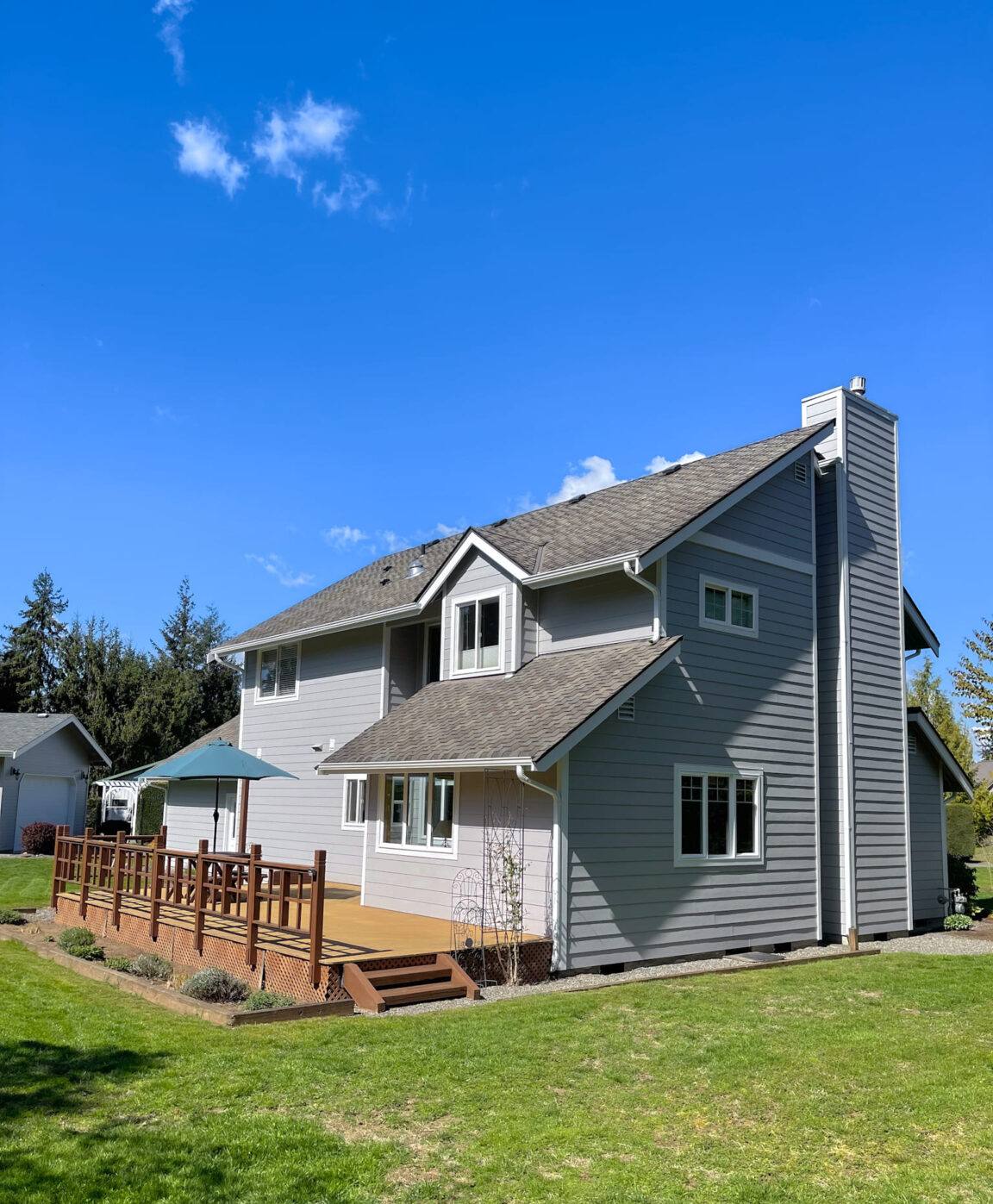
What Salt Air, Rain, and Moss Actually Do to Siding
Salt air and fasteners
Airborne salt is corrosive to standard fasteners and to any exposed metal trim or flashing. Over years, corroded fasteners lose holding power, and corrosion staining can bleed through paint and caulking at nail heads. The fix isn't complicated — it's using fasteners rated for coastal exposure and detailing flashing so metal components aren't left exposed to wash-down — but it has to be done deliberately. Standard interior-grade fasteners or bargain flashing stock are a common shortcut that shows up as rust streaks and loosening boards within a handful of years on a waterfront-adjacent home.
Driving rain and wind-driven moisture
Rain that comes in sideways off the water doesn't behave like rain that falls straight down. It gets pushed up under laps, into butt joints, and around penetrations like hose bibs and light fixtures. A siding installation built for driving rain needs correctly lapped water-resistive barrier, properly flashed openings, and siding coursing with enough overlap and drainage gap to shed wind-driven water instead of holding it against the wall.
Moss and prolonged dampness
Moss doesn't just grow on roofs. On shaded, north- or west-facing walls in Blaine — especially under tree cover or close to neighboring structures — moss and algae can colonize siding surfaces that stay damp longer than they dry. That prolonged dampness is the real problem: moss holds moisture against the siding face and, on materials that absorb water, that moisture works its way into the substrate. A siding material's resistance to moisture absorption matters more here than in a lot of inland climates.
Why We Install James Hardie Fiber Cement, and Nothing Else
We standardized on James Hardie fiber cement siding for every job we do, including here in Blaine, and we don't install vinyl, LP SmartSide, cedar, primed spruce, Cemplank, or Allura. That's a deliberate professional standard, not a sales pitch, and it's worth explaining honestly:
- Non-combustible core: fiber cement doesn't feed a fire the way wood-based products can, which matters for insurance conversations and long-term risk regardless of coastal exposure.
- Moisture behavior: Hardie's fiber cement doesn't swell, rot, or delaminate the way wood-based or wood-composite sidings can when they take on repeated moisture — a real advantage in a climate with this much sustained dampness.
- Factory-applied ColorPlus finish: the color and protective coating are baked on at the factory under controlled conditions, which holds up better against salt air and UV than field-applied paint, and it comes with its own finish warranty.
- HZ5 product engineering: Hardie makes climate-specific formulations, and the HZ5 line is engineered for cold, wet, freeze-prone regions — which describes Whatcom County's coastal edge well.
- Strong transferable warranty: Hardie backs its products with a long, transferable limited warranty, which matters to resale value on a coastal home where buyers are often asking pointed questions about how the exterior has held up.
We're not going to tell you vinyl or wood siding is junk — plenty of it is installed and holds up reasonably well in the right conditions. But we've made a business decision to stand behind one product system we can install to spec every time and warranty with confidence, and for a coastal, wet, mossy climate like Blaine's, fiber cement is the material we trust to hold up without high maintenance demands.
What Correct Siding Installation Looks Like Here
The material only performs as well as the installation underneath it. For a Blaine home, that means paying close attention to details that are easy to skip:
Water-resistive barrier and flashing
A continuous, properly lapped weather barrier behind the siding, with flashing integrated at every window, door, and penetration so water is directed out and down rather than trapped behind the cladding. This is the single most important layer for driving-rain performance, and it's invisible once the siding goes up — which is exactly why it has to be done right the first time.
Drainage plane and rainscreen gap
A small air gap between the siding and the wall assembly lets any moisture that does get past the surface drain and dry out instead of sitting against the sheathing. On a coastal, high-moisture site, this drainage detail is what separates siding that lasts decades from siding that traps rot-causing dampness.
Fastener selection and placement
Corrosion-resistant fasteners, placed and set to Hardie's specifications — not overdriven, not underdriven, and positioned to allow the board to perform as engineered. Overdriven fasteners crack the board's edge and create a moisture entry point; underdriven fasteners leave the board loose and prone to wind damage.
Caulking and sealant discipline
Sealant at trim joints and penetrations needs to be a product rated for the coastal exposure and applied where Hardie's install specs actually call for it — not everywhere, since over-caulking can trap moisture just as easily as under-caulking lets it in.
Our Process for a Blaine Siding Installation Project
- On-site assessment: we look at your home's specific exposure — which walls face the water, which sides stay shaded and damp, where the existing siding or sheathing is already showing moisture damage.
- Tear-off and sheathing inspection: removing old siding is when we find out what's really going on behind it — soft sheathing, prior water intrusion, or flashing that was never installed correctly.
- Repair before covering: any damaged sheathing or framing gets repaired before a single piece of new siding goes on. Covering a moisture problem with new siding just delays the same failure.
- Weather barrier and flashing installation: this is the step that determines how the wall performs for the next 30-plus years, done to manufacturer spec at every opening and penetration.
- James Hardie installation: installed per Hardie's fastening, clearance, and coursing specifications, which is also what keeps the manufacturer warranty valid.
- Final detailing: trim, caulking, and touch-up done with coastal-rated materials, then a walk-through so you know exactly what was done and why.
Cost Factors for Blaine Siding Installation
Every home is different, but the same variables tend to drive cost up or down on coastal Whatcom County projects:
| Factor | Why It Matters |
|---|---|
| Existing siding removal and disposal | Multiple layers or water-damaged sheathing add labor and repair time before install can even start |
| Sheathing and framing repair | Coastal homes with a history of moisture intrusion sometimes need structural repair, not just new siding |
| Home size and wall complexity | Dormers, multiple gables, and tall wall sections take more time to flash and detail correctly |
| Siding profile and trim package | Lap width, panel vs. plank choices, and trim detailing all affect material cost |
| Site access | Waterfront lots, steep grades, or tight setbacks can affect staging and equipment access |
What to Ask Any Contractor Before Hiring Them for Coastal Siding Work
- Do they install to the manufacturer's written specifications, and will they show you those specs?
- Do they use corrosion-resistant fasteners as standard practice, not as an upcharge?
- Will they show you the weather barrier and flashing details before the siding goes on, not just the finished product?
- How do they handle sheathing repair if they find water damage during tear-off?
- Are they familiar with how salt air and shaded, moss-prone walls behave differently on the same house?
- Is the manufacturer's warranty registered properly in your name after the job is done?
Why a Local Crew Matters for This Kind of Work
Siding installation done right the first time is far cheaper than siding installation redone after five years of hidden moisture damage. A crew that regularly works Blaine and the surrounding Whatcom County coastline has already seen how salt exposure, driving rain, and long moss seasons show up on real houses in this area — which walls tend to take the worst of it, which details get skipped on cheaper jobs, and what actually holds up over time here. That local pattern recognition is hard to replace with a general install checklist, and it's the difference between siding that looks good on installation day and siding that still looks good after a decade of Whatcom County weather.
If you're planning a siding project in Blaine, we're happy to walk your property, look at your specific exposure, and give you a straightforward, no-pressure estimate — just fill out the form below.