 Bellingham Siding
 Windows Built for Edgemoor's Bluff and Bay Exposure
Edgemoor sits up on the bluffs above Bellingham Bay, and that position is exactly what makes it one of the most desirable places to live in Whatcom County — and one of the harder spots on a house's windows. Homes here catch wind and moisture straight off the water, with less tree cover breaking the airflow than you'd get further inland. Add in mature landscaping that shades north- and east-facing walls for much of the year, and you get a neighborhood where window frames, sills, and seals age differently than they do just a few miles away in a more sheltered part of Bellingham.
We've replaced windows across Edgemoor long enough to know the pattern: it's rarely one catastrophic failure. It's slow, steady wear from salt-laden air, wind-driven rain that gets pushed sideways into gaps a calm-weather window never has to handle, and a moss season that runs long and wet even by Pacific Northwest standards. A window replacement here isn't just a cosmetic upgrade — it's a chance to correct details that were never built for this exposure in the first place.
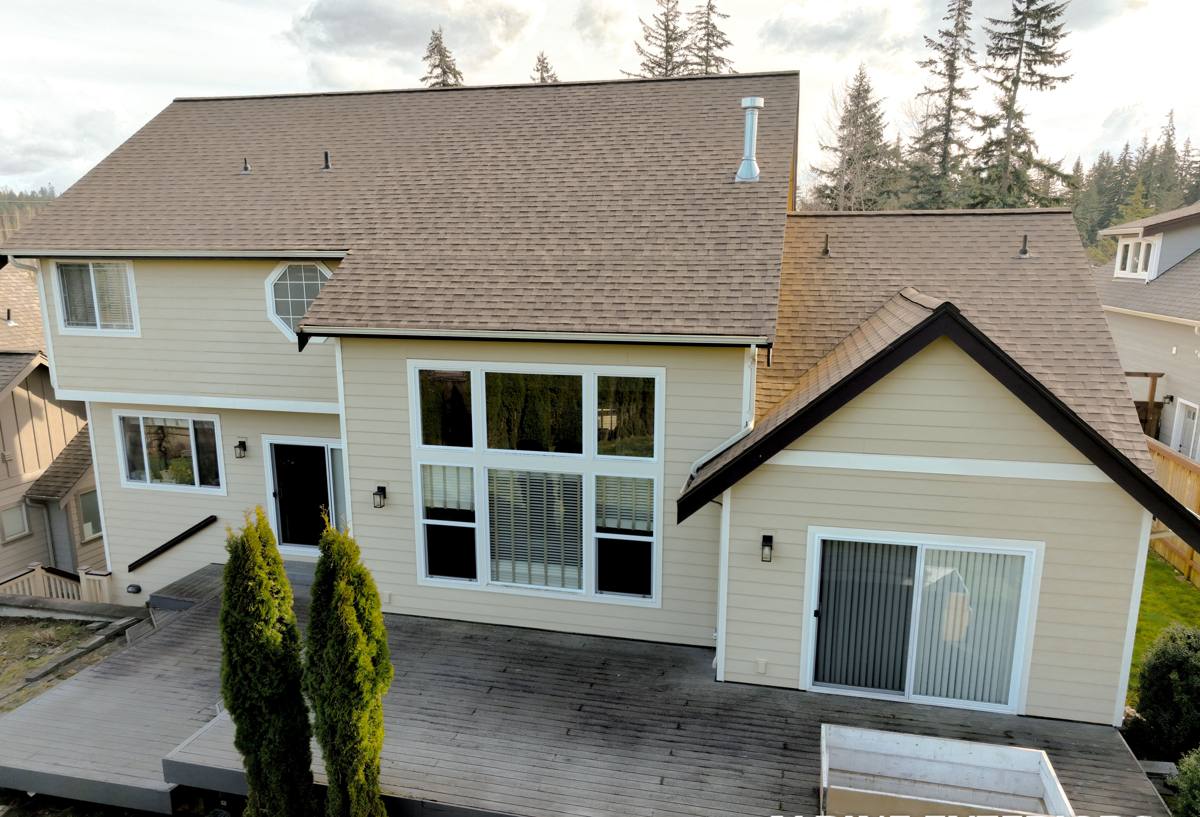
What Salt Air, Driving Rain, and Moss Season Actually Do to a Window
Salt Air
Salt-laden air off Bellingham Bay accelerates corrosion on exposed metal hardware — hinges, cranks, locking mechanisms, and screws — faster than inland exposure does. On older aluminum-frame windows, it also contributes to pitting and a chalky finish over time. This isn't a defect in the original window; it's just what happens to metal that sits a few blocks from saltwater for decades.
Driving Rain
Edgemoor's exposed position means rain often arrives at an angle instead of straight down, driven by wind coming off the water. That matters because a window's weakest point isn't usually the glass — it's the flashing, the sill pan, and the seal between the window unit and the wall. A window that's watertight in a light, vertical rain can still take on moisture during a wind-driven storm if those details were installed with shortcuts.
Moss Season
Bellingham's long wet season keeps humidity high around window sills, trim, and the wood framing behind it for months at a time. On shaded sides of a house — common in Edgemoor's tree-canopied lots — moss and algae can take hold on sills and exterior trim, holding moisture against the surface longer than it would otherwise sit. Over years, that steady dampness is what actually rots wood and de-laminates old sealant, not any single storm.
Signs an Edgemoor Home Is Due for Window Replacement
- Visible fogging or a hazy film between panes of double-glazed glass, meaning the seal has failed and the insulating gas has escaped
- Soft, spongy, or discolored wood at the sill or the bottom corners of the frame
- Windows that are difficult to open, close, or lock — often a sign the frame has swelled, warped, or shifted
- Visible corrosion, pitting, or stiff operation on metal hardware and cranks
- Persistent moss, algae, or dark streaking on the sill or exterior trim that keeps returning after cleaning
- Noticeable drafts or cold spots near the window even when it's fully closed
- Rising heating bills without any other clear explanation
- Condensation forming on the inside of the glass regularly during colder months
Any one of these on its own might just mean a repair or a re-caulk. Several together, especially on a home that's original to its era, usually means the windows are past the point where patching makes sense.
What a Correct Window Replacement Job Actually Involves
The window unit itself gets most of the attention, but in a coastal, high-moisture setting like Edgemoor, the installation details matter as much as the product. A window that's a fine choice on paper can still fail in five years if it's put in wrong. Here's what we hold every install to:
Removal Without Collateral Damage
Old windows come out carefully, with attention to the surrounding siding, trim, and framing so we're not creating new problems to fix the old one. This is also the point where hidden rot or water damage behind the old frame gets found — and it's better to find it now than to seal a new window over a problem that's still there.
Sill Pan and Flashing, Not Just Caulk
Caulk alone is not a water management strategy, especially with the kind of wind-driven rain Edgemoor gets off the bay. A correct install includes proper flashing integration with the existing water-resistive barrier and a sloped sill pan that directs any water that does get past the exterior seal back outside, rather than letting it pool against the framing.
Air Sealing and Insulation Around the Frame
The gap between the window frame and the rough opening needs to be filled with an appropriate low-expansion foam or insulation — not stuffed with excess fiberglass and not left with wide open gaps. Done right, this is what actually stops the drafts homeowners notice, more than the glass package itself.
Level, Plumb, and Square
A window that's out of square will bind, won't seal evenly, and will strain its own hardware over time. This is a basic step, but it's also the one most often rushed on a fast job.
Exterior Trim and Finish Detail
The trim and caulk lines around the finished window are what actually shed water day to day. On shaded, moss-prone walls, we pay particular attention to sealing seams cleanly so there's no ledge or gap where moisture and organic growth can sit and work their way in over a wet Bellingham winter.
Choosing a Window Material for Bluff-Exposed Homes
There's no single "best" window material — the right choice depends on the home's exposure, its existing trim style, and how much upkeep you want to take on. For Edgemoor's combination of salt air and sustained moisture, here's how the common options compare:
| Material | Salt Air Performance | Moisture & Rot Resistance | Maintenance |
|---|---|---|---|
| Vinyl | Does not corrode; unaffected by salt exposure | Won't rot; frame is inherently water-resistant | Low — occasional cleaning |
| Fiberglass | Does not corrode; very stable in coastal air | Excellent; dimensionally stable in wet/dry cycles | Low |
| Aluminum | Prone to pitting and corrosion over time near saltwater | Won't rot, but thermal performance lags without thermal breaks | Moderate — hardware and finish need attention |
| Wood (unclad) | No direct salt corrosion, but finish demands more upkeep | Vulnerable to rot without diligent maintenance in a wet climate | High — regular painting/sealing required |
| Wood, clad exterior | Cladding protects from salt exposure | Good, as long as cladding seams stay sealed | Moderate |
For most Edgemoor homes, we steer clients toward vinyl or fiberglass frames precisely because they remove the corrosion and rot variables from the equation entirely — you're not fighting the marine climate, you're just choosing based on style and budget. Where a home's character calls for a wood look, a clad-exterior window gives you that appearance with a lot less long-term maintenance exposed to the weather.
Glass and Performance Considerations for This Climate
Whatcom County doesn't see extreme heat, so the priority for glass here is usually insulating value and condensation control rather than solar heat rejection. A quality double-pane unit with a low-E coating and an argon or krypton gas fill is the standard baseline we recommend. On walls that get direct, unshaded exposure to wind off the bay, we'll also talk through upgraded weatherstripping and multi-point locking hardware, which help maintain a tight seal against sustained wind pressure — not just an occasional gust.
How Our Process Works
- On-site assessment — we look at each window's actual condition, the home's specific exposure to wind and rain, and any existing moisture or rot issues before recommending anything.
- Straightforward proposal — options laid out with real trade-offs, not upsold on features a particular home doesn't need.
- Careful removal — old units come out with the surrounding structure protected, and any hidden damage gets flagged before we move forward.
- Proper installation — flashing, sill pans, air sealing, and squaring done to the standard described above, every time.
- Finish work and cleanup — trim, caulking, and site cleanup completed so the job looks right and performs right from day one.
- Walkthrough — we go over the finished windows with you, including how to operate and maintain them.
What Affects the Cost
- Number of windows being replaced and whether it's a full-home project or a targeted few
- Frame material chosen (vinyl and fiberglass are typically more budget-friendly than clad wood)
- Window size and configuration — large picture windows or unusual shapes cost more than standard operable units
- Condition of the framing and sill behind the old window, which may need repair before the new unit goes in
- Access and site conditions, including second-story or hard-to-reach windows
- Trim and exterior finish work needed to complete the install cleanly
Every home is different, and the only way to give you real numbers is to look at your actual windows. We keep quotes honest and itemized so you know what you're paying for and why.
Why It Matters to Hire a Crew That Already Works Edgemoor
A window installer who mostly works inland jobs won't necessarily think twice about wind-driven rain or salt-air hardware corrosion — because they don't see it as often. Working regularly in Edgemoor and along Bellingham's coastal-facing neighborhoods means we're used to building in the extra margin these homes need: better flashing details on exposed walls, hardware choices that hold up near the bay, and finish work that accounts for a shaded, moss-prone sill needing to shed water for months at a time, not just survive a single storm. It's the difference between a window that looks right on install day and one that's still performing well in Bellingham's fifth or sixth wet winter.
If your Edgemoor home has windows showing their age — or you're just not sure whether repair or replacement makes more sense — we're happy to take a look and give you a straight answer. Fill out the form below for a free, no-pressure estimate.