 Bellingham Siding
 Windows Built for Barkley's Weather, Not Just the Catalog Photo
Barkley sits close enough to Bellingham Bay and the marine air moving in off it that window frames and seals take a different kind of beating than they would further inland. It's not one dramatic storm that wears out a window here — it's the accumulation. Salt-laden air working into hardware and finishes, months of driving rain testing every seal, and a moss season that runs longer than most homeowners expect, holding moisture against frames and sills long after the rain itself has stopped. Windows that are only "efficient" on paper, without construction that actually holds up to that combination, tend to disappoint owners by year five or six, not year twenty.
When we talk about energy-efficient windows for a Barkley home, we're talking about two things at once: how well the window keeps conditioned air in and outside air out, and how well it survives Whatcom County's wet, mild, salt-touched climate without the seals, frames, or hardware breaking down early. A window can be excellent on one count and mediocre on the other. Getting both right is the actual job.
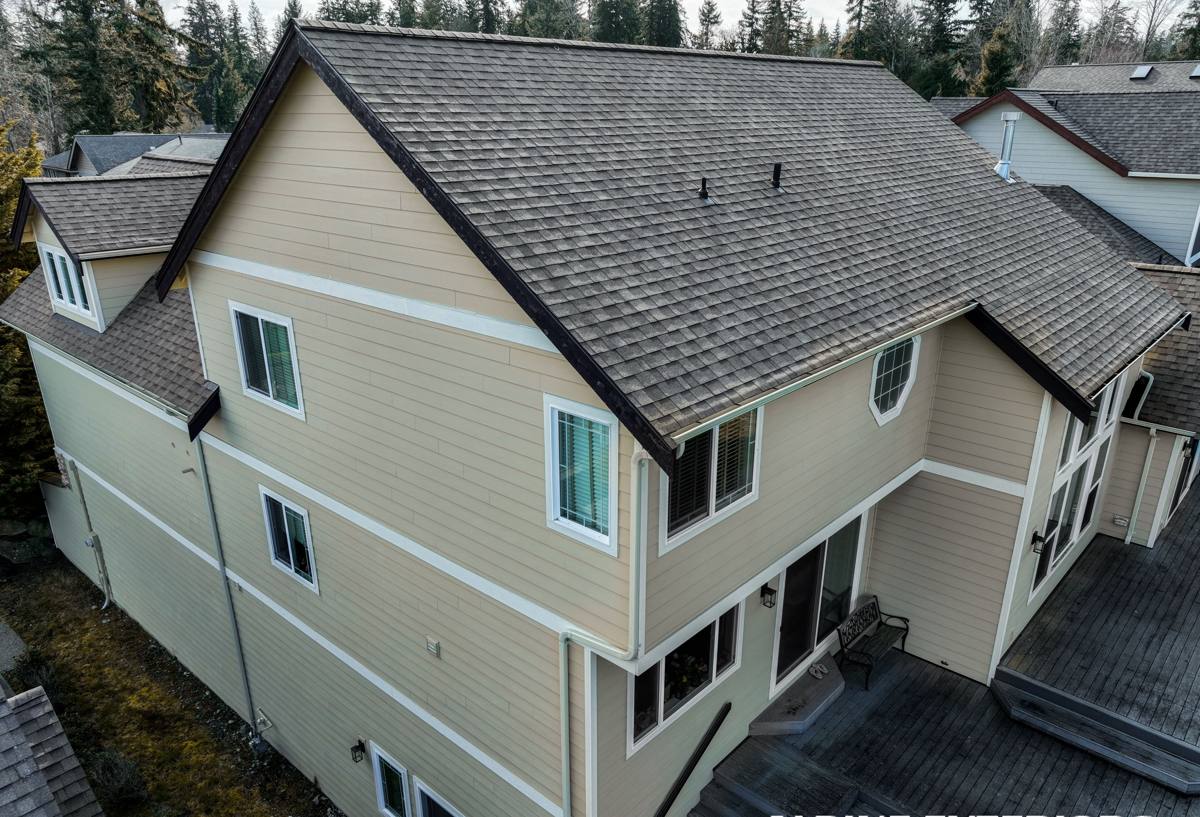
What Bellingham's Climate Does to Ordinary Windows
Driving Rain and Wind-Driven Moisture
Storms coming off the Strait and the Sound don't just drop rain straight down — they push it sideways into window assemblies. Ordinary flashing details or aging caulk lines that would hold up in a drier climate get tested repeatedly here, and it's usually the flashing and integration with the wall assembly, not the glass itself, that fails first.
Moss and Prolonged Moisture Contact
Bellingham's long wet season keeps humidity and shade conditions favorable for moss and algae growth for much of the year. On window sills, tracks, and lower frame edges, that translates into organic growth holding moisture against the material far longer than a quick rain-then-dry cycle would allow. Wood components without a properly maintained finish are especially vulnerable; even vinyl and fiberglass tracks need periodic clearing so water has somewhere to drain instead of sitting.
Salt Air and Corrosion
Proximity to the bay means airborne salt reaches hardware, screens, and metal components over time. Cheaper fasteners, hinges, and balance mechanisms corrode faster in this environment, which is one reason we pay attention to hardware specs and not just the glass package when we spec a window for this area.
What "Energy-Efficient" Actually Means for a Window
The term gets used loosely, so it's worth being specific. A genuinely efficient window for this region is judged on a handful of measurable factors, all listed on the NFRC label that should come with any legitimate window product:
- U-factor — how well the window resists heat flow; lower is better for our heating-dominated climate
- Solar Heat Gain Coefficient (SHGC) — how much solar heat passes through; matters more on south and west exposures
- Air Leakage rating — how much outside air infiltrates around the sash and frame
- Condensation resistance — relevant given our humidity and temperature swings between inside and outside air
Beyond the label, the glass package matters. Double-pane windows with a low-E coating and an argon or krypton gas fill are the practical standard for this climate — triple-pane can make sense on north-facing walls or busy-street exposures where noise and extreme cold retention matter more, but it's not automatically worth the added cost on every elevation of every home.
Frame Material: What Holds Up Here
Frame material affects both energy performance and how the window ages in wet, salt-touched air. There's no single right answer for every home, but the trade-offs are consistent enough to lay out plainly.
| Material | Energy Performance | Behavior in Bellingham's Climate | Maintenance |
|---|---|---|---|
| Vinyl | Good; multi-chambered frames insulate well | Doesn't rot or corrode; handles moisture well | Low — occasional cleaning |
| Fiberglass | Very good; dimensionally stable, allows tighter seals | Excellent — resists warping and expansion from temperature swings | Low |
| Wood-clad | Good, especially with quality glass packages | Vulnerable at cladding seams and sills if finish isn't maintained; moss and moisture exposure add risk | Higher — periodic finish and seal checks |
| Aluminum | Weaker unless thermally broken | Prone to corrosion from salt air over time; conducts cold, contributing to condensation | Moderate to high |
For most Barkley homes we lean toward vinyl or fiberglass as the practical, lower-maintenance choice, and we'll say so plainly rather than steer someone toward a pricier option that doesn't suit the site. Wood-clad windows can still be the right call for a home where appearance or historic character matters, but we're upfront that it comes with a real maintenance commitment in this climate — that's a trade-off, not a defect in the product.
What a Correct Installation Actually Involves
The window unit itself is maybe half the job. The other half is how it's integrated into the wall — which is exactly where our siding background matters, because a window opening is part of the same weather-resistive envelope as the siding around it.
Flashing and Drainage
Proper installation means flashing the rough opening so any water that gets past the window sheds down and out, never behind the siding or into the wall cavity. This is the single most common point of failure we find on older installations — not the glass, the flashing detail.
Air and Water Sealing
Sealant and backer rod at the right joints, done correctly, keep wind-driven rain out without trapping moisture inside the wall assembly. Over-sealing is as much a problem as under-sealing — walls need to be able to dry.
Integration with Existing Siding
Every re-side or window replacement job involves cutting back and re-integrating siding, trim, and building paper or house wrap around the new unit. Done poorly, this creates a weak point that undoes the benefit of an otherwise good window. This is where a crew that does both siding and windows has an advantage over one that only touches glass and frames.
Our Process for a Barkley Window Project
- On-site assessment — we look at existing window condition, framing, current flashing, and any moisture or moss issues already present around openings
- Product recommendation — frame material, glass package, and grille or hardware options matched to the home's exposure and your budget, with honest trade-offs explained
- Installation — proper flashing, sealing, and siding integration, not just swapping glass into an old opening
- Walkthrough and cleanup — operation check on every window, site cleaned up, and a clear explanation of anything you should keep an eye on going forward
We give a written, itemized estimate before any work starts, and we're straightforward about what's driving the cost — there's no reason a homeowner should have to guess at that.
Why a Crew That Already Works in Barkley Matters
Barkley is a mix of housing ages and construction styles, which means window openings and existing detailing vary more than in a single-era subdivision. A crew that's worked in the neighborhood has already seen how the common framing and siding pairings here behave, what flashing shortcuts tend to show up on older installs, and how local permitting and inspection expectations run in the City of Bellingham. That familiarity shortens the assessment phase and reduces surprises mid-project — it's not a marketing point, it's a practical time and cost advantage.
It also matters for follow-up. If a seal needs attention two winters from now, or a question comes up about how a window is draining during a heavy rain event, you're calling a crew that's still local and still accountable, not chasing down an installer who's moved on.
Keeping New Windows Performing Over Time
Even a correctly installed, well-rated window benefits from basic upkeep in this climate. A short seasonal routine goes a long way:
- Clear debris and moss from sills, tracks, and weep holes so water can drain freely
- Rinse salt residue from hardware and screens a couple times a year, especially on bay-facing elevations
- Check exterior caulk lines annually for cracking or separation and have gaps addressed before the wet season
- Operate each window periodically, even ones you don't open often, to keep hardware and weatherstripping functioning
- Watch for condensation between panes — it signals a failed seal on an insulated glass unit, not a cleaning issue
Getting an Honest Read on Your Windows
Not every home in Barkley needs a full window replacement — sometimes a few problem openings are driving most of the discomfort or the moisture issues, while the rest of the house is fine. We'll tell you which is which rather than pushing a whole-house replacement you don't need. If you're noticing drafts, fogging between panes, stuck sashes, or moisture and moss buildup around your window openings, we're glad to take a look and give you a straightforward, no-pressure estimate using the form below.