 Bellingham Siding
 Siding Built for the Puget Area's Weather, Not Just Any Weather
Homes in and around Puget deal with a specific combination of stresses that a lot of siding products simply weren't engineered for: salt-laden air drifting in off the water, wind-driven rain that gets pushed sideways into wall assemblies, and a moss and mildew season that can stretch for months at a time. Whatcom County's marine climate is mild compared to a lot of the country, but "mild" doesn't mean gentle on a house. Constant moisture cycling — wet, damp, wet again — is harder on siding than a hard freeze or a heat wave, because it never fully lets the material dry out and reset.
That's the lens we use on every Puget-area job: not "what siding looks good," but "what siding will still be doing its job in twenty years under these exact conditions." For us, that answer is James Hardie fiber cement, installed correctly, every time.
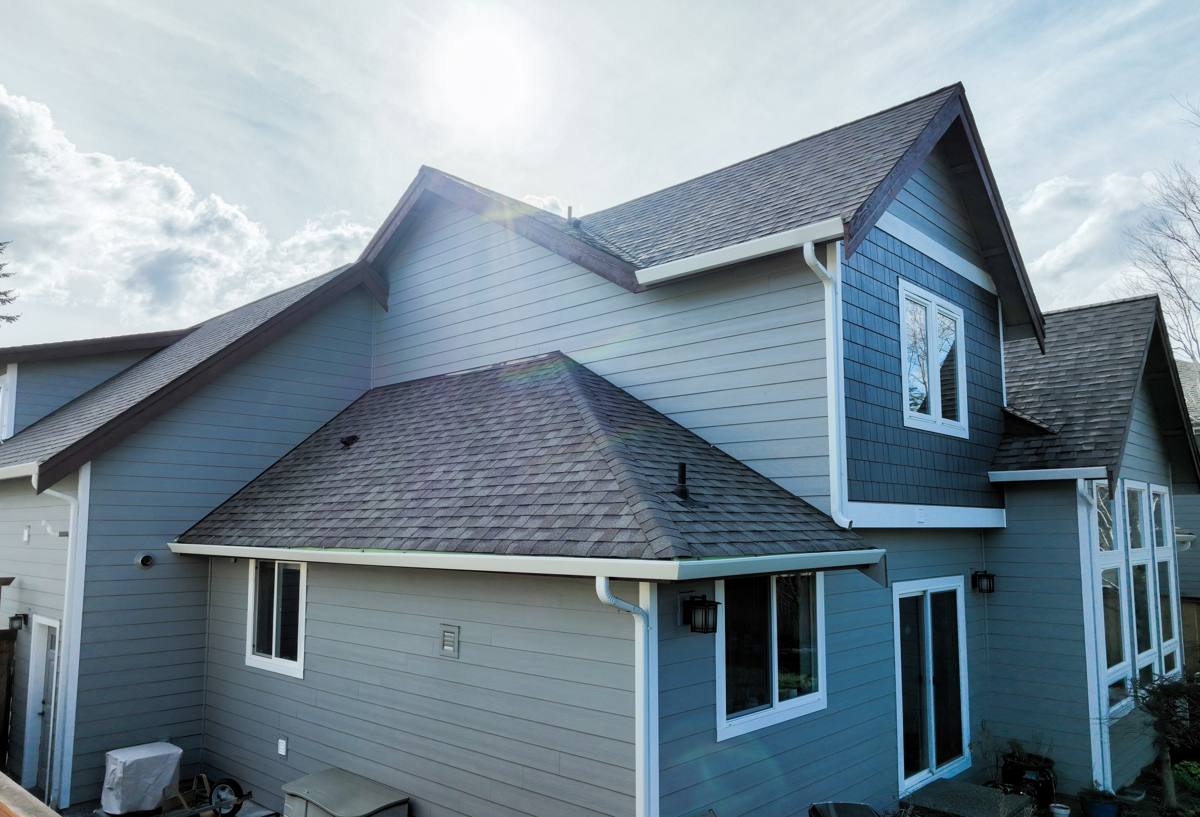
Why We Only Install James Hardie
We don't carry vinyl, LP SmartSide, primed spruce, cedar, or other fiber cement brands. That's a deliberate standard, not a lack of options. Vinyl softens, warps, and gaps over time as it heats and cools, and driving coastal rain finds every one of those gaps. Wood and wood-based composite siding need paint and caulk maintained on a strict schedule to keep moisture out — skip a cycle or two in a climate like this one and rot gets a foothold fast. Salt air also accelerates corrosion and finish breakdown on lower-grade trims and fasteners.
James Hardie fiber cement is cement, sand, and cellulose fiber — it doesn't rot, it isn't a food source for moss or mildew the way bare wood can be, and it holds paint and factory finish far longer than wood substrates. It's also non-combustible, which matters more each year as wildfire smoke and ember exposure become a bigger part of Pacific Northwest summers.
The HZ5 Product Line, Built for Zones Like Ours
James Hardie engineers its siding by climate zone, and the Pacific Northwest falls into the HZ5 category — formulated for regions with sustained damp weather and freeze-thaw cycling. That's a meaningful distinction: the same product installed in a dry inland climate is a different formulation than what goes on a home a few miles from saltwater. We install the HZ5 line specifically because it's engineered for the moisture load Puget-area homes actually see, not a generic national product.
What a Correct Installation Actually Involves
Fiber cement siding is only as good as the assembly behind it. A huge share of the "Hardie siding failed" stories you hear anywhere are actually installation failures — not product failures. In a climate that pushes rain sideways into walls, the details behind the boards matter as much as the boards themselves.
- A drainage plane (house wrap or building paper) installed and lapped correctly, shingle-style, so water sheds outward instead of tracking behind the siding
- A rainscreen gap where conditions call for it, so any moisture that does get behind the cladding can drain and dry instead of sitting against the wall
- Properly flashed windows, doors, and any horizontal trim or transition — the single most common source of hidden water intrusion
- Correct fastener type, spacing, and depth — over-driven or under-driven nails are a leading cause of premature siding problems
- Manufacturer-specified clearances at grade, roof lines, and decks, so siding never sits in standing water or gets buried under mulch and soil
- Factory-caulked and painted cut edges (ColorPlus edges) or properly primed and sealed field cuts, so raw fiber cement is never left exposed to weather
Where We See Existing Siding Fail Locally
On tear-offs and re-sides around Puget and greater Bellingham, the recurring problems aren't usually about the siding material chosen — they're missing or failed flashing at windows, siding installed tight to the ground or a deck with no clearance, and caulk joints that were never maintained. Salt air speeds up the breakdown of cheap caulk and unprotected fasteners specifically, which is part of why we spec corrosion-resistant fasteners and factory-finished products rather than field-painted alternatives wherever possible.
ColorPlus Factory Finish vs. Field Painting
James Hardie's ColorPlus finish is baked on at the factory under controlled conditions, with a warranty that covers the finish separately from the substrate. In a climate with this much sustained moisture and UV-and-rain cycling, that matters: a factory finish resists fading and peeling far longer than a job-site paint job applied on a schedule dictated by weather windows, not ideal cure conditions. We can install and field-paint primed Hardie panels when a project calls for a fully custom color, but for most Puget-area homes, ColorPlus is the lower-maintenance, longer-performing choice.
| Factor | Vinyl Siding | Wood / LP-Style Composite | James Hardie Fiber Cement |
|---|---|---|---|
| Moisture & salt air resistance | Weak seams trap moisture; can warp | Absorbs moisture; needs sealed finish maintained | Resists moisture; doesn't rot or swell |
| Moss / mildew susceptibility | Grows on surface, hard to fully clean | Can feed growth if finish fails | Cleanable surface, doesn't feed growth |
| Finish longevity | Color baked into material but chalks/fades | Paint typically needs attention every few years | ColorPlus factory finish holds significantly longer |
| Fire rating | Combustible | Combustible | Non-combustible |
| Typical lifespan when correctly installed | 20–30 years | 15–25 years, maintenance-dependent | 30+ years, maintenance-light |
How We Approach a Puget-Area Project
1. On-Site Assessment
We walk the exterior, check for existing moisture damage, look at current flashing and drainage details, and evaluate grade clearance and roof-wall transitions — the places local wind-driven rain causes the most trouble.
2. A Clear, Itemized Quote
You get a written scope covering product line, trim, house wrap or rainscreen approach, and any repair work uncovered during tear-off — not a vague per-square-foot number with unknowns buried in it.
3. Prep and Moisture Check
Old siding comes off, sheathing gets inspected for hidden rot before anything new goes on, and any damaged framing or sheathing is addressed and documented before we close the wall back up.
4. Installation to Manufacturer Spec
Drainage plane, flashing, fastener schedule, and clearances are installed to James Hardie's published requirements — the same requirements that keep their warranty valid.
5. Final Walkthrough and Warranty Registration
We review the finished work with you and register the installation so your material and finish warranties are properly on file.
Why a Crew That Already Works in Puget Matters
Siding installation isn't one-size-fits-all across Whatcom County. A crew that regularly works homes closer to the water already knows to plan for a higher moisture load, to double-check flashing details that get less scrutiny inland, and to expect a longer active moss season when scheduling maintenance conversations with homeowners. That's not marketing — it's the difference between a generic install and one tuned to what your specific wall assembly is going to face every winter. We also already understand Bellingham-area permitting norms and typical inspection expectations, which keeps a project moving instead of stalling on paperwork surprises.
Living With Hardie Siding in This Climate
James Hardie is genuinely low-maintenance compared to wood or vinyl, but "low-maintenance" isn't "no-maintenance," especially with a moss season this long. A little seasonal attention keeps it performing for decades.
- Rinse siding with a garden hose (not a pressure washer aimed directly at seams) once or twice a year to clear salt residue, pollen, and organic buildup
- Keep gutters clear so overflow doesn't run down the face of the siding repeatedly in one spot
- Trim back plants and shrubs so siding gets airflow and isn't sitting in constant shade and dampness
- Watch caulk joints at trim, windows, and butt joints — recaulk before a joint fully opens up, not after
- Address any moss or algae growth early with a gentle wash rather than letting it establish and hold moisture against the surface
- Have flashing and clearances checked periodically, especially after major storms with sustained wind-driven rain
Warranty and Long-Term Value
James Hardie backs its fiber cement products with a non-prorated limited warranty, and ColorPlus finishes carry their own separate finish warranty — both are transferable to a future owner if you sell, which is a real selling point in a market where buyers are increasingly asking about siding age and condition. That warranty coverage depends on installation meeting manufacturer specifications, which is exactly why the details covered above aren't optional extras — they're what keeps the coverage valid if you ever need it.
If your Puget-area home's siding is showing its age — fading, soft spots, persistent moss, or gaps that let daylight or draft through — we're happy to take a look and give you a straightforward, no-pressure estimate on what a correctly installed James Hardie system would look like for your house. Use the form below to get started.