 Bellingham Siding
 Why Cordata Roofs Take a Different Kind of Beating
Cordata sits close enough to Bellingham Bay and the Salish Sea that homes here deal with a mix most inland Whatcom County neighborhoods don't get in the same combination: salt-laden air, wind-driven rain off the water, and a moss season that can run eight months or longer under the tree cover common to this part of the county. None of those things alone will ruin a roof overnight. Together, over years, they change what "correct" asphalt shingle roofing actually means for a Cordata house compared to a roof going on somewhere dry and inland.
Salt air accelerates corrosion on exposed metal — nail heads, flashing edges, vent housings, gutter fasteners. Driving rain finds every gap in a lap or flashing detail that would never leak in a light, straight-down shower. And moss doesn't just look bad; it holds moisture against the shingle surface and works its way under tabs and around fasteners, which is where most premature failures on older Bellingham roofs actually start. A shingle roof built without those three factors in mind will often look fine for a few years and then fail early, right around the time the workmanship warranty runs out.
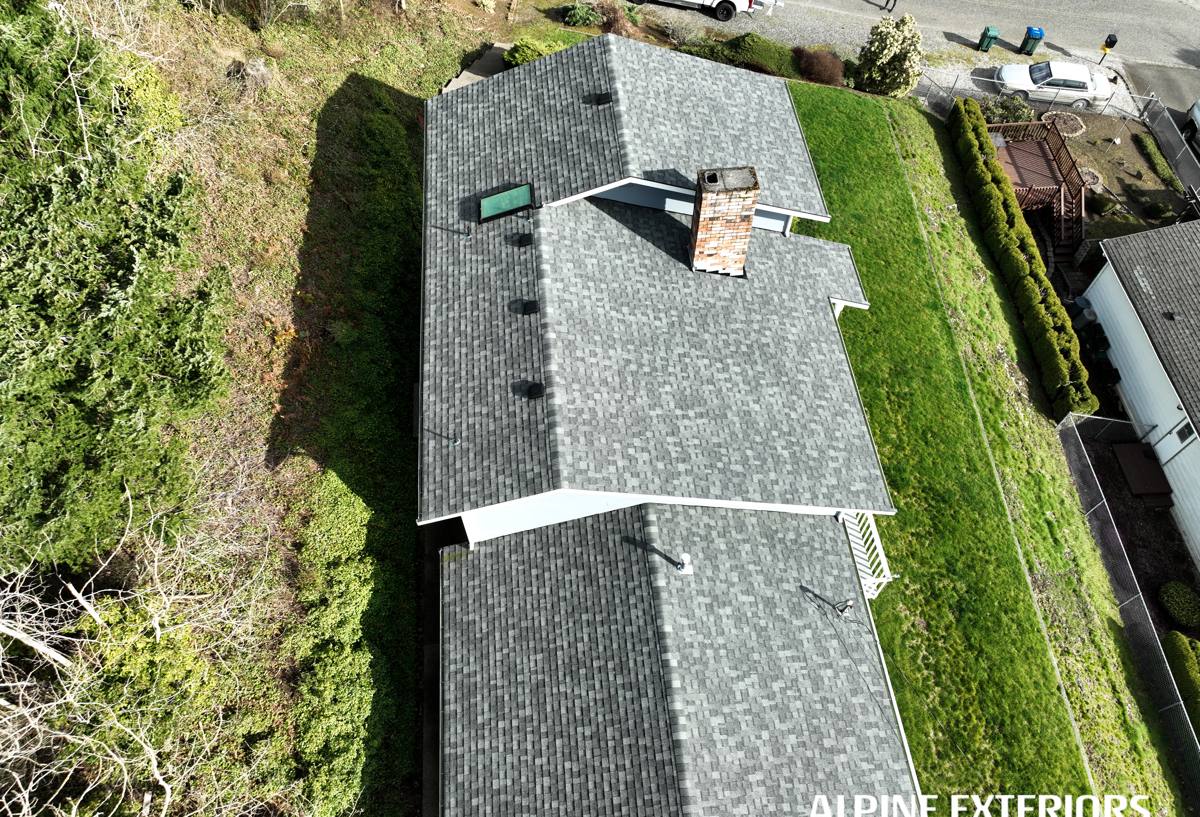
What a Correct Asphalt Shingle Roof Involves Here
Asphalt shingles themselves are a mature, well-understood product. The difference between a roof that lasts and one that doesn't almost never comes down to the shingle brand — it comes down to what's underneath and around it. In Cordata's climate, four details matter more than they would in a milder location.
Underlayment and Ice-and-Water Protection
A synthetic underlayment rated for high wind-driven rain exposure belongs on every Cordata roof, not just the parts code technically requires. Self-adhered ice-and-water membrane at eaves, valleys, and around every roof penetration gives a second line of defense when wind pushes rain sideways under the shingle tabs — which happens regularly during Whatcom County's fall and winter storm systems.
Ventilation That Actually Balances
Intake at the eaves and exhaust at the ridge need to work as a matched pair. Get this wrong and you trap moisture in the attic, which condenses, soaks the sheathing from underneath, and rots a roof from the inside — a failure mode that has nothing to do with the shingle warranty and everything to do with how the roof was built. Given how much of the year is damp here, ventilation isn't optional detailing; it's core to the system.
Flashing That's Formed, Not Caulked
Step flashing at walls and chimneys, counterflashing, and properly woven or metal valleys keep water moving off the roof instead of finding a seam. Caulk is a maintenance item, not a flashing strategy — any roof leaning on sealant instead of properly lapped metal is going to leak again, usually within a few seasons, once that bead breaks down in the sun and salt air.
Fastening for Wind and Corrosion
Correct nail placement (not staples, not overdriven or underdriven nails) and corrosion-resistant fasteners matter more this close to the water. Standard fasteners can start showing rust streaks through the shingle within a handful of years in a salt-air exposure; hot-dip galvanized or better hold up far longer.
Signs a Cordata Roof Needs a Closer Look
Most roof problems give warning signs well before a leak shows up inside the house. Worth checking a couple times a year, especially after the wetter months:
- Moss visible along ridges, in valleys, or on the north-facing slope
- Granules collecting in gutters or at downspout outlets
- Shingle tabs curling, cupping, or lifting at the edges
- Dark streaking across the roof surface (algae staining, not just dirt)
- Soft or spongy spots when walking the roof for inspection
- Daylight or damp insulation visible in the attic
- Rust streaking around nail heads or flashing
- Interior water stains after a heavy wind-and-rain event
Any one of these on its own might just mean routine maintenance. Several at once usually means it's time for a real inspection before a small problem becomes a full tear-off.
Choosing the Right Shingle for This Climate
Not every asphalt shingle tier is built the same, and the right choice depends on how exposed the roof is to wind, rain, and shade. Here's how the common tiers compare for a Cordata application:
| Shingle Type | Typical Lifespan Range | Wind Rating | Best Fit |
|---|---|---|---|
| 3-Tab (economy) | 15-20 years | Lower wind rating | Budget-driven jobs, low wind exposure |
| Architectural / Dimensional | 25-30 years | Higher wind rating | Most Cordata homes; better water-shedding profile |
| Algae-Resistant (AR) | 25-30 years | Same as base tier | Shaded lots, north-facing slopes, moss-prone areas |
| Impact-Resistant (Class 4) | 30+ years | Highest wind rating | Homes wanting maximum durability and potential insurance credit |
For most Cordata properties, an architectural shingle with algae-resistant granules is the practical middle ground — the added upfront cost over a basic 3-tab is modest, and it directly addresses the moss-and-algae exposure that's part of living this close to the Bay under tree cover. Class 4 impact-rated shingles are worth discussing if the property has had hail or falling-debris damage in the past, or if the homeowner wants the longest realistic service life.
Moss, Algae, and the Long-Term Maintenance Reality
No shingle — algae-resistant or not — makes a roof maintenance-free in this region. Copper or zinc control strips at the ridge help suppress regrowth over time, and keeping nearby tree limbs trimmed back reduces both shade and the leaf litter that feeds moss. Gutters need to stay clear so water isn't sitting against the eaves. None of this is complicated, but it does need to happen on a schedule, and it matters more here than it would in a drier climate where moss simply isn't a factor.
Pressure washing a shingle roof is not the answer — it strips granules and shortens the shingle's life. Soft washing with the correct solution, done carefully and infrequently, is the appropriate way to knock back moss and algae growth without damaging the roof surface.
Our Process, Start to Finish
- On-site inspection — we look at the roof, the attic ventilation, flashing condition, and decking, not just the shingles from the ground.
- Written estimate — a clear scope covering tear-off, underlayment, flashing, ventilation, and shingle selection, so there's no guessing what's included.
- Tear-off and decking check — old material comes off down to the sheathing, and any soft or damaged decking gets replaced before anything new goes down.
- Underlayment and flashing — ice-and-water membrane at vulnerable areas, synthetic underlayment across the field, new step and counterflashing where needed.
- Shingle installation — installed to manufacturer nailing specs, with attention to exposure and alignment.
- Ventilation confirmation — intake and exhaust checked and corrected if the existing setup was undersized or unbalanced.
- Cleanup and final walkthrough — magnetic sweep for stray fasteners, debris hauled off, and a walk of the finished roof together.
Cost Factors for a Cordata Roofing Project
Every roof is different, but the same handful of factors drive most of the cost variation between two houses of similar size:
| Factor | Why It Matters |
|---|---|
| Roof size and pitch | Steeper roofs take longer and require more safety equipment and labor |
| Number of existing layers | Tear-off of multiple old layers adds disposal and labor time |
| Decking condition | Rotted or soft sheathing needs replacement before new shingles go down |
| Shingle tier chosen | 3-tab, architectural, algae-resistant, and impact-rated all price differently |
| Flashing and penetrations | Chimneys, skylights, and multiple valleys add detail work |
| Ventilation upgrades | Adding or correcting intake/exhaust vents is often worth the added cost long-term |
| Access and site conditions | Trees, tight lot lines, or difficult staging can affect labor time |
We give a written, itemized estimate before any work starts, so a homeowner can see exactly what's driving the number rather than getting a single lump figure.
Why Hiring a Crew That Already Works Cordata Matters
A roofing crew that regularly works this part of Bellingham already knows which details of a shingle installation actually matter for this exposure — not from a manual, but from having seen what fails and why on roofs a mile away. That means starting with the right underlayment spec, the right fastener material, and a ventilation plan sized correctly the first time, instead of learning it the hard way on someone's house. It also means being reachable locally for warranty questions or a post-storm check, rather than dealing with a crew that was in the area for one job and is gone.
Whatcom County's building department and local suppliers are also easier to work with when a contractor has an established relationship with both — permitting moves faster, and material availability for the specific underlayment and flashing details this climate calls for isn't a guessing game.
Get a Straight Answer on Your Roof
If you're weighing a repair against a full replacement, or just want an honest read on how much life is left in a Cordata roof, we're happy to take a look. Estimates are free, there's no pressure to sign anything on the spot, and you'll get a clear written scope of what your roof actually needs — use the form below to get started.