 Bellingham Siding
 Why Siding Fails Faster in Puget Than in Most of the Country
Homes in the Puget area sit in a climate that punishes siding in three ways at once, and most siding materials were never engineered to handle all three together. There's the salt air carried in off the water, which accelerates corrosion of fasteners and metal trim and slowly breaks down cheaper coatings. There's driving, wind-pushed rain — not the gentle vertical rain siding manufacturers assume in their lab testing, but rain that gets pushed sideways into laps, seams, and trim joints. And there's a long moss and algae season, stretching from fall through spring, fed by shade, humidity, and surfaces that stay damp for days at a time.
Any one of those is manageable. Together, they expose weak points in a siding system fast — usually within a few years on products that weren't built for coastal Pacific Northwest exposure, or that were installed without the details this climate demands. A siding job that would hold up fine in a dry inland climate can start failing visibly in Puget well before it should.
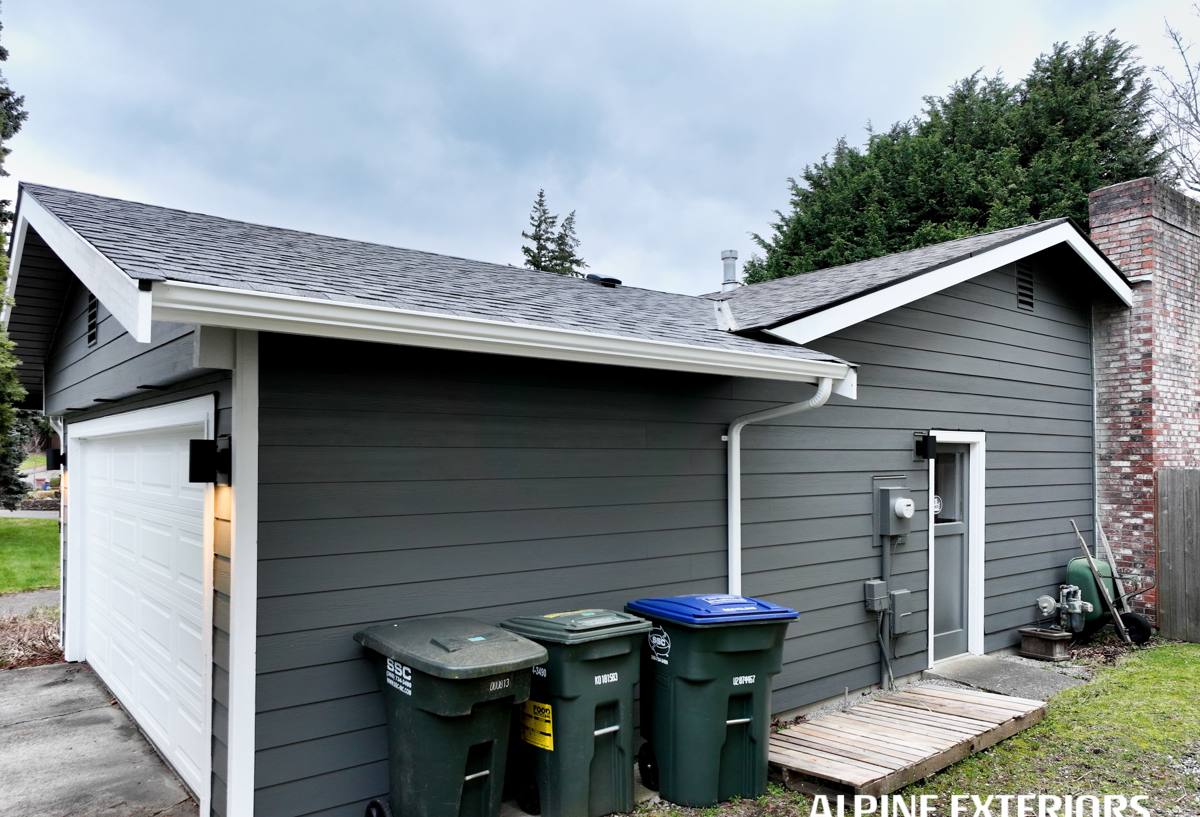
What "Correct" Fiber Cement Siding Looks Like in This Climate
Fiber cement is a good match for Whatcom County's climate on paper — it doesn't rot, it doesn't feed mold and moss the way wood fibers do, and it holds paint far longer than most alternatives. But "fiber cement" isn't a single product with one install method. What makes it perform here comes down to specification and detail work, not just the material itself.
The specification has to match the exposure
James Hardie engineers its siding into climate-specific HZ product lines. For a house exposed to Puget's damp, marine-influenced air, the HZ5 specification — engineered for wetter, more humid climates — is the right baseline, not a generic all-climate panel. Using the correct HZ line affects how the product resists moisture-related expansion and how well it holds its finish over time.
The details matter more than the panel
Most fiber cement failures we get called out to inspect aren't failures of the material — they're failures of installation detail: missing or undersized flashing above windows and doors, panels nailed too tight to allow for movement, caulked joints where a drainage gap should have been left, or siding installed directly against a wall assembly with no way for incidental moisture to escape. In a dry climate those shortcuts might not show up for a decade. In Puget, with driving rain and constant humidity, they show up in two or three years as staining, swelling at the joints, or paint that's bubbling from behind.
Why This Company Installs Only James Hardie
We don't install LP SmartSide, vinyl, Cemplank, Allura, or primed wood siding — not because those products have no legitimate use, but because we standardized on one system we can install to spec, warranty confidently, and stand behind on every job in this climate. James Hardie's fiber cement is non-combustible, its ColorPlus factory finish is baked on under controlled conditions rather than field-applied with a brush in variable weather, and the HZ engineering gives us a product line actually built for marine exposure like Puget's. That combination — material, factory finish, and a transferable warranty backed by a manufacturer with decades in this exact climate zone — is why it's the only siding we put on homes.
That doesn't mean other products are without merit. Vinyl is inexpensive and low-maintenance in mild, dry climates. Engineered wood products like LP SmartSide perform well when moisture is controlled and maintenance is kept current. But installing a wide range of products means spreading expertise thin, and in a climate as unforgiving as this one, we'd rather be excellent at one system than adequate at five.
How the main options compare for this climate
| Material | Moisture resistance in salt air / driving rain | Moss & algae resistance | Finish longevity | Typical lifespan here |
|---|---|---|---|---|
| James Hardie fiber cement (HZ5, ColorPlus) | Strong when installed to spec | Good — doesn't feed on organic fiber | Factory-cured finish, resists fading | 30+ years with normal upkeep |
| Vinyl siding | Fair — can warp or crack in temperature swings, seams trap moisture | Moderate — surface growth is common in shade | Color is molded in but fades and chalks over time | 15-25 years, shorter in coastal exposure |
| LP SmartSide / engineered wood | Moderate — vulnerable at cut edges and joints if not maintained | Requires diligent upkeep to prevent moisture intrusion | Field-painted, needs recoating on a schedule | Varies widely with maintenance |
| Primed cedar / spruce | Weakest — absorbs moisture, prone to swelling and rot | Poor — organic material feeds moss and mildew | Needs repainting every few years | Shortest, especially near the water |
Our Installation Process for Puget Homes
The process is the same discipline we apply everywhere, but the details we pay closest attention to are shaped by what this specific climate does to a house.
- Wall assessment. Before any siding comes off, we check the sheathing and framing underneath for moisture damage, especially around window and door openings where driving rain finds its way in over time.
- Weather-resistive barrier and drainage plane. We install a proper water-resistive barrier and, where the wall assembly calls for it, a drainage gap so any moisture that gets behind the siding has somewhere to go instead of sitting against the panel.
- Flashing at every penetration. Windows, doors, hose bibs, light fixtures — anywhere the wall is interrupted gets flashed correctly. This is the single most common place we find prior installation shortcuts on other homes.
- Correct HZ5 panel installation. Panels and trim are installed with the fastening pattern and clearances Hardie specifies for this climate zone — including gaps at butt joints and ground clearance to keep splashback and standing moisture away from the bottom course.
- ColorPlus finish handling. Because the finish is factory-applied, field touch-up is minimal, but any cut edges are sealed with the manufacturer's specified edge treatment to protect against moisture wicking.
- Final walkthrough. We check caulking, trim, and flashing details before calling the job done — this is where a rushed install shows itself, and where we don't cut corners.
Maintenance in a Salt Air, Moss-Prone Climate
Fiber cement is low-maintenance compared to wood, but "low-maintenance" isn't "no-maintenance" in this environment. A short annual routine keeps a correctly installed system performing for decades.
- Rinse siding once or twice a year with a garden hose to clear salt residue and organic buildup, especially on shaded or north-facing walls.
- Keep gutters clear so overflow doesn't run down the siding face and feed moss growth at the top courses.
- Trim back vegetation and tree limbs that keep siding shaded and damp — moss needs both shade and moisture to take hold.
- Inspect caulking at trim joints and penetrations once a year; recaulk before gaps let moisture behind the panel.
- Watch for soft spots, staining, or bubbling paint near the ground line, which usually means splashback moisture is getting trapped.
- Avoid pressure-washing directly into laps and seams — a wide fan tip and moderate pressure protect the joints.
Signs Your Current Siding Is Losing the Fight
If you're not sure whether your siding still has years left in it or is quietly failing behind the surface, a few signs are worth taking seriously in this climate:
- Persistent moss or dark streaking that comes back within weeks of cleaning
- Paint that's peeling, bubbling, or chalking heavily, especially on walls facing prevailing wind and rain
- Soft or spongy spots when pressed, particularly near the bottom courses or below windows
- Visible gaps opening at seams, corners, or trim boards
- A musty smell or moisture staining on interior walls that share an exterior wall with problem siding
Any of these can mean moisture has already gotten past the surface. Catching it early is the difference between a siding replacement and a siding-plus-sheathing repair.
Why a Crew That Already Works in Puget Matters
Correct fiber cement installation isn't a generic skill — it's shaped by the specific conditions of the wall it's going on. A crew that regularly works in Puget and the greater Bellingham area already understands which walls take the worst of the wind-driven rain off the water, where moss pressure is highest under tree cover, and how salt air affects fastener and trim choices over time. That local pattern recognition means fewer surprises during tear-off, fewer callbacks for missed flashing details, and a job that's built for the specific way this neighborhood's weather behaves — not just the way siding behaves in a manufacturer's general climate zone map.
It also means familiarity with Whatcom County permitting and inspection expectations, so the project moves without avoidable delays.
What This Costs to Get Right
Fiber cement siding costs more upfront than vinyl and is comparable to or somewhat more than engineered wood, largely because of the material itself and the labor required to install it correctly — proper flashing, drainage details, and precise fastening take more time than a faster, lower-spec install. That upfront difference is offset by a finish that doesn't need repainting on a short cycle, resistance to moss and rot that keeps maintenance costs down, and a lifespan measured in decades rather than years. In a climate as hard on siding as Puget's, the cheaper install often costs more over the life of the house.
If you'd like an honest look at what your home's siding needs — no pressure, no inflated scope — we're happy to walk the exterior with you and put together a free estimate based on what we actually find, not a generic quote.