 Bellingham Siding
 Why Ferndale Decks Wear Differently Than Decks Inland
Ferndale sits close enough to the Salish Sea that homes here deal with a mix most inland Whatcom County properties don't: salty, moisture-laden air off the water, long stretches of driving rain that comes in sideways more often than straight down, and a shoulder season every year where everything shaded stays damp for weeks at a time. None of that is dramatic on its own. It's the combination, repeated year after year, that shortens the life of a deck that wasn't built or finished with this climate in mind.
Salt air accelerates corrosion on fasteners and hardware faster than people expect, even a few miles from the shoreline. Driving rain finds gaps in flashing and end-grain that a straight-down rain never would. And moss doesn't need much — a little shade, a little organic debris, a little standing moisture — to get established on decking boards, especially on the north or east side of a house where the sun doesn't reach in winter. A deck built the same way you'd build one in Spokane or Eastern Washington just won't hold up the same way here.
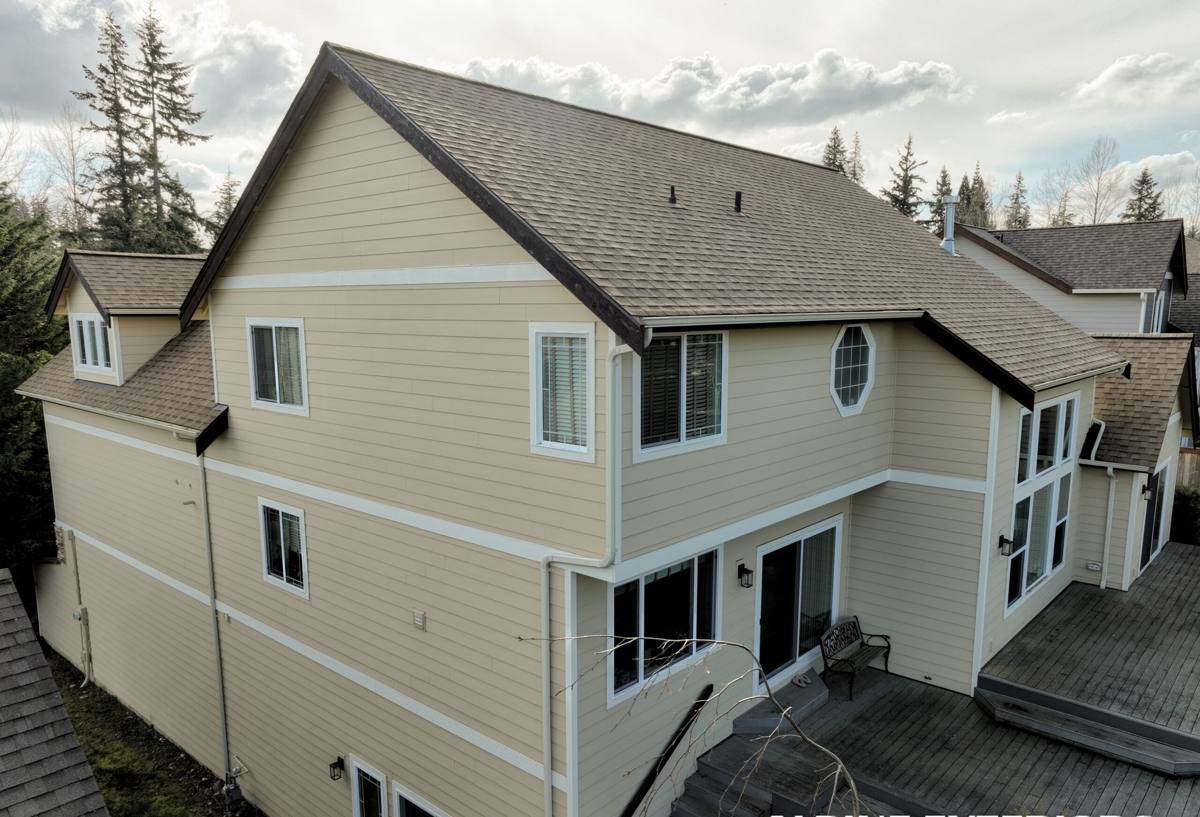
What Composite Decking Is Actually Good For in This Climate
The Wood Trade-Off
Wood decking isn't a bad material — it's a maintenance commitment. In a climate with this much sustained moisture, a wood deck needs regular cleaning, re-staining or sealing on a schedule, and an owner willing to catch soft or checked boards before they become a safety issue. Skip a season or two of upkeep here, and moss, graying, and surface checking show up faster than they would somewhere drier.
What Composite Changes
Composite decking swaps that maintenance schedule for an upfront material cost. The boards don't absorb water the way wood does, they don't need staining, and modern capped composites resist moss and mildew staining far better than bare wood ever will. That doesn't mean composite is maintenance-free — it still needs to be kept clean and it still needs a deck built correctly underneath it — but the day-to-day and season-to-season workload drops substantially, which matters to a lot of Ferndale homeowners who want a deck they can actually use instead of one they're constantly tending to.
The Part Homeowners Don't See: Substructure and Drainage
Framing and Ledger Attachment
Composite boards are only as good as what's underneath them. The ledger board attachment to the house, the joist spacing, and the flashing at the house connection all matter more in a wet climate than a dry one, because any water that gets behind the decking and can't drain or dry out will rot the framing long before the composite boards themselves show any wear. We spec joist spacing and blocking to the board manufacturer's requirements, not looser "it'll probably hold" spacing, because composite has different flex characteristics than wood and needs proper support to stay flat over time.
Joist Protection and Flashing
Every joist gets a protective tape or cap before decking goes down, and ledger flashing is detailed to shed water away from the house framing, not toward it. This is the step that gets skipped on rushed jobs and it's the step that causes the expensive, hidden problems — rotted rim joists and ledger connections — years down the line, well after the composite surface still looks fine.
Choosing the Right Composite Board
Not all composite decking performs the same way in a wet, moss-prone climate. The biggest distinction is whether the board is capped (a protective polymer shell wrapped around a wood-plastic composite core) or uncapped (the composite material exposed on all sides).
| Material | Moisture & Moss Resistance | Maintenance | Typical Lifespan Here |
|---|---|---|---|
| Untreated wood | Absorbs moisture; prone to moss staining in shade | Annual cleaning, periodic stain/seal | 10-15 years before major repair |
| Uncapped composite | Moderate; can absorb some surface moisture over time | Occasional cleaning | 15-20 years |
| Capped composite | Best resistance to moisture and moss staining | Periodic rinse/wash | 25+ years, manufacturer-warrantied |
For most Ferndale homes, especially decks with any tree cover or a north-facing exposure, we steer clients toward capped composite. The extra material cost up front buys meaningfully better resistance to the moss staining and moisture wicking that shows up first on uncapped boards.
How We Install It: Our Process on a Ferndale Job
- Site assessment — we look at drainage, sun/shade exposure, existing structure condition, and how the deck ties into the house before quoting anything.
- Demo and structural evaluation — if we're replacing an existing deck, we check the framing underneath before assuming it's reusable.
- Framing and flashing — joists, blocking, and ledger flashing are brought up to current spec, not just patched.
- Joist protection — tape or cap applied to every exposed joist surface before decking goes down.
- Board installation — hidden fastener systems where the board allows it, correct expansion gaps, and picture-frame or border detailing where the design calls for it.
- Railings and fascia — matched or complementary composite/aluminum railing systems installed to code.
- Final walkthrough — we go over basic care with the homeowner before we consider the job done.
Railings, Fascia, and Finish Details That Actually Hold Up
The railing and fascia are usually the first things people notice about a deck, and they're often where corners get cut. In a salt-air environment, hardware quality matters — stainless or coated fasteners rated for coastal exposure outlast standard galvanized hardware, which can start showing rust streaks within a few seasons this close to the water. We also pay attention to how fascia boards are fastened and vented, since trapped moisture behind fascia is a common spot for hidden rot to start.
Composite and aluminum railing systems both hold up well here; the right choice usually comes down to the look the homeowner wants and how it pairs with the siding and trim on the house, not a performance gap between the two.
Moss and Mildew: What Actually Works Here
Even a well-built composite deck will get some surface growth if it sits shaded and damp long enough — the difference is how easily it comes off and how much it actually damages the material. A simple, honest maintenance routine keeps a composite deck looking right for its full service life:
- Sweep debris — leaves, needles, seed pods — off the deck regularly, especially in fall, so organic matter doesn't sit and hold moisture against the boards.
- Rinse the deck a couple of times a year with a garden hose and a stiff (non-metal) bristle brush; pressure washers should be used carefully and at a wide fan setting, not close-range, to avoid damaging the cap surface.
- Use a cleaner made for composite decking if moss or mildew staining does show up — avoid bleach-heavy products that can dull the board's finish over time.
- Check that gaps between boards stay clear so water can actually drain through rather than pooling.
- Trim back overhanging branches where possible to cut down on both debris and shade.
Cost Factors for a Ferndale Composite Deck
Every deck project is different, but the same handful of factors drive most of the price difference between jobs. Installed composite decking in this region commonly runs somewhere in the broad range of $35–$75 per square foot depending on the factors below — treat that as a general planning range, not a quote.
| Factor | Why It Matters |
|---|---|
| Board tier (uncapped vs capped) | Capped boards cost more upfront but resist moisture and moss staining better |
| Substructure condition | Rotted or undersized existing framing needs to be repaired or replaced before decking goes on |
| Deck size and shape | Complex layouts, angles, and multiple levels add labor and material waste |
| Railing style | Cable, glass, and custom railing systems cost more than standard baluster designs |
| Site access | Difficult access for material delivery or old-deck removal adds labor time |
| Permitting | Deck height, size, and attachment to the house may require a permit and inspection |
Why Hire a Crew That Already Works in Ferndale
A contractor who works this area regularly already knows how Whatcom County's permitting process handles deck attachments and railing height requirements, what kind of drainage and framing problems tend to show up on homes with this region's rainfall pattern, and how much shade and moisture a given lot is realistically going to deal with based on its orientation and tree cover. That local familiarity shows up in fewer surprises mid-project — not because someone from farther away couldn't do competent work, but because a crew that's already built and repaired decks in this specific stretch of Whatcom County has already worked through the local quirks once.
It also matters for warranty follow-through. Composite decking manufacturers back their products with material warranties, but the installation itself needs to meet their specifications for those warranties to hold — a contractor who's installed the same board systems repeatedly in this climate knows those specs cold, rather than learning them job to job.
If you're planning a composite deck in Ferndale, we're happy to walk the site, look at what's there now, and put together a straightforward estimate — no pressure, no upsell, just an honest look at what your deck actually needs. Use the form below to get started.