 Bellingham Siding
 Fairhaven Decks Work Harder Than Decks Inland
Fairhaven sits close to the water, and that changes what a deck has to survive year after year. Homes just a few miles inland in Bellingham still deal with the Pacific Northwest's wet season, but Fairhaven adds salt-laden air, wind-driven rain that gets pushed sideways onto vertical surfaces, and heavy shade from mature trees and hillside lots that keeps everything damp longer than it should be. A deck built without that specific combination in mind tends to show problems early — soft spots, green film, corroding hardware, boards that cup or crown before their time.
We build and replace decks throughout Bellingham and Whatcom County, and the decks we service in Fairhaven consistently need a different set of decisions than decks in drier, more open parts of the county. This page walks through what that actually means: the material choice, the build details that matter most, what a fair project costs to budget for, and how to keep a composite deck looking right for decades in this specific environment.
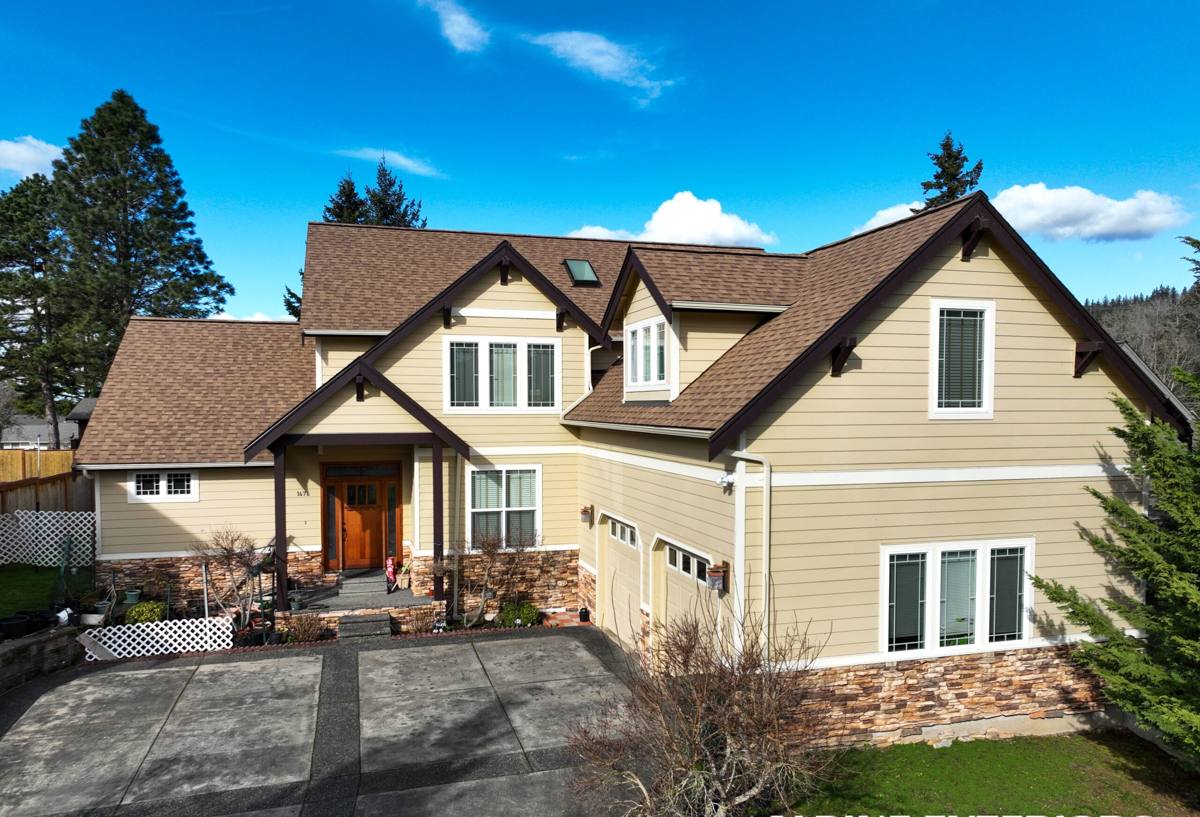
What Salt Air, Rain, and Moss Actually Do to a Deck
It helps to understand the failure modes before talking about the fix.
Salt Air and Metal Hardware
Airborne salt accelerates corrosion on any exposed metal — screw heads, joist hangers, structural brackets, railing hardware. Standard hardware can start showing rust streaks within a couple of seasons this close to the water. Once a fastener corrodes, it weakens, and a weakened fastener in a deck's structural connections is not a cosmetic issue.
Driving Rain and Hidden Moisture
Rain that comes in at an angle gets past gaps and laps that would keep a dry-climate deck fine. It works into ledger board connections, under poorly flashed rim joists, and into end grain on any wood that's exposed. Moisture that gets trapped instead of draining is what causes rot in the framing underneath a deck — long before the surface boards show any sign of trouble.
Moss and Organic Growth
Whatcom County's long wet season and Fairhaven's shaded lots are close to ideal conditions for moss, algae, and mildew. On a wood deck, moss holds moisture directly against the board surface and accelerates decay. On any decking surface, moss buildup in the board grooves or between boards also makes the surface slick — a real slip hazard on stairs and landings.
Why Composite Decking Fits This Climate
Composite decking — boards made from a blend of wood fiber and recycled plastic, most with a protective outer layer called a capstock — was developed specifically to resist the things that wear out wood: moisture absorption, rot, splintering, and UV fading. That makes it a strong fit for a marine-influenced climate like Fairhaven's, where a wood deck's maintenance burden (annual sealing, sanding, spot-treating mildew) gets steeper than it does in drier regions.
That doesn't mean every composite board performs the same way, and it doesn't mean composite decking eliminates the need for a well-built substructure. The board is only as good as what's under it — more on that below.
Composite Decking: Board Tiers Compared
| Tier | Typical Construction | How It Handles Fairhaven's Climate | Trade-Offs |
|---|---|---|---|
| Uncapped composite | Wood fiber and plastic blended throughout, no protective outer layer | Still moisture-resistant, but the exposed surface can absorb some water and is more prone to mold staining in constant shade and damp | Lower upfront cost; shorter realistic lifespan in this climate |
| Capped composite | Composite core wrapped in a plastic capstock layer | Capstock sheds water and resists staining and moss growth far better on shaded, damp lots | Higher upfront cost; the better fit for most Fairhaven properties |
| PVC / cellular PVC | Fully synthetic, no wood fiber | Essentially immune to moisture absorption and rot; performs well in constant dampness | Highest cost; can feel and flex differently underfoot than wood-fiber composite |
For most Fairhaven homes we recommend capped composite as the balance point — it holds up to the moss and moisture exposure without the full PVC price jump. On decks with heavy shade, minimal airflow, or direct salt spray exposure, we'll walk through whether PVC is worth the upgrade for your specific site.
What a Correctly Built Composite Deck Involves
The decking board is the part you see, but it's a small piece of what determines whether the deck holds up. In this climate, the details below are where a deck earns its lifespan or loses it.
Framing and Fasteners
We use stainless steel or heavily coated, marine-rated fasteners and hardware for anything within reach of salt air — not the standard galvanized hardware that's fine further inland. Joist hangers, ledger bolts, and structural screws all get the same treatment.
Ledger Board Flashing
Where the deck attaches to the house, proper flashing keeps water from working its way behind the siding and into the wall framing. This is one of the most common failure points on older decks we're asked to replace — it's invisible until it isn't.
Joist Protection
Composite boards don't rot, but the wood joists underneath them still can if water sits on top of the joist. Joist tape over the top of every joist sheds water away from the wood and dramatically extends the substructure's life — cheap insurance against the region's rain volume.
Drainage and Airflow
Low-clearance decks and decks built tight against grade trap moisture underneath, which is exactly what moss and mold need. We grade for drainage away from the foundation and build in enough clearance and ventilation for the underside to actually dry out between storms.
Fastening Method
Hidden fastener systems keep the deck surface free of exposed screw heads, which means fewer places for moss to gain a foothold and a cleaner surface to keep clear of algae film.
Our Process, Start to Finish
- On-site assessment. We look at sun exposure, shade patterns, drainage, existing structure condition (if it's a replacement), and how close the deck sits to salt air exposure.
- Material recommendation. Based on that assessment, we recommend a board tier and layout — not a one-size answer for every lot.
- Written estimate. Clear scope, materials, and price before any work starts. No surprise add-ons mid-project.
- Permitting. Most deck work in Bellingham and Whatcom County requires a permit depending on height and scope — we handle that process as part of the job.
- Demolition (if replacing). Old decking and, if needed, framing removed and hauled off.
- Structural build. Framing, flashing, joist protection, and hardware installed to the standard outlined above.
- Decking and railing install. Boards, fascia, and railing system installed per manufacturer specification to keep warranty coverage intact.
- Final walkthrough. We review the finished deck with you and go over basic care specific to your site's sun and shade conditions.
Cost Factors on a Fairhaven Composite Deck
| Factor | Why It Moves the Price |
|---|---|
| Deck size and shape | Square footage and complexity of the layout (multiple levels, angles, cutouts) both add labor |
| Board tier | Uncapped, capped, and PVC composite carry different material costs per square foot |
| Height and stairs | Elevated decks need more substructure, railing (often required by code above a certain height), and stair construction |
| Existing structure condition | Replacing decking only, versus rebuilding rotted framing underneath, changes scope significantly |
| Hardware and flashing upgrades | Marine-rated fasteners and full ledger flashing cost more than standard hardware but matter more here |
| Site access | Hillside or tight-access Fairhaven lots can add labor time for material staging and equipment |
Living With a Composite Deck in This Climate
Composite decking cuts the maintenance workload compared to wood, but "low-maintenance" isn't "no-maintenance" — especially with the moss pressure Fairhaven sees.
- Sweep or rinse the deck surface regularly during wet months to keep organic debris from sitting and feeding moss growth
- Clean board grooves and gaps between boards where moss and algae tend to establish first
- Trim back overhanging branches and vegetation to improve airflow and sun exposure where possible
- Check railing hardware and fastener points periodically for early corrosion, especially in the first couple of years
- Use a cleaner rated for composite decking rather than a wood deck cleaner or pressure washer on high setting, which can damage the capstock
- Keep gutters and downspouts near the deck clear so runoff isn't dumping directly onto or under the deck surface
Why a Crew That Already Works Fairhaven Matters
A contractor who mostly builds decks in drier parts of Whatcom County may default to standard hardware, standard flashing details, and standard board tiers — because that's what holds up fine where they usually work. On a Fairhaven lot with salt air exposure and heavy shade, those defaults leave a homeowner with a deck that needs real repair years before it should.
Working this neighborhood regularly means we've seen which decks in this specific environment hold up and which ones don't, and we build accordingly from the first framing decision rather than treating it as an afterthought. That's the difference between a deck that needs attention in year three and one that's still solid well into its second decade.
Get a Straight Answer for Your Property
Every lot in Fairhaven has its own mix of shade, wind exposure, and structural starting point, so the right build spec for your deck depends on seeing it in person. If you're planning a new composite deck or replacing one that's showing its age, we're happy to come take a look and put together a clear, no-pressure estimate — use the form below to get started.