 Bellingham Siding
 Why Columbia Roofs Take a Different Kind of Beating
The Columbia neighborhood sits close enough to Bellingham Bay that salt-laden air is a daily fact of life for anything on a rooftop — fasteners, flashing, vent boots, and the metal drip edge along your eaves. Add in the driving, wind-pushed rain that comes off the water during fall and winter storms, and you've got two forces working against a roof at the same time: corrosion from the air and water intrusion from wind-driven rain that doesn't behave like a straight-down shower. Then there's the moss. Whatcom County's mild, wet stretch from October through May gives moss and algae months to establish themselves on north-facing slopes and shaded sections, and a roof that's already compromised by storm damage gives moss an even easier foothold.
None of this means Columbia homes need exotic solutions. It means storm damage repair here has to account for what's actually happening to the roof between storms, not just patch the one spot that's leaking today. A repair that ignores the salt air and moss cycle tends to fail again within a season or two, which is the single most common callback we see on this side of Bellingham.
What Storm Damage Actually Looks Like
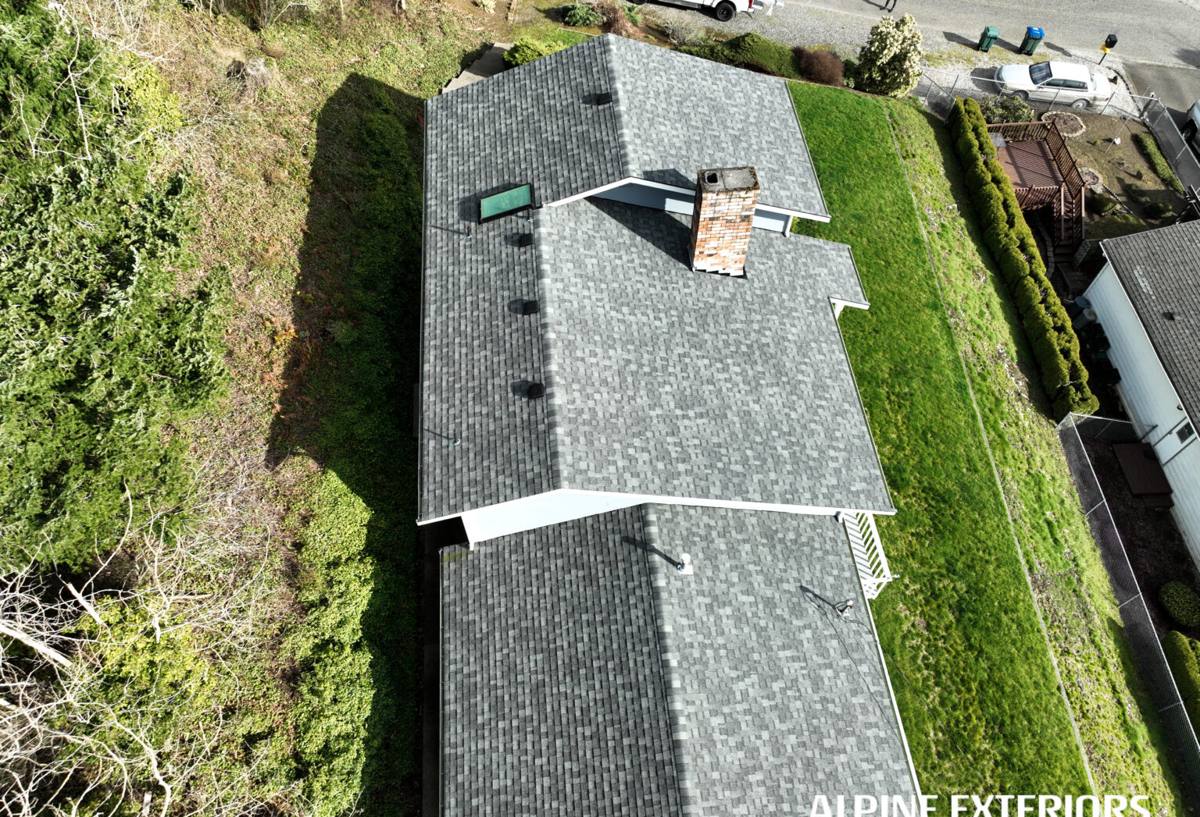
Storm damage isn't always a dramatic hole in the roof. Most of what we find during post-storm inspections in Columbia falls into a handful of categories:
- Wind-lifted or creased shingles — tabs that have been peeled back and re-sealed poorly, or creased so the seal is broken even though the shingle looks intact from the ground
- Flashing separation — around chimneys, skylights, and roof-to-wall transitions, where wind-driven rain finds the smallest gap
- Granule loss — heavy rain and hail-adjacent debris can strip the protective granules off asphalt shingles, leaving the underlying mat exposed to UV and moisture
- Debris impact — branches and cones from wind events can crack shingles or dent metal roofing without leaving an obvious hole
- Clogged or torn gutters — not roof damage itself, but a direct cause of water backing up under the roof edge during heavy rain
- Vent boot and pipe collar cracking — rubber boots degrade with age and salt exposure, then split open during a storm's temperature and moisture swings
A lot of these are only visible from the roof itself, which is why a ground-level look after a storm often misses the real damage. If your gutters overflowed during the last heavy rain or you noticed a new stain on a ceiling, that's usually enough reason to have someone actually get up there and look.
What a Correct Repair Involves
Separating today's damage from pre-existing wear
Before any repair starts, we distinguish between damage caused by the storm and wear that was already there. This matters for two reasons: it's the honest way to scope the job, and if you're filing an insurance claim, your adjuster is going to want the same distinction. A roof that was already twelve years into a twenty-year shingle life doesn't get replaced for free because of one storm — but the storm-caused damage still needs to be fixed correctly, not just tarped and forgotten.
Matching materials and structural integrity
A correct repair replaces damaged shingles, flashing, or underlayment with materials that match the existing roof's age, color, and manufacturer specification as closely as possible — mismatched shingles are a cosmetic problem now and a warranty problem later. Underneath, we check the decking itself. Wind and water damage that goes unnoticed for even a few weeks can soften plywood sheathing, and no amount of new shingles on top of soft decking will hold up through the next storm. If decking needs replacing, that gets addressed before anything else goes back on.
Our Process for Columbia Storm Repairs
- Inspection. We get on the roof (not just the ladder) and document every affected area — shingles, flashing, vents, gutters, and decking.
- Written scope and honest estimate. You get a clear breakdown of what's storm damage versus pre-existing wear, and what each part will cost.
- Temporary protection if needed. If there's active leaking, we get it weathertight first, even if the full repair is scheduled for a few days out.
- Repair work. Matching materials, correct flashing technique at every penetration and transition, and proper fastening for wind resistance.
- Final walkthrough. We show you what was done and why, in plain terms — not a jargon-heavy invoice.
We don't upsell a full roof replacement when a targeted repair will genuinely hold. We also won't tell you a patch job is fine if the roof is past the point where patching makes financial sense — that call gets made honestly, based on what we actually find.
Repair or Replace: The Real Cost Factors
Homeowners in Columbia often ask whether it's worth repairing an older roof after storm damage or if that's just delaying a bigger expense. There's no single right answer — it depends on the roof's age, how widespread the damage is, and what condition the decking is in underneath.
| Factor | Favors Repair | Favors Replacement |
|---|---|---|
| Roof age | Under 10-12 years, most of the material life remaining | Near or past the shingle's rated lifespan |
| Damage extent | Isolated to one slope or a few sections | Spread across multiple slopes or the whole roof |
| Decking condition | Solid, no soft spots found | Soft or delaminated sheathing found in multiple areas |
| Moss/algae history | Minimal, roof has been maintained | Heavy, long-term moss growth already degrading the surface |
| Cost | Typically a few hundred to a couple thousand dollars for a targeted repair | A full roof runs several thousand and up, depending on size and material |
If your roof is already showing granule loss across most slopes, or this is the second or third storm-related repair in a few years, that pattern usually points toward replacement being the more cost-effective path over time — not because repair is a bad option in general, but because you'd be paying to fix the same aging material repeatedly.
Materials That Hold Up in This Climate
Not every roofing product performs the same way under salt air and prolonged wet conditions. Our standard for Columbia jobs favors materials and details that are proven to handle this specific combination of exposure, rather than whatever is cheapest to install.
| Component | Our Standard | Why |
|---|---|---|
| Underlayment | Synthetic, fully sealed at seams | Better moisture resistance and durability than traditional felt under prolonged wet weather |
| Flashing | Corrosion-resistant metal, properly step-flashed at walls and chimneys | Standard metal flashing corrodes faster in salt-influenced air near the bay |
| Fasteners | Hot-dip galvanized or stainless where salt exposure is highest | Ordinary fasteners can rust and back out over time in coastal-influenced conditions |
| Vent boots | Reinforced rubber or metal-collar style | Standard rubber boots crack sooner with repeated wet-dry and temperature cycling |
We're not tied to one shingle brand, and we won't tell you a manufacturer's product is bad — most major asphalt shingle lines perform fine when installed correctly. What matters more than the brand name is installation detail: nailing pattern, flashing overlap, and ventilation. A well-installed mid-range shingle roof will consistently outlast a premium shingle roof that was installed with shortcuts.
Moss, Algae, and Long-Term Roof Health
Whatcom County's moss season is long enough that it deserves its own line item in any storm repair conversation. Moss holds moisture against the shingle surface, which accelerates granule loss and can lift shingle edges — exactly the kind of weak point that wind then exploits during the next storm. When we repair storm damage on a roof that already has moss growth, we address both: clearing growth from the repair area and, where it makes sense, recommending a broader moss treatment or zinc/copper strip installation to slow regrowth on shaded, north-facing sections. We don't push unnecessary moss treatments on every job — if the roof is clean and well-ventilated, we say so.
Insurance Documentation That Actually Helps
If you're filing a homeowner's insurance claim for storm damage, documentation quality matters more than most people expect. We provide dated photos of the damage, a written description tied to the specific storm event where relevant, and a scope of repair that separates storm-caused issues from pre-existing wear. This doesn't replace your own communication with your adjuster, but it gives you something concrete to work from instead of a vague verbal description. We're happy to walk a roof with an adjuster if that's useful to your claim.
Why a Crew That Already Works in Columbia Matters
Roof repair quality has as much to do with local knowledge as it does with technique. A crew that regularly works in the Columbia neighborhood already knows which roof styles and ages are common in the area, how the bay's salt air tends to show up first in flashing and fasteners rather than shingles, and how fast moss reestablishes on shaded slopes here compared to drier parts of the county. That familiarity shortens the inspection, sharpens the estimate, and means fewer surprises once work starts. It also means we're not learning Bellingham's weather patterns on your roof — we already know what a Whatcom County winter does to an under-maintained repair.
A Simple Post-Storm Checklist
After any significant wind or rain event, a quick check can catch problems before they turn into interior damage:
- Walk the yard and check for shingle granules collecting in gutters or downspout runoff
- Look for any new staining on interior ceilings, especially near chimneys or skylights
- Check gutters for debris buildup or sections pulling away from the fascia
- Note any visible shingle tabs that look lifted, curled, or missing from the ground
- Watch for daylight or water stains in the attic if you have safe access
- Call for an inspection before the next storm if anything looks off — small issues are far cheaper to fix than water-damaged decking or insulation
If it's been a while since your roof was checked, or you're not sure whether recent weather caused any damage, we're glad to take a look. Fill out the form below for a free, no-pressure estimate — we'll tell you honestly what we find, what needs fixing now, and what can wait.