 Bellingham Siding
 Birchwood's Climate Is Harder on Siding Than Most Homeowners Realize
Birchwood is a settled, tree-lined residential neighborhood in Bellingham, and that shade and greenery is part of what makes it a nice place to live — it's also part of what makes siding maintenance a real issue here. Whatcom County sits at the intersection of three things that are individually manageable but genuinely punishing in combination: salt-laced air off the Salish Sea, long stretches of driving, wind-blown rain, and a moss season that can run eight or nine months out of the year under tree cover. Siding that's rated for a generic "Pacific Northwest" climate on paper doesn't always hold up to that combination on a shaded lot with limited afternoon sun.
Homes in Birchwood tend to have mature landscaping, which means more shade, more standing moisture on north-facing walls, and more organic debris collecting in siding laps and corners. That's a different maintenance profile than a new-construction subdivision on an open lot, and it's worth planning for specifically rather than treating every Bellingham home the same.
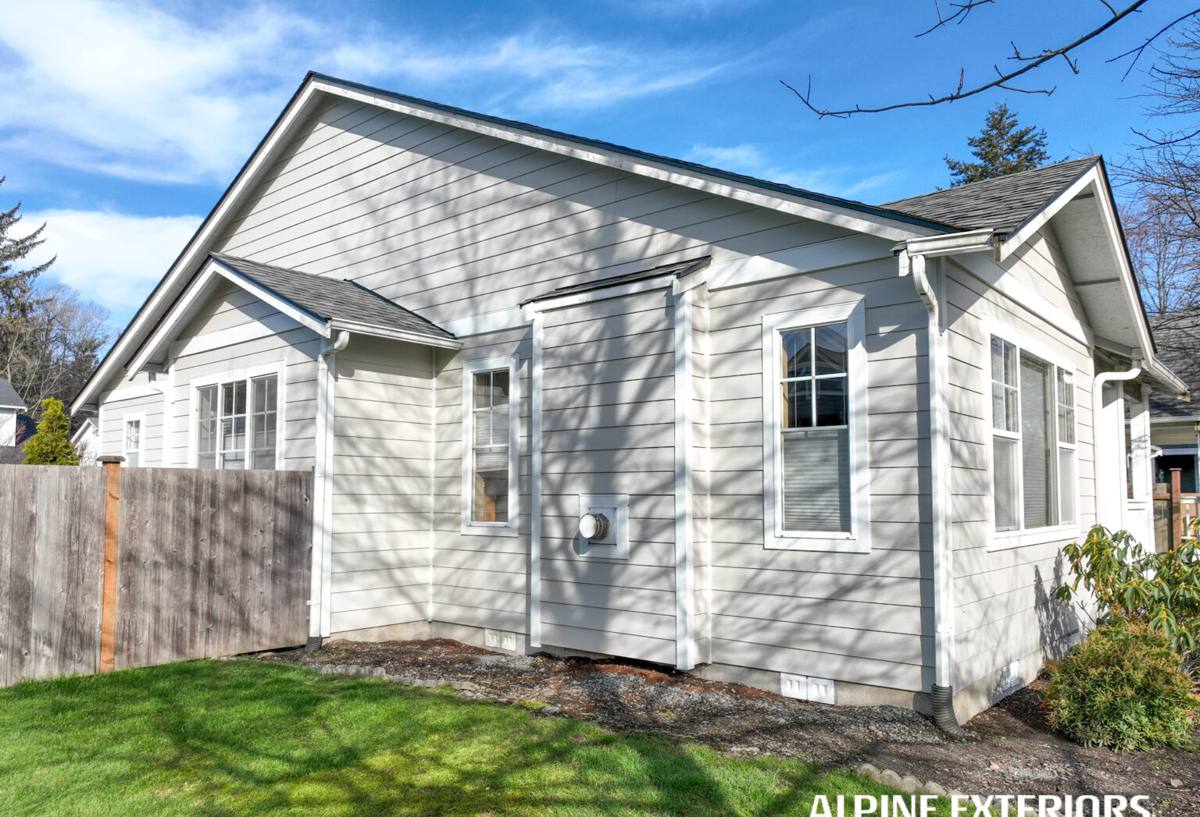
What This Climate Does to the Wrong Siding Choice
Moss and Moisture
Moss doesn't just sit on top of siding — its root structure holds moisture against the surface, which accelerates rot in wood-based products and can degrade the paint film on lower-grade fiber cement or engineered wood. On shaded Birchwood lots, north- and west-facing walls can stay damp for days after a storm system moves through, which is exactly the environment moss and mildew need to establish.
Salt Air
Bellingham isn't oceanfront, but it's close enough to Bellingham Bay that airborne salt and moisture reach inland neighborhoods, especially during winter storm winds. Salt exposure corrodes unprotected fasteners, degrades cheap caulk faster than the manufacturer's warranty assumes, and works into any gap in a paint or coating system.
Driving Rain
Whatcom County rain rarely falls straight down — winter storms push it sideways into wall assemblies, which is why flashing detail and water-shedding lap design matter more here than in drier climates. A siding system that depends on a perfect, unbroken caulk seal to stay watertight is a bad match for this weather pattern, because caulk is the first thing that fails.
Why James Hardie Is the Product We Install Here
We install James Hardie fiber cement exclusively, and Birchwood's climate is a big part of why. Hardie's siding is engineered specifically for regional weather zones — the HZ5 product line used in the Pacific Northwest is formulated for climates with sustained moisture exposure, and it doesn't rely on an unbroken paint film to keep water out the way wood-based or engineered-wood sidings do. Fiber cement is dimensionally stable; it doesn't swell, cup, or delaminate at the edges the way products with a wood-fiber core can when they take on moisture repeatedly over a Whatcom County winter.
ColorPlus Factory Finish
Hardie's ColorPlus finish is baked on in a controlled factory environment rather than field-applied, which matters a great deal in a climate where field-applied paint has a narrow dry-weather window to cure properly. A factory finish also resists the fading and chalking that job-site paint jobs are prone to after a few Whatcom County winters, and it comes with its own finish warranty separate from the substrate warranty.
Non-Combustible Core
Fiber cement is non-combustible, which isn't a Birchwood-specific climate issue, but it's a real, practical advantage over vinyl or wood-based siding that homeowners in this region increasingly factor into their decision given regional wildfire smoke seasons and insurance considerations.
What a Correct Installation Involves
James Hardie siding performs the way it's rated to perform only when it's installed to the manufacturer's specification. Most of the siding failures we get called out to inspect in older Bellingham homes aren't a product problem — they're an installation shortcut that a wet climate eventually exposed.
The Details That Actually Matter
- A drainable rainscreen gap or approved weather-resistive barrier system behind the siding, so incidental moisture can drain and dry instead of sitting against the wall sheathing
- Correct fastener type, spacing, and penetration depth — under- or over-driven nails are one of the most common defects we find on re-inspections
- Proper flashing at every window, door, and roofline intersection, lapped in the correct shingle-style order so water sheds outward, not inward
- Manufacturer-specified clearances from grade, decks, and roof lines to keep the bottom edge of the siding out of standing moisture and splashback
- Correct joint treatment at butt seams, with either engineered joiners or properly caulked and primed field joints — not just caulk over an exposed cut edge
- Fully sealed and painted cut edges on every piece trimmed on site, since a factory-primed edge left exposed is a direct path for moisture into the board
Mistakes We Commonly Correct
The most frequent issues we see on homes that had siding installed by a crew unfamiliar with Hardie's spec are missing rainscreen gaps against solid sheathing, siding installed too close to grade or roof lines, and cut edges that were never primed before painting. Each of these is invisible on install day and shows up two to five years later as swelling, staining, or paint failure along the affected edge.
James Hardie Product Lines That Fit Birchwood Homes
Birchwood has a mix of home styles and eras, and Hardie's product lines cover most of what we see in the neighborhood without needing to mix in a different manufacturer.
| Product Line | Best Fit | Why It Works Here |
|---|---|---|
| HardiePlank Lap Siding | Traditional and craftsman-style homes | Classic horizontal lap profile with strong water-shedding lines; the most common choice in established Bellingham neighborhoods |
| HardieShingle | Craftsman and cottage-style homes | Staggered or straight-edge shingle look without the moisture retention issues of real wood shingles under tree cover |
| HardiePanel | Modern or mixed-material homes | Clean vertical panel look, often paired with lap siding as an accent |
| HardieTrim | All of the above | Matches fascia, corner boards, and window trim to the same climate-engineered material and finish system |
What Drives the Cost of a Job Like This
Every Birchwood home is different, and a fair estimate depends on a site visit, but the same handful of factors drive most of the cost variation we see on jobs in this neighborhood.
| Factor | Why It Matters |
|---|---|
| Existing siding removal | Tear-off and disposal of old wood, vinyl, or aluminum siding adds labor and dump fees before installation even starts |
| Sheathing and moisture damage | Shaded, moss-prone walls sometimes hide rotted sheathing underneath the old siding, which has to be repaired before new siding goes on |
| Home size and complexity | Roof lines, dormers, and wall articulation add cutting, flashing, and labor time |
| Rainscreen requirements | Adding a code-compliant drainage gap where one doesn't exist is additional material and labor, but it's not optional for a correct install |
| Product line and trim selection | Shingle profiles and custom trim packages cost more in material and install time than a straightforward lap siding job |
| Color and finish choice | Factory ColorPlus finishes cost more up front than primed boards painted on site, but they eliminate a full field-paint job and its own recurring cost |
How We Approach a Birchwood Project
- Site assessment — we walk the home, check existing wall conditions, look for moisture or rot behind the current siding, and note shade patterns and drainage that affect the install
- Product and color selection — we walk you through Hardie's lines and ColorPlus palette against your home's style and exposure
- Written estimate — a clear scope covering removal, repair allowances if needed, rainscreen and flashing work, and the finished product
- Prep and protection — landscaping, walkways, and outdoor living spaces are protected before tear-off begins
- Installation to spec — rainscreen, flashing, fastening, and joint treatment done to Hardie's published installation guide, not shortcuts
- Final walkthrough — we go over the finished job with you before calling it complete
Why It Matters to Hire a Crew That Already Works This Neighborhood
Siding crews that install a little bit of everything — vinyl one week, LP SmartSide the next, fiber cement after that — don't build the same depth of familiarity with any one system's install requirements. We only install James Hardie, and we work throughout Bellingham and Whatcom County regularly enough to know how Birchwood's shade patterns, tree cover, and driving-rain exposure typically affect a wall assembly before we even open the siding boxes. That translates into fewer surprises mid-project and a rainscreen and flashing plan that's suited to the actual site conditions, not a generic install.
A crew that already knows the local building department's expectations for weather-resistive barriers and drainage also moves through permitting and inspection more smoothly, which keeps the timeline predictable — something that matters more here than in a drier climate, since a stalled project sitting open through a rainy stretch is its own risk.
Keeping James Hardie Siding Looking Right in This Climate
Fiber cement is low-maintenance compared to wood or engineered wood, but "low-maintenance" isn't "no-maintenance," especially under Birchwood's tree cover. A little seasonal attention keeps the finish looking good and prevents the kind of moss buildup that eventually stains or degrades any exterior surface.
- Rinse siding gently once or twice a year, focusing on shaded, north-facing walls where moss and algae establish first
- Trim back tree branches and shrubs to keep airflow moving across the wall surface and reduce standing shade and moisture
- Check and clear gutters before the fall rains so overflow isn't running down the siding face
- Inspect caulk joints at trim and penetrations every couple of years and have any cracked sealant redone before it becomes a water path
- Address any impact damage or exposed cut edges promptly rather than letting bare fiber cement sit unsealed through a wet season
Handled this way, a correctly installed James Hardie system on a Birchwood home is built to hold its finish and structural integrity for decades, backed by Hardie's transferable warranty on the substrate and a separate finish warranty on ColorPlus color.
If you're planning a siding project in Birchwood or anywhere else in Bellingham, we're happy to walk your home, look at what's actually going on behind the existing siding, and give you a straightforward, no-pressure estimate for doing it right the first time.