 Bellingham Siding
 Why Silver Beach Decks Wear Out Faster Than You'd Expect
Silver Beach sits close enough to the water that decks here take a different kind of beating than decks a few miles inland. Salt-laden air corrodes fasteners and hardware faster than most homeowners expect, wind-driven rain gets pushed sideways under railings and against house walls, and the shaded, damp stretches of the year let moss and algae take hold on any surface that doesn't drain and dry quickly. None of that is unique to any one house — it's just what this stretch of Bellingham does to exterior wood and composite surfaces year-round.
A deck that would hold up fine in a drier part of Whatcom County can start showing problems within a couple of seasons here if it wasn't built with this environment in mind. That's not a knock on composite decking as a product — it's a reminder that the installation details matter more in a marine-influenced microclimate than they do somewhere sheltered and dry.
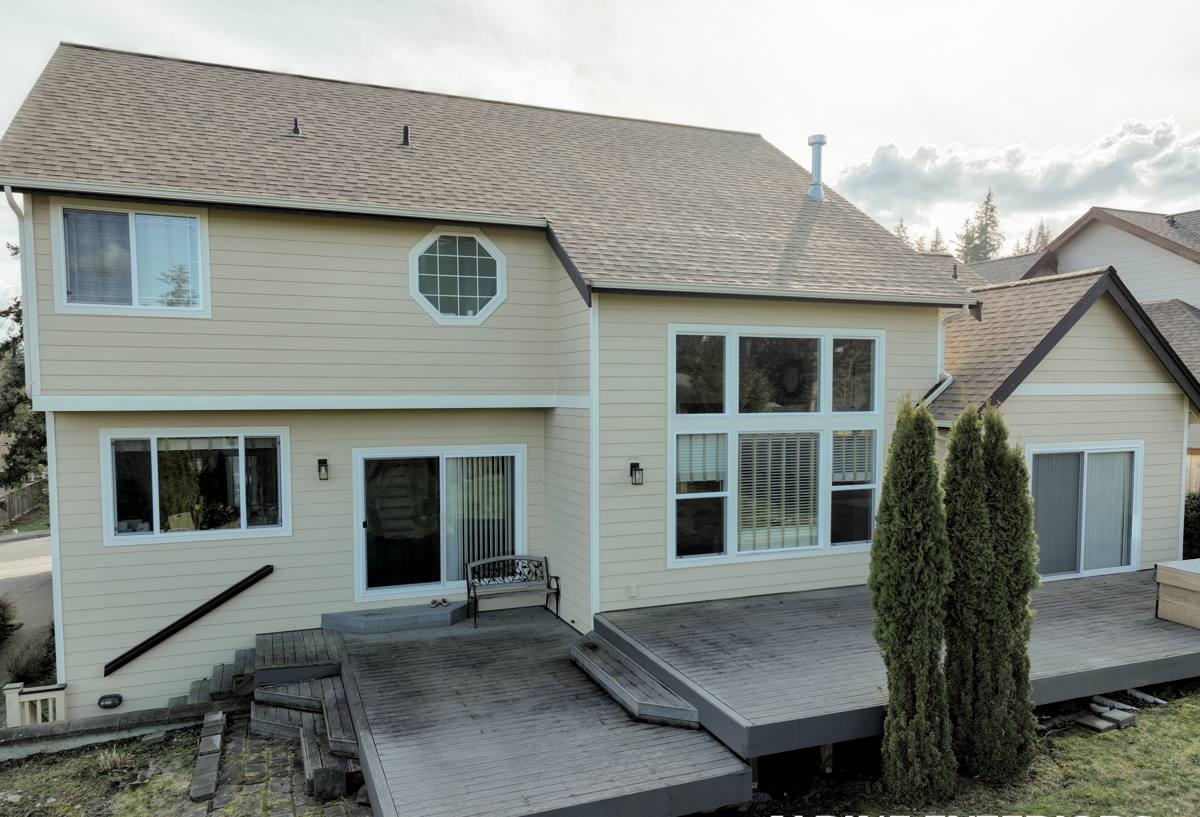
What Composite Decking Actually Solves — and Where It Still Needs Respect
Composite decking earns its reputation in a place like Silver Beach because it doesn't absorb water the way solid wood does, it won't splinter or cup from repeated wet-dry cycles, and it resists the rot that ruins untreated lumber near salt air. Most modern composite boards also resist mold and mildew staining far better than wood, which matters when moss season runs long.
But composite isn't maintenance-free, and it isn't immune to bad installation. A few honest points worth knowing before you commit:
- Composite boards still expand and contract with temperature swings — gaps and fastener spacing have to account for that, especially on a deck that gets both sun exposure and cold, damp mornings off the water.
- Capped composite (a solid outer shell over the core) handles moisture and staining better than uncapped composite, which matters more here than in a dry inland yard.
- Composite surfaces can still grow algae or moss film if they stay shaded and wet — the board resists rot, but it doesn't resist organic growth sitting on top of it. Airflow and drainage underneath still do most of the work.
- Substructure — the framing underneath — is still typically pressure-treated wood or in some cases aluminum, and that framing is exactly where salt air and trapped moisture do their damage if it's not detailed correctly.
In other words: the board itself is a real upgrade for this climate, but the deck is only as good as what's underneath it and how it was put together.
Getting the Substructure Right
Framing and Fasteners
In a salt-air environment, standard fasteners corrode faster than they would a few miles inland. We use fastener and hardware rated for coastal or marine exposure on Silver Beach jobs, not because it's required everywhere, but because it's cheap insurance against streaking, staining, and early hardware failure on a deck that's supposed to last decades.
Ledger Board and Flashing
The ledger board — where the deck attaches to the house — is the single most common failure point on any deck, composite or wood. Water that gets behind a poorly flashed ledger doesn't just rot the ledger; it can work its way into the house framing and siding. Correct flashing, proper fastener spacing, and a drainage gap between the ledger and the house band are non-negotiable details, especially with the volume of driving rain this area gets in fall and winter.
Joist Protection
Joist tape or an equivalent moisture barrier over the top of each joist keeps water from pooling where fasteners penetrate the wood. It's a small material cost that prevents the framing from becoming the weak link under a deck surface that's otherwise built to last.
Drainage and Airflow — The Details That Matter Most Near the Water
Composite decking sheds water well on the surface, but what happens underneath the deck determines how long the whole structure lasts. Decks close to the water tend to sit in more consistently damp air, which slows drying time between rain events. A few things we pay close attention to on Silver Beach installs:
- Adequate clearance between the ground (or a lower deck surface) and the framing above, so air can actually move and dry things out between storms.
- Board spacing and gapping set correctly for composite's expansion behavior, so water doesn't pool on the surface or get trapped between boards.
- Picture-frame and border details built with drainage in mind, not just appearance — a border board can trap water against end grain if it's not vented or flashed properly.
- Stair stringers and any ground-contact posts treated or isolated to handle sustained dampness, since these areas often stay wet longest.
None of this shows up in a photo of the finished deck, but it's the difference between a deck that still looks and performs well in ten years and one that starts having quiet structural problems in three or four.
Choosing the Right Composite Board for This Climate
Not all composite decking is built the same way, and the differences matter more in a moist, salt-influenced environment than they would somewhere dry. Here's a general comparison of the tiers most homeowners choose between:
| Board Type | Moisture & Stain Resistance | Typical Warranty Structure | Best Fit |
|---|---|---|---|
| Uncapped composite | Lower — surface can absorb moisture and stain over time | Shorter, often prorated | Budget-conscious projects in drier, more sheltered spots |
| Capped composite (cap on top surface only) | Good on the walking surface; edges more exposed | Moderate, often longer than uncapped | Most residential decks, including many Silver Beach homes |
| Fully capped composite (cap on all sides) | Best — resists moisture, staining, and fading on every exposed edge | Longest, typically the manufacturer's top tier | Decks with heavy sun, rain, or salt-air exposure |
For most Silver Beach homes, we steer clients toward fully capped composite for any board that will see direct weather — it costs more up front, but the cut ends and edges are exactly where uncapped and partially capped boards show wear first in this climate. We'll always give you the honest trade-offs for your specific deck rather than pushing the most expensive option by default.
Fastening Method
Hidden fastener clip systems give a clean surface with no visible screw heads, but they do require correct board seating and clip spacing to perform well over years of expansion and contraction. Face-screwed boards are more forgiving to install and easier to service individual boards later, which is worth considering on a deck that will see heavy salt-air exposure over time.
Our Installation Process for Silver Beach Homes
Every deck starts with a site walk specific to the property — grade, sun exposure, proximity to the water, existing drainage, and how the deck ties into the house. From there:
- Structural assessment — checking existing framing (on replacement jobs) or planning new framing sized correctly for the span and load.
- Ledger and flashing detail — the connection to the house gets built to shed water away from the structure, not just sealed and hoped for.
- Framing with corrosion-resistant fasteners — appropriate for the salt-air exposure at this location.
- Joist protection — moisture barrier tape over framing before decking goes down.
- Board installation — correct gapping for composite expansion, consistent fastening, and attention to end-grain and edge exposure.
- Railing and stair build-out — matched to the composite system and detailed for drainage at post bases.
- Final walk-through — reviewing maintenance expectations specific to this climate before we consider the job done.
We don't treat any of these as optional steps to save time. On a deck exposed to Bellingham's rain volume and Silver Beach's salt air, skipping a step here is what turns into a callback two or three years down the road.
What Cost Actually Depends On
Composite decking costs vary by project, and it's fair to expect a range rather than a flat number until we've seen the site. The main variables:
| Factor | Why It Moves the Price |
|---|---|
| Deck size and shape | More linear footage and cuts around curves or angles increase labor and material waste |
| Board tier | Fully capped, premium composite costs more per square foot than uncapped or entry-level lines |
| Height and access | Elevated decks or difficult site access add framing, railing, and safety requirements |
| Existing structure condition | Rebuilding failed framing costs more than decking over a sound existing structure |
| Railing and stair complexity | Custom railing systems and multiple stair sets add material and labor |
| Site exposure | Waterfront-adjacent sites often warrant upgraded fasteners and flashing, which adds modest cost for long-term durability |
We'll walk your specific property and give you a real number based on what's actually there, not a generic estimate pulled from an average job somewhere else.
Maintaining a Composite Deck in a Salt-Air, High-Rain Climate
Composite decking cuts down on maintenance compared to wood, but "low-maintenance" isn't "no-maintenance," especially this close to the water. A simple seasonal routine keeps a Silver Beach deck performing the way it should:
- Rinse the deck periodically to clear salt residue, pollen, and debris before it builds up in board grooves.
- Sweep or blow off leaves and organic debris promptly during fall — trapped, wet leaves are what feed moss and algae growth.
- Clean visible moss or algae film with a composite-safe cleaner rather than a pressure washer on high setting, which can damage the board surface.
- Check railing posts and stair connections annually for movement, since these areas take the most direct weather exposure.
- Keep planters, mats, and furniture feet from sitting in one spot for months at a time — trapped moisture under stationary items is a common source of surface staining.
Why Hiring a Crew That Already Works Silver Beach Matters
A lot of deck problems in this neighborhood don't trace back to bad composite decking — they trace back to a build that didn't account for how close the property sits to salt air and driving rain. A crew that hasn't worked this specific stretch of Bellingham might build a technically fine deck for a drier climate and not think twice about fastener grade, ledger drainage, or airflow underneath.
We work in Silver Beach and the surrounding Whatcom County waterfront areas regularly, which means we're not guessing at how this environment treats a deck over time — we're building to account for it from the first framing decision. That's the difference between a deck that needs attention again in a few years and one that just holds up.
If you're planning a new deck or replacing one that's showing its age, we're happy to walk the site and give you a straightforward, no-pressure estimate — just fill out the form below.