 Bellingham Siding
 Roofing in Ferndale: A Different Set of Problems Than Inland Homes Face
Ferndale sits close enough to the water and open farmland that its roofs take a different kind of beating than homes further inland in Whatcom County. Salt-tinged air off the Strait works into fasteners, flashing, and gutter systems over time. Wind-driven rain doesn't just fall straight down here — it gets pushed sideways under shingle tabs and around chimney flashing if those details weren't installed correctly the first time. And because the region rarely gets a hard, dry summer stretch, moss and algae get months of damp shade to establish themselves on north-facing slopes and anywhere tree cover blocks the sun.
None of that means Ferndale roofs fail faster than anywhere else. It means they fail differently — usually starting at the details rather than in the middle of a shingle field. A roof replacement here has to be built around those specific stresses, not just installed by the book from a manual written for a drier climate.
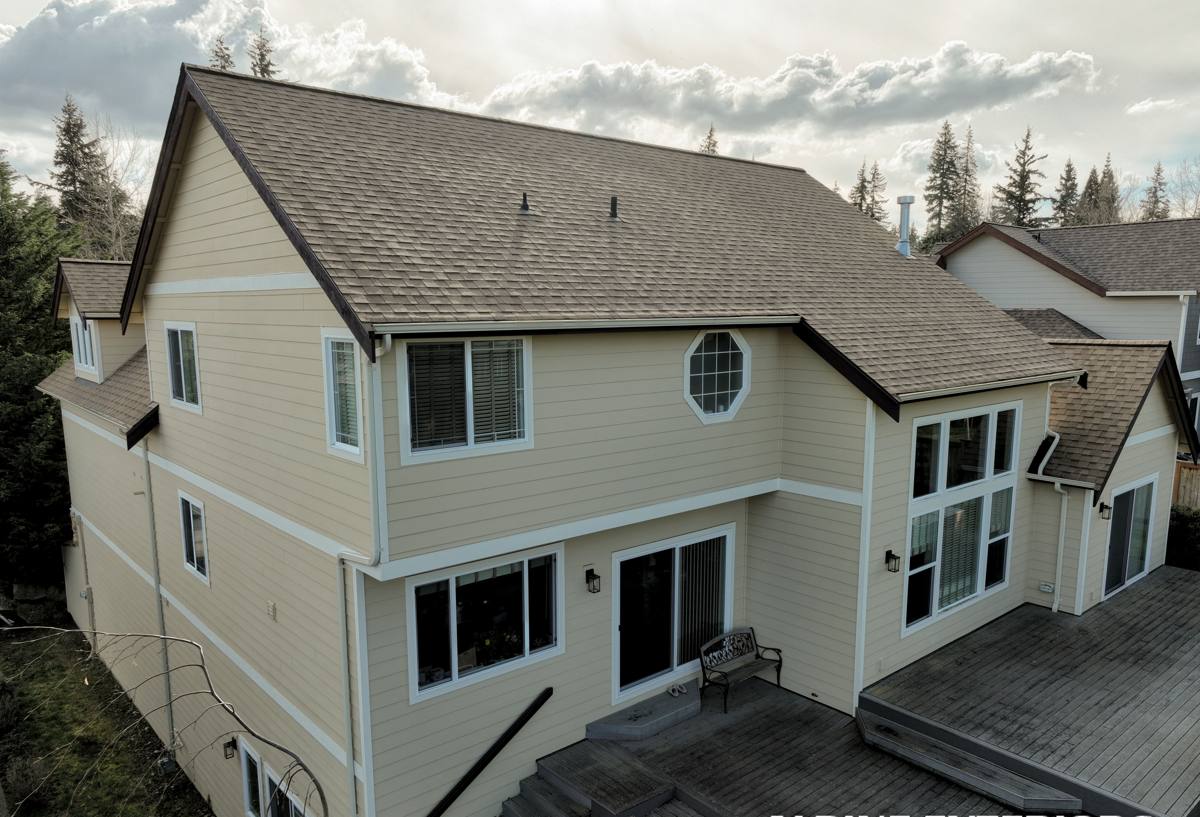
Signs Your Ferndale Roof Needs Replacement, Not Another Repair
Repairs make sense when a problem is isolated. Replacement makes sense when the roof's overall ability to shed water has broken down. The signs worth taking seriously:
- Granule loss heavy enough that you're finding grit in gutters and downspouts every season
- Shingles that are cupping, curling, or cracking across multiple slopes, not just one spot
- Moss that keeps returning within a year or two of cleaning, even after treatment
- Soft or spongy decking felt underfoot, or daylight visible through the attic roof deck
- Repeated leaks around the same penetration — chimney, vent pipe, skylight — despite past patch jobs
- A roof at or past 20-25 years old for asphalt shingle, especially with visible wear from coastal exposure
If you're only seeing one or two of these, a repair or a moss/gutter maintenance visit may still be the right call. A licensed inspection is the only way to know for sure, and it costs you nothing to ask.
What a Correct Roof Replacement Actually Involves
Full Tear-Off, Not a Layover
Some crews will offer to install new shingles over an existing layer to save time and money. We don't recommend that in this climate. A layover traps whatever moisture is already in the old roofing system, hides deck damage that needs to be found and fixed, and voids most manufacturer warranties. A proper replacement means stripping down to the deck so every layer underneath is new and can be inspected.
Deck Inspection and Repair
Once the old roofing is off, the plywood or OSB decking gets checked panel by panel. Any wood that's soft, delaminated, or water-stained gets replaced before anything new goes down — this is the step that gets skipped by crews trying to move fast, and it's the one that determines whether the new roof actually lasts.
Underlayment Built for Wet Climates
We use synthetic underlayment as a base layer across the whole roof, with self-adhering ice-and-water membrane at the vulnerable spots: eaves, valleys, around chimneys and skylights, and anywhere two roof planes meet. That membrane is what keeps wind-driven rain from finding its way under the shingles at the exact points where most Whatcom County leaks actually start.
Flashing Done Right
Flashing failure — not shingle failure — is behind most of the roof leaks we get called out for. Step flashing at walls, counter-flashing at chimneys, and properly lapped valley metal all need to be installed in the correct order relative to the underlayment and shingles, not caulked together after the fact as a shortcut.
Ventilation That Matches the Home
A roof that can't breathe traps moisture in the attic, which shortens the life of the decking and the shingles from underneath. We balance intake at the soffits with exhaust at the ridge or through vents sized to the attic volume, not just whatever was there before.
Material Options for Whatcom County Homes
There's no single "best" roofing material — the right choice depends on your budget, your roof's slope and shade exposure, and how much long-term maintenance you're willing to keep up with. Here's how the common options stack up for a coastal, moss-prone climate like Ferndale's:
| Material | Typical Lifespan | Moss/Algae Resistance | Maintenance Burden | Relative Cost |
|---|---|---|---|---|
| 3-Tab Asphalt Shingle | 15-20 years | Lower unless treated | Regular moss checks needed | Lowest |
| Architectural (Laminate) Shingle | 25-30 years | Better with algae-resistant granules | Moderate | Mid-range |
| Standing Seam Metal | 40-50+ years | Very high — sheds moss naturally | Low | Higher upfront |
| Cedar Shake | 20-30 years with upkeep | Low without diligent care | High — needs regular treatment | Mid-to-high |
For most Ferndale homes we recommend algae-resistant architectural shingles as the practical middle ground, and metal roofing for clients who want to largely stop thinking about moss and maintenance for the next few decades. We'll walk through the honest trade-offs for your specific roof during the estimate rather than push one product across the board.
What Drives the Cost of a Ferndale Roof Replacement
We don't publish flat prices because roof cost depends on real variables, not a one-size number. The main factors:
| Factor | Why It Matters |
|---|---|
| Roof size and number of slopes/planes | More material, more cutting, more labor hours |
| Pitch and access | Steep or multi-story roofs need more safety setup and time |
| Deck condition | Rotten sheathing found during tear-off adds material and labor |
| Material chosen | Asphalt, architectural, and metal carry different material costs |
| Flashing and penetration count | Chimneys, skylights, and multiple vents each add detail work |
| Tear-off layers | Removing an existing layover adds disposal and labor time |
We give a written estimate that breaks these out so you know what you're paying for, not a single lump number with no explanation behind it.
Our Process, Start to Finish
- On-site inspection — we get on the roof (weather permitting) and check the attic from inside, not just a look from the driveway
- Written estimate — itemized by material, labor, and any deck repair contingency, so there are no surprise change orders mid-job
- Material order and scheduling — we work around Whatcom County's wetter stretches to pick a weather window that keeps the deck dry during tear-off
- Tear-off and deck repair — old roofing removed, decking inspected and repaired before anything new goes down
- Underlayment, flashing, and new roofing installed — in the sequence that actually sheds water, not just what's fastest
- Cleanup and magnetic sweep — job site and yard cleared of debris and stray nails before we call it done
- Final walkthrough — we go over the finished roof with you before wrapping up
Why a Crew That Already Works in Ferndale Matters
Roofing crews that mostly work drier inland regions sometimes underbuild for coastal exposure — lighter underlayment packages, less flashing detail, ventilation specs pulled from a generic manual. A crew based in Bellingham and working Whatcom County day in and day out already knows which details fail first in this climate because we've seen it on other roofs nearby. That shows up in the underlayment we spec, how much flashing work we budget into an estimate, and how seriously we treat ventilation on every job — not as upsells, but as the baseline for a roof that's actually built for where it sits.
It also means we're not disappearing after the job is done. If something needs a warranty check or a follow-up visit two winters from now, we're still a local call away, not a company that worked the region for one season and moved on.
Caring for Your New Roof After Installation
A well-installed roof still needs basic upkeep to hit its full lifespan in this climate. A simple maintenance routine goes a long way:
- Clear gutters and downspouts at least twice a year, more often under heavy tree cover
- Have moss growth treated or gently removed before it spreads, rather than waiting for a full covering
- Trim back overhanging branches that keep roof sections shaded and damp
- Check attic ventilation isn't blocked by insulation or storage after any attic work
- Schedule a roof check after major windstorms, especially if you notice missing granules or debris
- Keep a copy of your material and workmanship warranty paperwork somewhere you can find it
None of this is complicated, but skipping it is the most common reason a well-installed roof underperforms its expected lifespan.
Get a Straight Answer on Your Ferndale Roof
If you're not sure whether your roof needs a full replacement or just some repair and maintenance, we're happy to take a look and tell you honestly which one it is. Reach out for a free, no-pressure estimate using the form below — we'll walk the roof, explain what we find, and give you a clear, itemized quote with no obligation attached.