 Bellingham Siding
 Board & Batten Siding in Lynden: A Look That Has to Earn Its Keep
Board and batten shows up a lot in Lynden — on farmhouses, on newer builds going for that clean vertical-line look, and on additions where a homeowner wants to break up a long flat wall. It's a good-looking profile: wide boards with narrow battens covering the seams, strong vertical shadow lines, a style that reads as both traditional and current depending on the trim and color. But in Whatcom County, board and batten isn't just a design choice. The seams, the fastening pattern, and the way water is allowed to move (or not move) behind the boards all matter more here than they would in a drier climate. Get those details right and you get decades of good service. Get them wrong and you get moisture trapped exactly where you can't see it, behind a wall that still looks fine from the driveway.
This page is about doing board and batten correctly on Lynden homes specifically — what the local climate demands, what we actually do differently because of it, and why we only install James Hardie fiber cement for this profile.
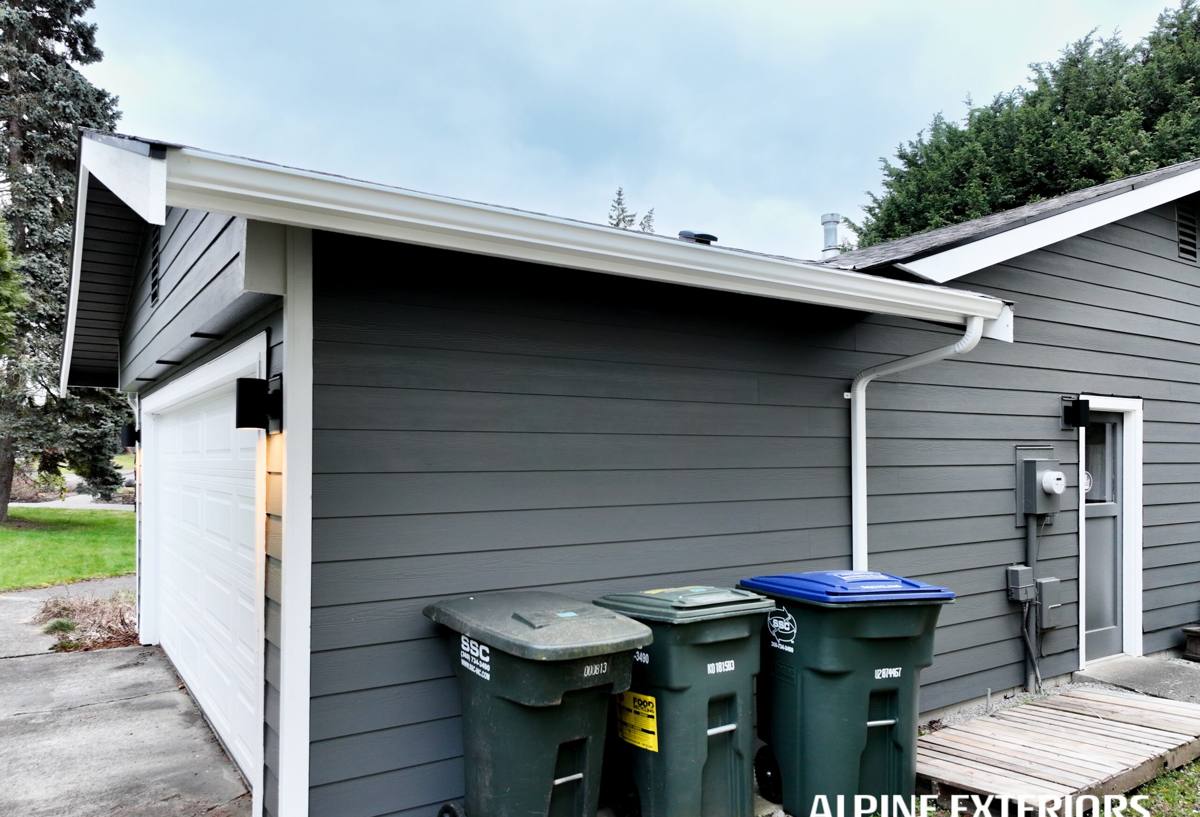
Why Whatcom County's Climate Puts Vertical Siding to the Test
Lynden sits inland from the coast, but it's still squarely inside Whatcom County's marine-influenced climate: long wet stretches from fall through spring, driving rain that comes in sideways during winter storms, and enough shaded, damp conditions on north- and west-facing walls to grow a healthy crop of moss and algae if a wall never gets the chance to dry. Add in the salt-tinged air that moves through this part of western Washington and you've got a combination that's hard on any exterior material, and particularly hard on vertical siding profiles where every batten seam is a potential path for water to find its way behind the cladding.
Board and batten has more linear feet of seam per square foot of wall than most horizontal lap profiles. That's not a knock on the style — it's just the geometry. Every one of those seams needs to be detailed so wind-driven rain can't push past it, and every board needs a way to dry out after it gets wet, because in this climate it will get wet, repeatedly, for months at a stretch. A siding job that looks great in July and starts showing streaking, swelling, or moss growth by the following winter usually has one of these details missing, not a defective product.
What "Driving Rain" Actually Does to a Wall
Wind-driven rain doesn't just run down a wall — it gets pushed sideways and upward into laps, seams, and fastener penetrations. On a vertical profile, that means the batten-to-board seams and the top/bottom terminations (soffit line, water table, window and door casings) take the brunt of it. If those transitions aren't flashed and lapped correctly, water works its way behind the siding and stays there, because it has nowhere to drain and no airflow to dry it out.
What a Correct Board & Batten Installation Actually Involves
A board and batten job that's built for this climate isn't just nailing boards to the wall in a vertical pattern. The details that separate a job that lasts from one that fails early are mostly invisible once the siding is up:
- Proper drainage plane and rainscreen gap — a wall assembly that lets any water that does get past the cladding drain out and lets the back side of the boards dry, rather than trapping moisture against the sheathing.
- Correct fastener placement and spacing — Hardie's published fastening schedules exist for a reason; fasteners in the wrong location or spacing pattern can cause boards to crack, cup, or work loose over time.
- Flashed, lapped transitions — every window head, door casing, roofline intersection, and water table needs flashing that sheds water outward, not a bead of caulk asked to do a flashing detail's job.
- Consistent, code-minimum clearance — siding held up off grade, decks, and roof lines so splashback and standing water don't sit against the bottom edge of the boards.
- Sealed and primed cut ends — every field cut is a raw edge that needs to be treated before it goes on the wall, not after.
- Battens installed with room to move — fastened to allow for the material's normal expansion and contraction rather than pinned rigid at every point.
None of this is exotic. It's discipline — following the manufacturer's installation instructions to the letter instead of treating them as a suggestion. In a climate that gets this much sustained moisture, the gap between "close enough" and "correct" shows up faster than it would somewhere drier.
Why We Install Only James Hardie for Board & Batten
We don't offer board and batten in vinyl, LP SmartSide, primed spruce, cedar, or other fiber cement brands. That's a deliberate standard, not a limitation of what we're capable of installing. Board and batten is one of the least forgiving profiles for material choice, because those vertical seams and exposed board edges are exactly where a weaker product shows its weaknesses first.
Wood-based products, including engineered wood, rely on a factory coating and careful field sealing of every cut edge to keep moisture out. In a climate with this much sustained wet weather, that maintenance burden is real and it's ongoing — miss a resealing cycle on a batten edge and you've opened a path for water absorption and swelling. Vinyl board and batten handles moisture fine in the sense that it doesn't absorb water, but it's a thin material that shows waviness and impact damage, and it doesn't hold paint if a homeowner ever wants to change the color down the road.
James Hardie fiber cement is engineered specifically for this: it doesn't absorb water the way wood-based products do, it's non-combustible, and Hardie makes an HZ5 product line engineered for the kind of freeze-moisture cycling and sustained wet exposure that western Washington delivers most of the year. The ColorPlus factory finish is baked on and warranted against fading and peeling, which matters more on a vertical profile where every seam and edge is visible up close. It's also simply a heavier, more dimensionally stable board — it holds its line over a 10-foot batten run instead of showing waviness after a few seasons of wet-dry cycling.
We're not saying every other product fails immediately. We're saying that for a profile with this many seams, installed in a climate this wet, we'd rather stand behind one material we trust completely than offer four options and hope the cheaper ones hold up.
Board & Batten vs. Other Siding Profiles: What to Weigh
| Factor | Board & Batten (Hardie) | Lap Siding (Hardie) | Vinyl Board & Batten |
|---|---|---|---|
| Seam exposure | Higher — vertical joints throughout | Lower — horizontal overlap sheds water naturally | Higher, plus thinner material at seams |
| Moisture resistance | Excellent when installed to spec | Excellent when installed to spec | Won't absorb water, but seams can flex and gap |
| Look | Bold vertical lines, farmhouse/modern styles | Traditional, widely used | Similar look, less depth and shadow line |
| Repaintable | Yes | Yes | No |
| Fire resistance | Non-combustible | Non-combustible | Melts/deforms under heat |
| Best use | Accent walls, gables, full-home statement look | Whole-home, lower-maintenance default | Budget-driven projects |
A lot of Lynden homes end up mixing profiles — board and batten on a gable or entry feature, lap siding across the main body. That's a reasonable way to get the look without turning the entire home into the highest-seam-count option. We'll talk through where it makes sense on your specific house rather than defaulting to one answer.
Our Process on a Lynden Board & Batten Job
- On-site assessment — we look at existing siding, sheathing condition, moisture history, and how each wall is exposed to prevailing wind and rain before quoting anything.
- Tear-off and sheathing check — old siding comes off and we inspect what's underneath; if there's rot or hidden water damage, we flag it before covering it back up.
- Weather-resistive barrier and drainage plane — installed per code and per Hardie's requirements, with a rainscreen gap where the wall assembly calls for one.
- Flashing at every penetration and transition — windows, doors, rooflines, water tables — done before a single board goes up.
- Board and batten installation — fastened per Hardie's published schedule, cut ends sealed on-site, consistent reveal and batten spacing throughout.
- Final detailing and walkthrough — caulking where specified (not as a substitute for flashing), touch-up, and a walkthrough so you know exactly what was done and why.
Maintenance: What to Actually Expect
One of the honest selling points of Hardie board and batten is how little upkeep it asks for compared to the alternatives — but "low maintenance" isn't "no maintenance," especially in a climate that grows moss on anything that sits still.
- Rinse the siding once or twice a year, focusing on shaded and north-facing walls where moss and algae take hold first.
- Keep gutters clear so overflow doesn't run down the wall face and stay wet longer than it should.
- Keep landscaping and irrigation from spraying directly onto the lower courses.
- Repaint on a normal cycle if you choose a custom (non-ColorPlus) finish; ColorPlus factory color stretches that cycle out considerably.
- Have caulking and trim joints checked every few years — sealant is a maintenance item on any siding system, and catching a failed joint early is a lot cheaper than dealing with what happens if it goes unnoticed for a couple of wet seasons.
Why Hiring a Crew That Already Works in Lynden Matters
Board and batten installed to spec in a dry climate and board and batten installed to spec for Whatcom County aren't quite the same job. A crew that works this area regularly already knows what a wall exposed to a full winter of driving rain needs, has already seen what happens when a batten seam is detailed wrong, and isn't learning those lessons on your house. That local pattern recognition — knowing which elevations need extra attention, how much clearance really matters given the wet season length, where moss tends to establish first — is the kind of thing that only comes from doing this work here, repeatedly, not from a general installation manual.
If you're weighing board and batten for a Lynden home, we're glad to walk the property, talk through where the profile makes sense, and give you a straight answer — including if we think a different approach fits your house better. There's no pressure and no cost to have us take a look; reach out through the form below for a free estimate.