 Bellingham Siding
 Why Siding in Happy Valley Wears Differently Than People Expect
Bellingham sits on Bellingham Bay, and that marine influence doesn't stop at the waterfront — it reaches every neighborhood in the city, Happy Valley included. Add in the tree canopy and sloped lots that are common across this part of Bellingham, and you get a specific set of conditions that push siding harder than a dry-climate house ever sees: shaded walls that stay damp for days after a storm, driving rain that comes in sideways off the water, and a moss season that, in Whatcom County, can run most of the year rather than just a few weeks.
None of that means siding here is doomed. It means the repair has to account for what's actually happening at the wall, not just patch the visible symptom. A lot of the repair calls we get in this neighborhood are for siding that was patched once already — caulked over, painted over, or replaced with a mismatched piece — and failed again within a couple of years because the underlying moisture problem was never addressed.
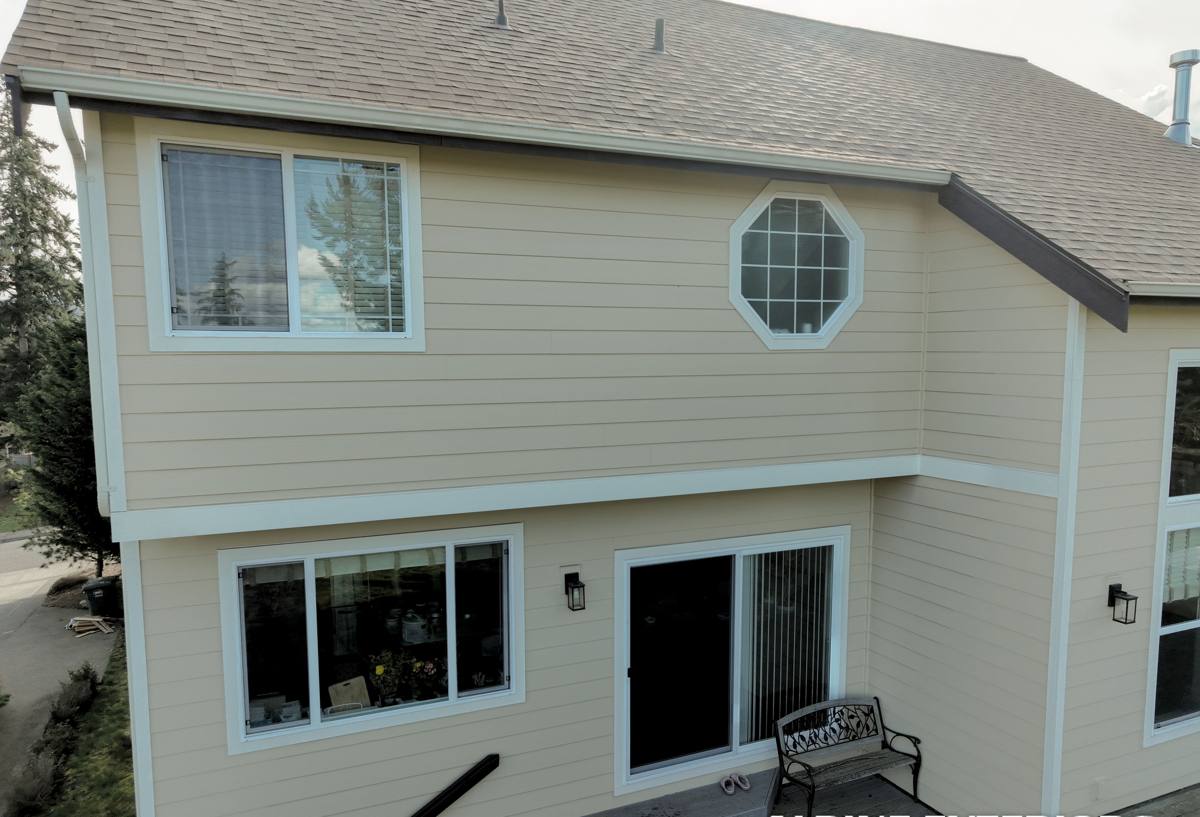
Signs Your Siding Needs Repair, Not Just a Cleaning
Homeowners often can't tell the difference between siding that needs a wash and siding that's actively failing. A quick self-check before you call anyone:
- Boards or panels that are cracked, split, or visibly bowed
- Soft or spongy spots when you press on the siding (a sign of moisture-damaged material underneath)
- Moss or dark staining that comes right back within weeks of being cleaned
- Gaps opening up at seams, corners, or where siding meets trim and window casings
- Paint or factory finish peeling in patches rather than fading evenly
- A musty smell along interior walls near an exterior corner
- Rust streaking below fasteners or trim fasteners that have backed out
If you're only seeing surface grime with none of the above, a cleaning may be all you need. If you're seeing two or more of these, it's worth having someone look at what's happening behind the siding, not just the surface.
What's Actually Causing the Damage We See in This Neighborhood
Moss and Retained Moisture
Moss itself isn't what destroys siding — it's what moss represents. A wall growing moss is a wall that stays wet longer than it should, and prolonged moisture contact is what breaks down caulking, swells wood-based trim, and eventually finds its way behind seams. Shaded, tree-lined lots — common throughout Happy Valley and much of Bellingham — dry out slower after every rain event, which is exactly the condition moss needs to establish and keep coming back.
Driving Rain and Wind-Driven Water
Storms coming off the water don't just fall straight down; wind pushes rain sideways into laps, seams, and trim joints that were never designed to be soaked head-on. Over time, that wind-driven water finds any gap in caulking or flashing and works its way behind the siding rather than running off the face of it.
Salt Air and Fastener Corrosion
Marine air carries salt content that accelerates corrosion of exposed metal — fasteners, flashing, trim brackets. Once a fastener starts to rust and lose its grip, the siding around it loosens, which opens a path for water that wasn't there before. This is a slow process, which is why it often shows up first as a small isolated repair rather than an obvious failure.
Repair or Replace? How We Make That Call
Not every problem area needs a full re-side, and not every "small crack" is actually small once you look behind it. We walk through the same factors on every job:
| Factor | Usually Repairable | Usually Points to Replacement |
|---|---|---|
| Extent of damage | Isolated to a few boards or one elevation | Spread across multiple walls or the whole exterior |
| Moisture behind siding | Surface-level, sheathing is dry | Sheathing or framing shows rot or staining |
| Age of existing material | Newer siding with an isolated defect | Siding is near or past its expected service life |
| Fastener/trim condition | Localized corrosion, easily replaced | Widespread rust or fastener failure |
| Cost relative to full re-side | Repair cost is a fraction of replacement | Repair cost approaches what a re-side would run |
We'll always tell you honestly which column your situation falls into. There's no benefit to us in talking a homeowner into a full replacement when a targeted repair will genuinely hold — but there's also no benefit in patching over a moisture problem that's going to resurface in a different spot next winter.
Diagnosing What's Behind the Siding
Before any repair, we check what's underneath the visible damage — moisture readings, a look at the sheathing where it's accessible, and an honest look at how water is actually reaching that section (roof runoff, a failed gutter, missing flashing, grade sloped toward the house). Repairing the siding without fixing the water source just delays the next repair.
Matching Material and Finish
A repair that's structurally sound but visually obvious — different color, different profile, a seam that doesn't line up — isn't a job well done. Matching factory-finished siding correctly, especially on a wall that's had sun exposure and weathering, takes more attention than most quick-patch jobs get.
Proper Flashing and Fastening
Every repair is an opportunity to correct what caused the failure in the first place. That means proper flashing at the repair boundary, correctly spaced and set fasteners, and sealing details that direct water out and away instead of trapping it behind the new piece.
Why We Repair and Install Only James Hardie Fiber Cement — and What That Means for Your Patch Job
We install exclusively James Hardie fiber cement siding. We don't install vinyl, LP SmartSide, Cemplank, Allura, or primed wood siding, and that standard carries into how we handle repairs, too. If your home already has Hardie siding, a repair is usually the most straightforward version of this job — we can match the ColorPlus finish and HZ product line already on the house and get a clean, durable patch.
If your home has a different siding material and only a small, isolated section needs work, we'll be upfront about your options rather than pretend we install everything. For anything beyond a minor patch, our recommendation is usually to replace the damaged section — or in some cases the whole elevation — with James Hardie rather than sourcing a matching piece of a product we don't stock or stand behind. That's not us upselling; it's the same reasoning that led us to standardize on Hardie in the first place: fiber cement doesn't swell, rot, or feed moss the way some wood-based and engineered products can when they stay damp, and non-combustible fiber cement holds up to the wet, shaded conditions common in this part of Whatcom County better over the long run than the alternatives.
Our Repair Process for Happy Valley Homeowners
- Walk the exterior (and relevant interior walls) to document every area of concern, not just the one you called about
- Check moisture levels and inspect what's accessible behind the damaged siding
- Identify the actual water source — gutters, flashing, grading, or a failed seal — not just the symptom
- Provide a written scope and estimate that's clear about what's repair versus what we'd recommend replacing
- Complete the repair with correct flashing, fastening, and sealing, matched to the existing material where reasonable
- Clean up the site and walk the finished work with you before we consider the job done
Why It Matters to Hire a Crew That Already Works This Neighborhood
Happy Valley isn't a uniform tract of identical houses — it's a mix of home ages and construction styles like much of Bellingham's residential core, which means every repair call is a little different. A crew that regularly works this neighborhood has already seen how the local combination of shade, slope, and coastal moisture plays out on real houses nearby: which elevations tend to hold water longest, which trim details fail first, and what actually needs to change so a repair doesn't repeat itself. That local pattern recognition is worth more than a generic repair quote, and it's the difference between fixing the siding and fixing the reason the siding failed.
After the Repair: Keeping Moss and Moisture From Coming Back
A good repair buys you time, but ongoing conditions in Happy Valley don't change once the work is done. A few habits keep a repair from becoming a recurring one:
- Keep gutters and downspouts clear so runoff isn't dumping directly onto a wall section
- Trim back vegetation and low branches that keep a wall shaded and slow to dry
- Use a soft wash rather than pressure washing when cleaning siding — high-pressure water can drive moisture behind seams instead of removing it
- Have caulking and trim seals checked every couple of years, especially on walls that face prevailing wind and rain
If you're dealing with a siding problem in Happy Valley, we're happy to take a look and give you a straight answer on whether it's a repair, a section replacement, or something bigger — no pressure either way. Fill out the form below and we'll set up a free estimate.