 Bellingham Siding
 Edgemoor's Roofs Work Harder Than Most
Edgemoor sits right on Bellingham Bay, tucked under a heavy tree canopy along the bluff south of downtown. That combination — salt-laden air off the water, mature fir and cedar overhead, and some of the wettest, greyest stretches of the year in Whatcom County — puts a specific kind of stress on a roof that you don't see on a dry inland lot. It's not one big problem. It's a slow accumulation of small ones: fasteners that corrode a little faster, shaded slopes that never fully dry out, gutters that fill with needles every fall, and moss that gets a running start every winter and doesn't let go until late spring.
None of that means Edgemoor roofs fail early. It means they need to be built and maintained with that environment in mind, not treated like a roof going up in a subdivision with full sun and no salt air. That's the difference between a roof replacement that looks fine on install day and one that's still doing its job in year eighteen.
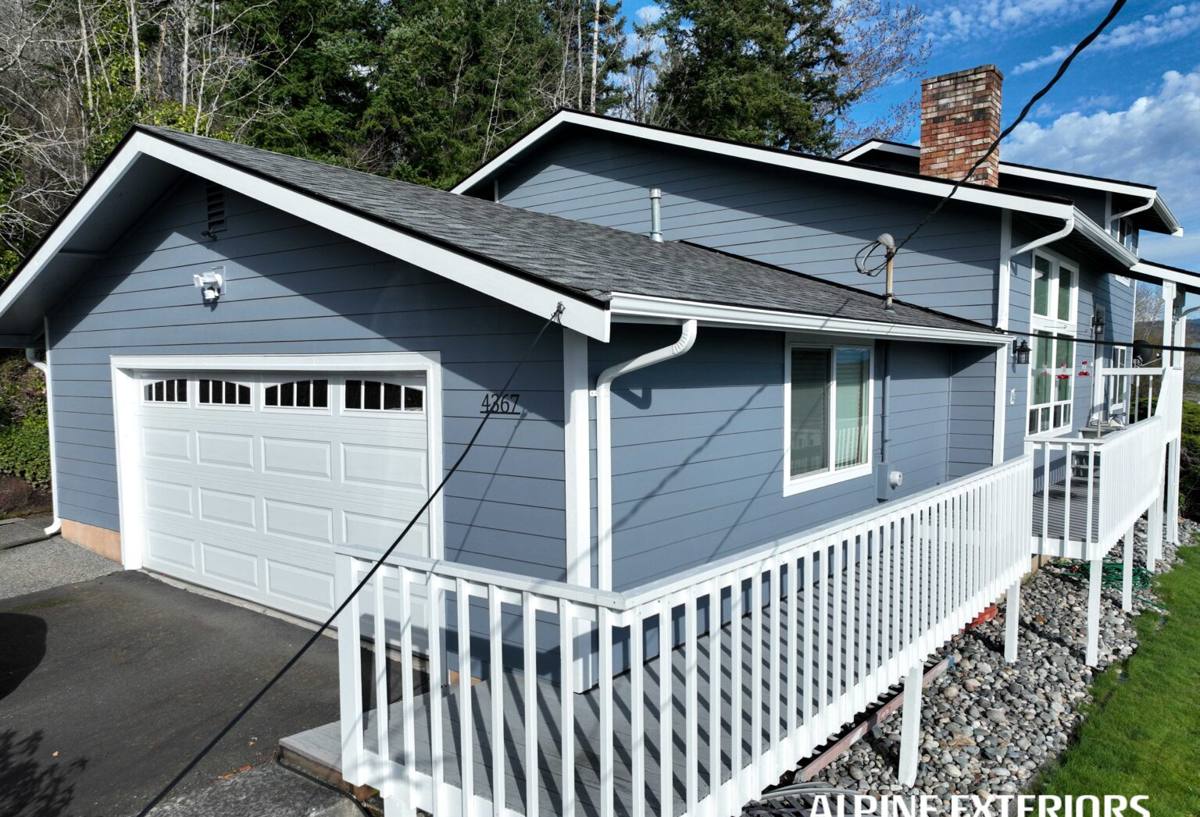
Signs an Edgemoor Roof Is Due for Replacement, Not Another Repair
Every roof reaches a point where patching stops making financial sense. In this part of Bellingham, we typically see homeowners cross that line for one of these reasons:
- Granule loss heavy enough that you're finding grit in the gutters every time you clean them
- Moss that keeps coming back within a season or two of cleaning, even after treatment
- Soft spots or sag visible along the roofline, which usually points to decking damage underneath
- Shingles curling, cracking, or lifting at the edges — often worse on the shaded, north-facing slopes
- Interior signs: ceiling stains, musty smell in the attic, or daylight visible through the roof deck
- A roof already past 20-25 years old for asphalt composition, even if it "looks okay" from the ground
If you're only seeing one or two of these and the roof is under 15 years old, a repair or a partial section replacement is often the right call — we'll tell you that straight if that's what the inspection shows. Replacement makes sense when the underlying materials — decking, underlayment, flashing — are failing together, not just the top layer.
What Actually Goes Into a Correct Roof Replacement
A roof replacement done right is a system, not just a layer of new shingles. Skipping any one of these steps is how a roof that looks good for the first year starts leaking by year five in a climate this wet.
Tear-off and deck inspection
We remove the old roofing down to the deck rather than layering over it. That's the only way to actually see what's underneath — soft or delaminated plywood, rot around old flashing, or damage from a slow leak that never showed up inside the house yet. Any bad decking gets replaced before anything new goes down.
Underlayment built for a wet climate
In a region that gets sustained, driving rain rather than short bursts, underlayment matters more than it does in drier parts of the country. We use synthetic or ice-and-water underlayment at vulnerable points — eaves, valleys, around penetrations — to give the roof a real second line of defense, not just a builder-grade felt layer.
Flashing at every transition
Chimneys, skylights, dormers, and sidewalls are where roofs actually fail, far more often than open field areas. Correct step flashing, counter-flashing, and sealed penetrations at every one of these points is non-negotiable — it's also the detail that gets rushed on a lot of cut-rate jobs.
Ventilation that matches the house
Under a dense tree canopy with limited direct sun, a roof needs to be able to dry out through airflow, not just sunlight. Balanced intake and exhaust ventilation keeps moisture from building up in the attic, which protects both the new roof and the decking from the inside.
Choosing a Roofing Material for a Bay-Side, Tree-Covered Lot
There's no single "best" roofing material — there's the right material for this specific site, this budget, and this level of shade and salt exposure. Here's how the common options actually compare for an Edgemoor-type property:
| Material | Moss/algae resistance | Typical lifespan | Best fit |
|---|---|---|---|
| Architectural asphalt shingle | Good with algae-resistant granules; still needs periodic moss removal | 25-30 years | Most homes; best balance of cost and durability |
| Standing seam metal | Excellent — moss and algae struggle to get a foothold | 40-50+ years | Homes wanting long-term, low-maintenance performance near the water |
| Cedar shake | Poor in a shaded, damp setting without diligent upkeep | 20-30 years with regular maintenance | Homeowners committed to the maintenance schedule for the look |
| Synthetic/composite shingle | Good; resists moisture absorption better than wood | 30-40 years | Homes wanting a wood-look profile with less upkeep |
We're upfront that we steer most Edgemoor clients away from cedar shake unless they're prepared for regular cleaning and treatment — under heavy tree cover with limited sun exposure, wood roofing simply stays damp longer than it does on an open lot, and that shortens its real-world life regardless of the warranty on the label. That's a maintenance and moisture-behavior tradeoff, not a knock on the product itself.
Our Roof Replacement Process
- Inspection and honest assessment — we get on the roof, check the attic, and tell you what we actually find, including if repair is the more sensible option.
- Written estimate — clear scope, material options, and pricing, with no pressure to decide on the spot.
- Permitting — we handle the permit process with the appropriate local authority so the work is inspected and documented correctly.
- Site protection — landscaping, walkways, and windows get covered before tear-off begins; on wooded lots we're careful around root systems and low branches.
- Tear-off and deck repair — old roofing comes off, decking gets inspected, and any damaged sections are replaced.
- Dry-in — underlayment and flashing go down the same day where weather allows, so the house isn't left exposed overnight.
- Material installation — new roofing installed to manufacturer specification, not shortcuts.
- Cleanup and magnetic sweep — full site cleanup, including a nail sweep of the yard and driveway.
- Final walkthrough — we go over the finished roof with you and explain the warranty coverage in plain terms.
What Roof Replacement Costs Depend On
We won't quote a number without seeing the roof, but the factors that move the price up or down are consistent from job to job:
| Factor | Why it matters |
|---|---|
| Roof size and number of stories | More square footage and steeper access both add labor time |
| Roof pitch and complexity | Multiple valleys, dormers, and roof planes take longer to flash and detail correctly |
| Number of existing layers | Tearing off two layers of old shingles costs more than one |
| Decking condition | Rotted or soft plywood found during tear-off requires replacement before install |
| Material choice | Asphalt, metal, and composite options span a wide price range |
| Site access | Tree cover, tight lots, and steep driveways can affect staging and disposal |
| Chimneys, skylights, and penetrations | Each one adds flashing work and a potential leak point to detail properly |
Living With Moss, Algae, and Long Wet Seasons
A new roof doesn't make moss season disappear — it just gives you a roof that's built to handle it. A few habits go a long way toward protecting the investment:
- Clear gutters and downspouts each fall before the heavy rains set in, especially under tree cover
- Have moss physically removed rather than just treated when it builds up on shaded slopes
- Keep overhanging branches trimmed back so roof surfaces get more light and airflow
- Check attic ventilation isn't blocked by insulation, which can trap moisture against the deck
- Schedule a roof check every couple of years, not just after you spot a problem
None of this is complicated, but skipping it is the single most common reason a roof underperforms its expected lifespan in this climate.
Why It Matters That We Already Work in Edgemoor
A roofing crew that's worked this specific stretch of Bellingham knows things that don't show up in a generic estimate: how the shaded, water-facing slopes on these lots hold moisture longer than the street-facing side, what access looks like on a wooded waterfront lot, and how local permitting and inspection actually run day to day. That familiarity shows up in fewer surprises mid-project and a roof that's specced for the site it's actually going on, not a generic template. We also know how to work around Bellingham's rain windows — scheduling tear-off and dry-in to minimize how long a roof sits exposed, which matters a lot more here than it does somewhere dry for eight months a year.
Get a Straight Answer on Your Roof
If you're not sure whether your Edgemoor home needs a repair or a full roof replacement, the fastest way to find out is to have someone look at it who knows this neighborhood's conditions. We offer free, no-pressure estimates — you'll get a clear assessment and a written quote, with no obligation to move forward. Fill out the form below to get started.