 Bellingham Siding
 Why Puget Homes Ask About Metal Roofing
Puget sits close enough to the water that homes here deal with a specific combination of weather stress: salt-laden air off the Sound, long stretches of driving rain through fall and winter, and a moss season that can run most of the year in shaded, north-facing sections of a roof. Asphalt shingles can handle any one of these on their own well enough. It's the combination, repeated year after year, that wears them down faster than homeowners expect — granule loss from wind-driven rain, algae staining, and moss roots working into the shingle mat.
Metal roofing holds up differently against that combination. It sheds water fast off a smooth or ribbed surface, gives moss and algae far less to grip onto, and with the right coating system, resists the salt exposure that speeds up corrosion on lower-grade materials. That's why we get more metal roofing questions from Puget homeowners than from some inland Whatcom County neighborhoods — the climate here makes the case for it more directly.
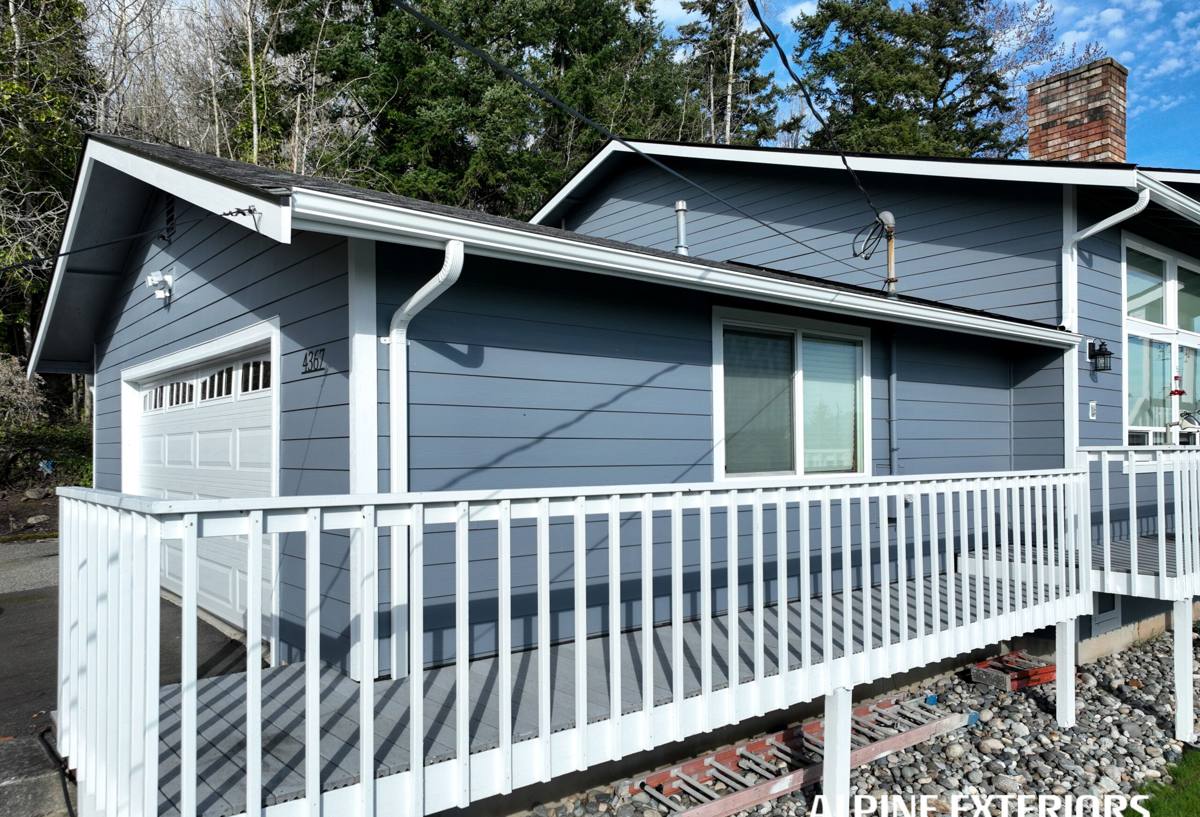
What Puget's Climate Actually Does to a Roof
Salt Air and Corrosion
Proximity to the Sound means airborne salt settles on exterior surfaces, including roofing. Bare or poorly coated steel will corrode faster in this environment than it would twenty or thirty miles inland. This doesn't rule out metal roofing — it just means material selection and finish quality matter more here than they would in a drier, inland part of the county.
Driving Rain and Wind-Driven Water
Storms coming off the water frequently push rain sideways, not just down. That matters at every seam, fastener, and flashing point on a roof. A roof that performs fine in a straight-down rain can still leak under wind-driven conditions if the laps, seams, and flashing details weren't built for it.
The Long Moss Season
Shade, moisture, and mild temperatures are exactly what moss wants, and Puget's tree cover combined with our wet season gives it a long window to establish. On asphalt shingles, moss doesn't just sit on the surface — it holds moisture against the shingle and works into the mat over time, shortening the roof's life. Metal's smooth, hard surface gives moss far less to anchor to, which is one of the bigger practical advantages homeowners see after switching.
What a Correct Metal Roof Installation Involves
Metal roofing fails when it's installed like it's just a different-looking shingle. It isn't. The systems, fastening methods, and moisture management are different, and skipping steps is where most metal roof problems trace back to.
- Deck inspection and prep: the roof deck gets checked for rot, soft spots, and proper attachment before anything goes down — metal will telegraph an uneven or damaged deck over time.
- Underlayment suited to metal: a synthetic or high-temp underlayment rated for use under metal, not a generic felt, to manage condensation and act as a secondary water barrier.
- Correct fastening pattern: exposed-fastener systems need fasteners set at the manufacturer's spacing and torque — overdriven or underdriven screws are a leading cause of leaks. Standing seam systems use concealed clips instead, which avoids that failure point entirely.
- Flashing at every transition: valleys, wall intersections, chimneys, and penetrations all need flashing details matched to the panel profile — this is where wind-driven rain finds its way in if it's rushed.
- Ventilation: proper intake and exhaust airflow under the roof deck to control condensation, which matters more under metal than under shingles.
- Panel alignment and expansion allowance: metal expands and contracts with temperature swings, so fastening and trim details need to allow for that movement without buckling or loosening over time.
Choosing the Right System for a Puget Roof
Not every metal roofing system is the same, and the right choice depends on the home's roof pitch, budget, and how long the owner plans to be in the house.
| System | How It's Fastened | Best Fit | Trade-offs |
|---|---|---|---|
| Standing Seam | Concealed clips, no exposed fasteners on the field | Homes wanting the longest service life and cleanest look | Higher upfront cost; installation is less forgiving of shortcuts |
| Exposed-Fastener Panel | Screws driven through the panel face | Budget-conscious projects, outbuildings, some full-home reroofs | Fasteners and washers need periodic inspection and eventual replacement |
| Stone-Coated Steel | Interlocking panels, often screwed or clipped | Homeowners who want a shingle or shake look with metal's durability | More seams and profile detail to flash correctly around penetrations |
We'll walk through which of these makes sense for your specific roof rather than defaulting to one system for every job — pitch, existing structure, and budget all factor in.
Coatings and Salt-Air Durability
In a coastal-influenced area like Puget, the coating on a metal roof matters as much as the base metal. Galvanized and galvalume steel with a quality paint system (like a PVDF-based finish) hold color and resist chalking and corrosion far longer near salt air than uncoated or lower-grade finishes. We don't install bare or minimally coated panels on homes this close to the water — it's a maintenance and longevity trade-off that isn't worth the small savings, not because those materials are unusable everywhere, but because Puget's air exposure specifically works against them.
Fastener and Trim Material
Fasteners, flashing, and trim need to match the panel material to avoid galvanic corrosion — mixing incompatible metals at contact points is a slow but real failure mode in salt-exposed environments. This is a detail that's easy to overlook and expensive to fix later.
Our Process on a Puget Metal Roofing Project
- On-site assessment: we look at the existing roof, deck condition, ventilation, and how exposed the home is to wind-driven rain and salt air before recommending a system.
- Tear-off vs. overlay decision: most metal roofing goes on after a tear-off to the deck, though some systems allow installation over existing shingles under the right conditions — we'll tell you honestly which applies to your roof.
- Deck repair: any rot, soft spots, or damaged sheathing gets replaced before underlayment goes down.
- Underlayment and flashing installation: the moisture management layer goes in first, with flashing detail work at every valley, wall, and penetration.
- Panel installation: panels go on with correct fastening or clip spacing, working to keep seams and laps tight against wind-driven rain.
- Final walkthrough: we check flashing, fastener seating, and site cleanup before calling the job done.
Why a Crew That Already Works Puget Matters
A metal roof installed correctly in a dry inland climate can still underperform on a home exposed to Puget's wind and salt air if the crew doesn't adjust their flashing details and fastener choices for it. Crews that work this area regularly already know which roof orientations catch the worst of the wind-driven rain, where moss tends to establish first, and which coating and fastener combinations actually hold up near the water. That local pattern recognition is hard to replace with a generic installation checklist, and it's usually the difference between a metal roof that looks the same in year one and year fifteen, and one that doesn't.
We also know the practical side of working in Bellingham and Whatcom County — permitting expectations, typical roof pitches in older Puget-area homes, and how to sequence a reroof around the wetter months instead of fighting them.
Maintaining a Metal Roof in a Wet, Mossy Climate
Metal roofing is lower-maintenance than asphalt, but "lower-maintenance" isn't "no maintenance," especially in a climate with this much moss pressure and moisture.
- Clear overhanging branches and debris that trap moisture against panels or in valleys.
- Check gutters and downspouts each fall so wind-driven rain has a clear path off the roof.
- Look for any moss or algae starting to establish in shaded valleys or north-facing slopes, and address it before it spreads.
- Inspect exposed fasteners periodically on screw-down systems — washers can wear over years of temperature cycling.
- Have flashing and penetrations checked after major storms, since wind-driven rain is the condition most likely to expose a weak point.
What Drives Cost on a Puget Metal Roofing Project
| Factor | Why It Matters |
|---|---|
| System type | Standing seam costs more upfront than exposed-fastener panel but needs less long-term fastener maintenance |
| Roof complexity | More valleys, dormers, and penetrations mean more flashing work and labor time |
| Deck condition | Rot or soft sheathing found during tear-off adds repair cost before installation can proceed |
| Coating grade | Higher-grade coatings cost more but hold up better against Puget's salt air exposure |
| Tear-off vs. overlay | Full tear-off adds labor and disposal cost but gives a clean start and full deck inspection |
Every roof is different, and we'd rather give you an honest number based on your actual roof than a broad estimate that doesn't hold up once we're up there measuring.
Is Metal Roofing the Right Call for Your Puget Home?
Metal roofing isn't automatically the right answer for every home — a shorter ownership timeline, a tight budget, or a roof shape with a lot of complex framing can shift the math. Part of an honest assessment is telling you when a well-installed asphalt roof is still the more practical choice, and when the climate and long-term ownership plan make metal worth the higher upfront cost.
If you're weighing options for a Puget-area home, we're happy to walk the roof with you, talk through what your specific exposure and structure call for, and give you a straight answer — not a sales pitch. There's a free, no-pressure estimate form below whenever you're ready.