 Bellingham Siding
 Why Cordata Homes Face a Different Set of Window Problems
Cordata sits far enough north in Bellingham that its homes get the full range of what Whatcom County weather can do in a year — long stretches of driving rain off the Pacific, damp air carrying salt from Bellingham Bay and the Salish Sea, and a shoulder season every fall and spring where nothing quite dries out. Add the shade and moisture that come with mature landscaping in a lot of Cordata's established yards, and you get conditions that are genuinely hard on window frames, sills, and hardware.
None of this is dramatic on its own. It's cumulative. Salt-laden air speeds up corrosion on screws, balances, and lock hardware. Sustained wind-driven rain finds any weak point in a window-to-wall seal, not just once but every storm season for years. And the long grey stretch of low sun and high humidity that Whatcom County is known for gives moss and algae time to take hold on sills, tracks, and trim — which holds moisture against the window even longer. A window that would perform fine in a drier climate can fail years early here if it wasn't built or installed with these conditions in mind.
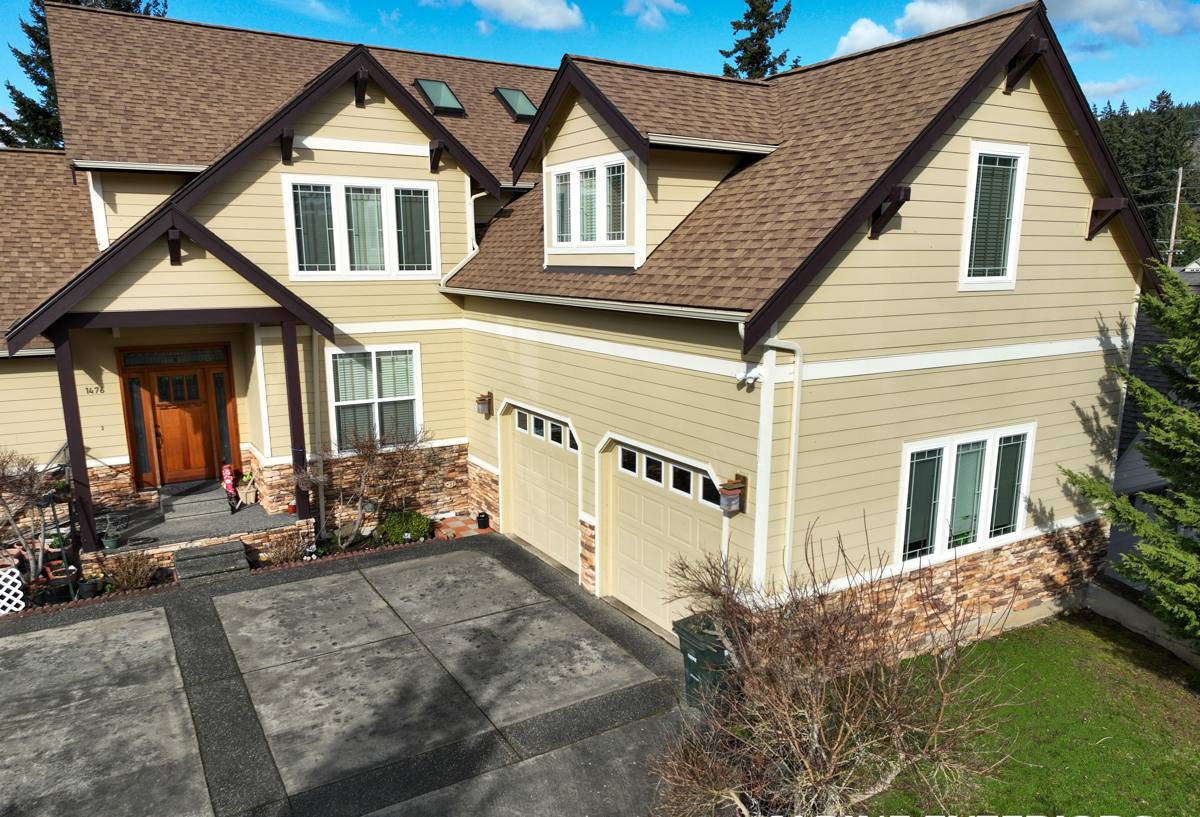
What "Custom" Actually Means on a Window Job
"Custom" doesn't mean expensive or fancy — it means the window is made to fit your home's actual openings and architecture, not a generic big-box size with the gaps shimmed and caulked to fit. On Cordata homes, that matters for a few practical reasons:
- Older homes settle over time, so rough openings are rarely perfectly square — custom units are measured and built to the opening as it actually is.
- Newer Cordata construction often has specific trim profiles and grid patterns that a stock replacement won't match, leaving mismatched sightlines from the street.
- Glass packages can be specified by exposure — a window facing prevailing weather needs a different performance spec than one on a sheltered wall.
- Custom sizing lets us correct for out-of-square or slightly bowed openings instead of forcing a standard-size unit into a space it wasn't made for.
Getting this right up front avoids the two most common outcomes of a rushed window job: gaps that get caulked over instead of properly sealed, and windows that operate stiffly because they were never quite square to begin with.
Choosing the Right Material for This Climate
Every window material has a place, but they don't all hold up the same way to sustained rain and salt air. Here's how the common options compare for a Cordata home:
| Material | Moisture Resistance | Maintenance | Notes for This Climate |
|---|---|---|---|
| Vinyl | Very good — won't rot or corrode | Low — occasional cleaning | Solid all-around choice; check weld quality on corners for a tight seal |
| Fiberglass | Excellent — dimensionally stable in wet/dry cycles | Low | Handles temperature and moisture swings with minimal expansion or contraction |
| Aluminum-clad wood | Good exterior protection, wood interior warmth | Moderate — exterior clad protects wood, but seals need periodic checking | Good option when matching an existing wood-window look; clad seams are the detail to get right |
| Bare aluminum | Prone to condensation and corrosion in salt air over time | Higher | We generally steer clients toward thermally broken options if aluminum is preferred, given the coastal air here |
There's no single "best" material — it depends on your home's style, budget, and how much upkeep you want to take on. What matters more than the brand name on the frame is how well the unit is built and how correctly it's installed, which is where most window problems actually start.
A Note on Wood Windows
Traditional all-wood windows can look great on an older Cordata home, but bare wood exposed to this much sustained moisture requires a real maintenance commitment — regular repainting and caulk checks — to avoid rot at the sill and joints. If you want the wood look with less upkeep, aluminum- or vinyl-clad wood units give you that appearance with a protected exterior face.
The Installation Details That Actually Keep Water Out
More window failures come from installation shortcuts than from the windows themselves. In a climate that gets as much driving rain as Whatcom County, the sequence of materials behind the window frame matters as much as the window itself:
- Weather-resistive barrier integration — the housewrap or barrier needs to lap correctly over the flashing, not just get taped over gaps afterward.
- Sill pan flashing — a sloped, sealed pan under the window directs any water that does get past the exterior back out, instead of letting it sit against the framing.
- Flashing tape at the jambs and head, installed in the correct shingle-style order so water sheds downward and outward at every layer.
- Correct fastening and shimming so the frame stays square and doesn't rack over time, which is what causes seals to open up years later.
Sealant is the last line of defense, not the first. A window that relies on a bead of caulk to do the job that flashing and a sill pan should be doing will eventually leak — usually a year or two after installation, once the caulk starts to fail, right when it's least obvious what went wrong.
Full-Frame Replacement vs. Insert Windows
Not every Cordata home needs the same approach, and a contractor who only offers one method is going to fit your house to their process instead of the other way around.
Insert (Pocket) Replacement
The new window goes into the existing, sound frame. This works when the original frame is square, dry, and free of rot — it's less invasive and typically faster, since existing siding and trim stay in place.
Full-Frame Replacement
The old frame comes out entirely, down to the rough opening. This is the right call when there's rot, water damage, an out-of-square opening, or when you're changing the window size or style. It costs more and takes longer, but it's the only way to actually fix a compromised opening rather than build a new window on top of an old problem.
Part of a proper estimate is opening things up enough to tell you honestly which one your home needs — not defaulting to the faster option because it's easier to sell.
Signs Your Current Windows Are Already Losing the Battle
A lot of window problems in this climate show up gradually, so homeowners get used to them before recognizing they're actually a problem. Worth checking for:
- Fogging or haze between the panes of a double-pane window — this means the seal has failed and the gas fill is gone
- Soft or discolored wood at the sill or lower corners of the frame
- Moss, algae, or persistent green staining building up on the sill or in the track
- Drafts you can feel with a hand near the frame on a windy day
- Windows that are hard to open, close, or lock — often a sign the frame has shifted
- Visible gaps or cracked caulk lines around the exterior trim
- A noticeable jump in heating costs without any other explanation
Any one of these on its own isn't an emergency, but they're worth addressing before winter's driving rain finds the weak spot for you.
Our Process, Start to Finish
- On-site assessment of every window being considered, including a look at the framing and sill condition, not just the glass
- An honest recommendation on insert vs. full-frame replacement, with the reasoning explained
- Precise measurement of each opening and material/style selection suited to your home and its exposure
- Manufacturing lead time communicated up front, so there are no surprises on scheduling
- Installation with proper flashing, sill pan, and sealing at every opening — not just the window swapped in
- Final walkthrough on operation, locks, and sightlines before we consider the job finished
- Job-site cleanup, including removal of old units and packaging
Energy Performance and Condensation Control
A well-installed custom window should do more than stop leaks — it should noticeably improve comfort near the glass in winter and cut down on interior condensation. A few things worth understanding before you choose a glass package:
Low-E coatings and gas fills (typically argon) reduce heat transfer and are worth the modest upgrade cost in a climate where heating runs a good part of the year. Double-pane units are standard and perform well; triple-pane adds further insulation value but at a higher cost, and the payoff depends on the specific wall and exposure. Interior condensation on a cold morning isn't automatically a sign of a bad window — it's often about indoor humidity and ventilation. Condensation between the panes, on the other hand, always means a failed seal and a unit that needs replacing.
Why Local Install Experience in Cordata Matters
Window performance in Whatcom County isn't theoretical — it's tested every rainy season. A crew that's worked windows across Bellingham and Cordata specifically has already seen how the local mix of home ages, exposures, and moisture patterns plays out over time: which orientations take the worst of the driving rain, which older openings tend to be out of square, and where moss and algae build up fastest. That experience shows up in the small decisions during install — how flashing gets lapped, where extra attention goes on a sill pan, which materials are worth the upgrade for a given exposure — that a crew unfamiliar with this climate might not think twice about.
If you're weighing custom windows for a Cordata home, we're happy to come take a look and give you a straightforward assessment — what your current windows need, what your options are, and a clear estimate with no pressure attached. The form below is the easiest way to get that started.