 Bellingham Siding
 Siding Built for Where Columbia Actually Sits
Columbia sits close enough to the water that salt-laden air is a daily fact of life for anything on the outside of a house. Add Whatcom County's long wet season, driving rain that comes in sideways off Bellingham Bay, and a moss season that can run most of the year on shaded north and west walls, and you have a climate that is genuinely hard on exterior materials. Siding here isn't just cosmetic — it's the first line of defense against moisture intrusion, and it takes a beating that siding in a drier inland climate never sees.
We install siding for homes throughout Bellingham, and Columbia's mix of older housing stock and infill construction means we see a wide range of starting conditions: original wood siding gone soft at the bottom courses, vinyl that's chalked and cracked from UV and salt exposure, and newer builds where the siding is fine but the water management behind it was never done right. The material on the wall matters, but what's underneath it — and how it was put on — matters just as much.
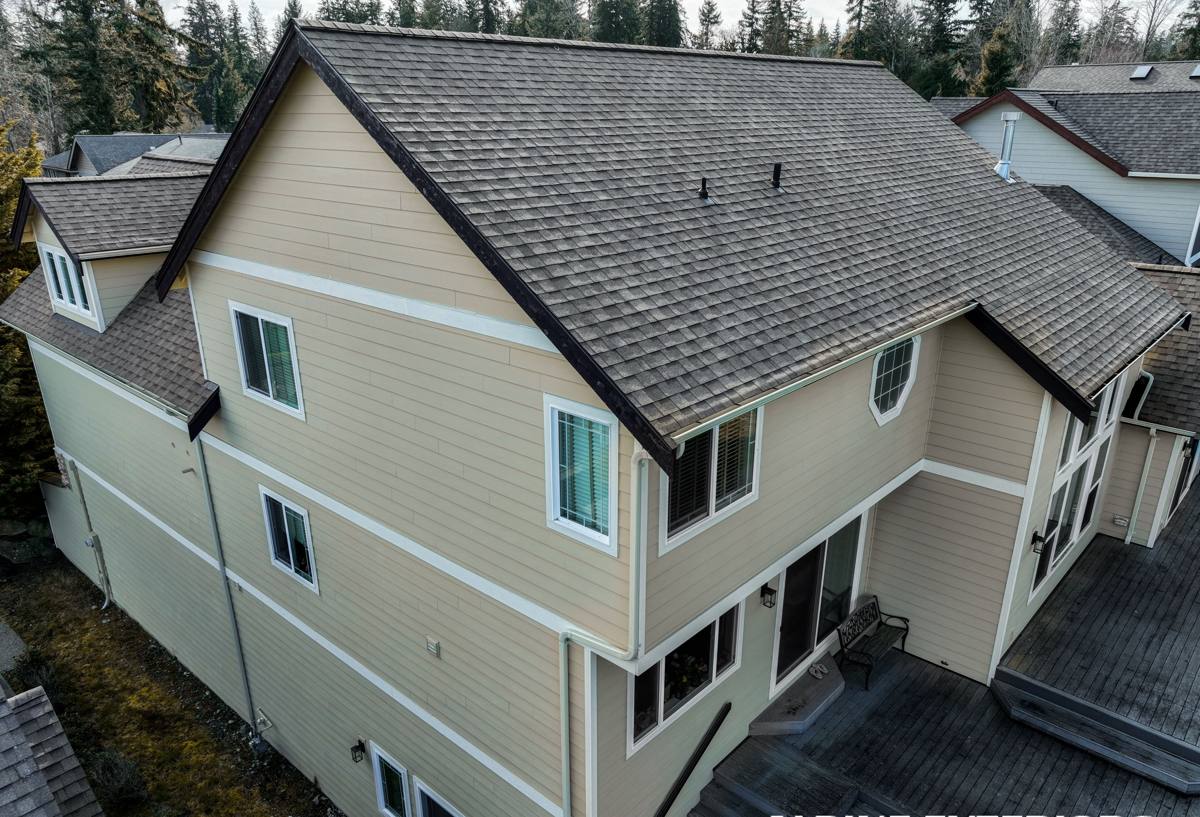
What Salt Air, Rain, and Moss Actually Do to Siding
Salt Air
Airborne salt accelerates corrosion on fasteners, flashing, and any exposed metal trim. It also breaks down cheaper paint and coating systems faster than inland weathering would, leading to chalking, fading, and premature clear-coat failure on products that weren't engineered with coastal exposure in mind.
Driving Rain
Bellingham doesn't just get a lot of rain — a good share of it comes in wind-driven, hitting walls at an angle instead of falling straight down. That means water gets pushed up under laps, into seams, and around penetrations that would stay dry in a calmer climate. Siding systems and installation details that work fine somewhere with gentle, vertical rainfall can leak here.
Moss and Sustained Moisture
Shaded walls, especially those facing north or tucked under tree cover, stay damp for extended stretches. That's exactly the environment moss and algae need to establish. Beyond the cosmetic staining, sustained surface moisture keeps the siding material itself wet longer, which is hard on anything that isn't dimensionally stable or properly finished.
What a Correct Installation Actually Involves
Most siding failures we're called out to inspect aren't material failures — they're installation failures. The siding looked fine on install day and fell apart two, five, or ten years later because something behind it was done wrong. A correct job includes:
- A continuous, properly lapped weather-resistive barrier behind the siding — the actual waterproofing layer, not the siding itself
- Correct flashing at every window, door, and penetration, integrated with the barrier so water sheds outward and down, never behind
- Rainscreen or drainage gap where conditions call for it, so incidental moisture that does get behind the siding can drain and dry instead of sitting against the sheathing
- Manufacturer-specified fastener type, spacing, and penetration depth — not "close enough"
- Proper clearance at grade, decks, and roof lines so siding never sits in standing water or gets buried in soil or mulch
- Caulking and sealant used only where the manufacturer calls for it — over-sealing traps moisture just as badly as under-sealing lets it in
Skip any one of these and you can end up with siding that looks correct from the curb while water is quietly working behind it. In a climate like Bellingham's, that process moves faster than most homeowners expect.
Why We Install Only James Hardie Fiber Cement
We don't install vinyl, LP SmartSide, Cemplank, Allura, or primed wood siding. That's a deliberate standard, not a matter of preference. James Hardie is a non-combustible fiber cement product, which matters both for fire risk and for how it holds up to sustained moisture exposure compared to wood-based or vinyl products. It doesn't rot, it isn't a food source for insects, and it resists the freeze-thaw and moisture cycling that this region puts siding through.
Hardie's ColorPlus factory-applied finish is baked on under controlled conditions, which gives it better UV and fade resistance than field-applied paint — a real advantage against Bellingham's combination of salt exposure and long gray-sky UV exposure. Hardie also engineers its HZ product lines by climate zone; the HZ5 formulation used in this region is built specifically for wetter, harsher weather patterns rather than a one-size-fits-all national product. That's the kind of engineering decision that shows up in how the siding performs fifteen years in, not on install day.
We're not going to tell you every other product on the market is worthless — vinyl is inexpensive and low-maintenance in the right conditions, and LP SmartSide has real fans. But we've made a professional call that in this climate, with the moisture load Whatcom County walls take on, fiber cement done right is what we're willing to put our name on. Vinyl can warp and crack under UV and temperature swings and it's a poor performer if the wall behind it isn't perfectly managed for water. Wood-based composite products need the factory coating and edge-sealing to stay intact, and any breach in that coating is a path for the exact sustained moisture this region specializes in. We'd rather install one product correctly, every time, than juggle installation details across five different systems with five different moisture tolerances.
Our Installation Process
| Step | What Happens |
|---|---|
| Assessment | On-site inspection of existing siding, sheathing condition, and any moisture or rot found during removal |
| Water management plan | Weather-resistive barrier, flashing details, and drainage approach specified before any siding goes up |
| Removal and substrate check | Old siding stripped, sheathing inspected and repaired where needed — this is where hidden problems get caught |
| Barrier and flashing installation | Continuous barrier installed and lapped correctly, flashing integrated at every window, door, and penetration |
| Hardie installation | Panels or lap siding installed to manufacturer fastening and clearance specs, with attention to the details specific to this climate |
| Trim, caulk, and touch-up | Finish trim installed, sealant applied only where specified, ColorPlus touch-up applied to any field cuts |
| Final walkthrough | Walk the job with you, confirm clearances and details, answer questions about care going forward |
Cost Factors for a Columbia Siding Job
| Factor | Why It Matters Here |
|---|---|
| Extent of substrate repair | Homes with hidden moisture damage behind old siding need sheathing repair before new siding goes on — this is common on older Columbia homes |
| Siding profile chosen | Lap, panel, and shingle-style Hardie products carry different material and labor costs |
| Wall complexity | Dormers, multiple gables, and lots of trim and penetrations add labor time and flashing detail |
| Access and staging | Tight lots, slopes, and limited driveway access common in older neighborhoods can affect scheduling and equipment needs |
| Full tear-off vs. partial | Full removal lets us inspect and correct the water management system underneath — partial replacement can't always do that |
We don't quote a job sight unseen. Every estimate starts with an actual look at your walls, because the two biggest cost drivers — hidden substrate condition and wall complexity — can't be judged from a photo or a square-footage number alone.
Signs Your Current Siding Needs Attention
- Soft or spongy spots when you press on the siding, especially near the bottom courses or under windows
- Persistent moss or algae staining that comes back within a season of cleaning
- Visible cracking, warping, or buckling panels
- Paint that's peeling or bubbling in patches rather than wearing evenly
- Rising utility bills with no other explanation — a sign the wall assembly may no longer be doing its job
- Visible daylight, drafts, or musty smell along exterior walls from the inside
- Siding that was installed with no visible rainscreen gap or clearance at grade
Any one of these on its own isn't necessarily an emergency. Several together, especially on a wall that takes direct weather, are worth having looked at before the next wet season.
Why Local Experience in Columbia Matters
Siding specs on paper don't account for how a particular street sits relative to prevailing wind, how much shade a lot gets through the winter, or how a neighborhood's typical construction era tends to have handled (or mishandled) moisture management the first time around. A crew that already works in Columbia and the surrounding Bellingham neighborhoods has seen how these homes actually perform over time — which walls take the worst of the driving rain, where moss problems tend to concentrate, and what's usually hiding behind the siding on a house of a given age. That's the kind of judgment that doesn't come from a spec sheet, and it's what keeps a straightforward job from turning into a surprise.
Caring for Hardie Siding After Installation
James Hardie siding is genuinely low-maintenance compared to wood, but "low-maintenance" doesn't mean "no maintenance" in this climate. A yearly rinse-down helps keep salt residue and early moss growth from taking hold, particularly on shaded and north-facing walls. Keep an eye on caulking around windows and trim over the years — sealant is the one component that wears out before the siding does. Trim back vegetation and mulch that's crept up against the bottom edge, since Hardie needs the clearance it was installed with to keep functioning as designed. Beyond that, correctly installed Hardie siding in this region is built to go a long time without asking much of you.
If you're weighing a siding project in Columbia, we're glad to come take a look, walk your walls with you, and put together a straightforward, no-pressure estimate — no scare tactics, just an honest read on what your home needs. Use the form below to get started.