 Bellingham Siding
 Why Decks in Sunnyland Wear Out Faster Than the Manual Says
Sunnyland sits close enough to Bellingham Bay that salt-laden air reaches most yards in the neighborhood, and that changes how a deck ages. Fasteners corrode faster than their rated lifespan suggests, aluminum and steel hardware can pit and streak, and any exposed end grain on wood soaks up moisture on a schedule that has little to do with the calendar and everything to do with our nine-month wet season. Add in the driving rain that comes sideways off the water during winter storms, and you get water finding its way into joints, ledger connections, and fastener holes that a drier climate would never test.
Then there's moss. Whatcom County's long, mild, damp stretch from fall through spring is ideal moss and algae territory, and a deck surface holds moisture longer than a roof or a driveway because it's horizontal, often shaded by trees, and rarely gets full sun exposure to dry it out between rain events. A deck built without that reality in mind — standard spacing, minimal ventilation underneath, generic fasteners — will show rot, soft spots, and slick moss growth years before a deck built for this specific climate.
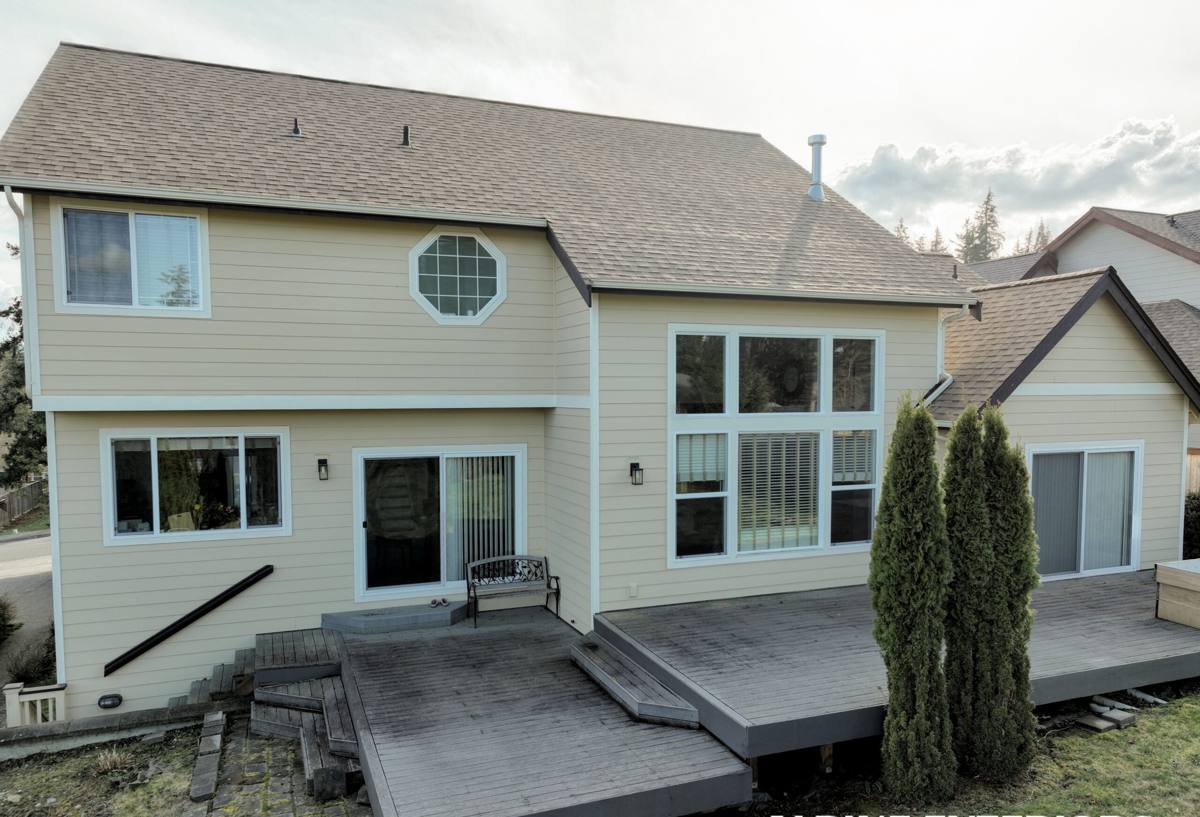
Signs a Sunnyland Deck Needs Replacement, Not Just Repair
Not every tired-looking deck needs a full tear-off. But there's a point where patching boards is throwing money at a structure that's already compromised underneath. Here's how we tell the difference on site visits around Sunnyland:
- Soft or spongy decking, especially near the house, around posts, or at board ends — usually means moisture has been sitting there for more than one season
- Rust streaks running down from fasteners or brackets — a sign the hardware itself is failing, not just staining the surface
- Gaps or movement where the ledger board meets the house — this is the single most common failure point we see and it's a safety issue, not cosmetic
- Persistent moss or black-green staining that comes back within weeks of cleaning, even after a pressure wash
- Posts or footings that feel loose when you push on the railing, or visible cracking in the concrete footings
- A deck built more than 20-25 years ago with no visible flashing at the house connection — older Whatcom County builds often predate current flashing standards
If it's mostly surface wear — some graying, a few loose boards, railing that needs tightening — repair can make sense. If the framing, ledger, or footings are involved, replacement is almost always the more honest answer, because rebuilding on a compromised structure just moves the failure point a few years down the road.
What a Correct Deck Replacement Involves Here
Ledger Board and Flashing
The ledger — the board that attaches the deck to the house — is where most of the water damage we find actually starts. In a climate with as much annual rainfall as ours, the flashing detail at that connection matters more than almost anything else on the project. We install proper step or Z-flashing with a water-resistive barrier behind it, sloped to shed water away from the house rather than trap it against the rim joist. This is the detail that's easiest to skip and most expensive to fix later, since by the time it fails you're usually looking at rim joist or sheathing repair on the house itself, not just the deck.
Footings and Frost Depth
Whatcom County soil and our regional frost depth requirements mean footings need to go deep enough to stay stable through freeze-thaw cycles, even though our winters are mild compared to inland climates. We size and pour footings to local code rather than guessing based on what the old deck had — a lot of older Sunnyland decks were built with undersized or shallow footings that have shifted slightly over the decades, which shows up as a deck that feels slightly uneven even though nothing looks obviously wrong.
Framing and Ventilation
Joist spacing, beam sizing, and post placement all get engineered to the actual size and use of the deck, not just copied from what was there before. We also pay attention to airflow underneath the deck — tight-to-the-ground framing with no ventilation is exactly what keeps moisture (and moss) sitting on the underside of boards long after a rain event, which shortens the life of even good decking material.
Decking Material Comparison
| Material | How It Handles Our Climate | Maintenance | Typical Lifespan Here |
|---|---|---|---|
| Pressure-treated wood | Affordable, but end grain and fastener holes absorb moisture; needs sealing to resist our wet season | Annual cleaning, re-sealing every 1-2 years | 10-15 years |
| Cedar | Naturally rot-resistant and handles moisture better than most softwoods, but still grays and can grow moss without upkeep | Cleaning and oiling every 1-2 years | 15-20 years |
| Composite decking | Resists rot and doesn't absorb water like wood; some early-generation composites held moisture at the core, so board quality matters | Periodic washing, no sealing needed | 20-25+ years |
| PVC/capped composite | Fully sealed surface handles driving rain and salt air with the least material breakdown | Occasional washing | 25+ years |
We don't push one material on every job. A shaded, moisture-heavy Sunnyland lot often does best with composite or capped composite because it won't wick water the way wood does, while a sunnier, more open yard can get a lot of life out of well-maintained cedar. We'll walk your specific site conditions with you before recommending anything.
Railings, Fasteners, and Hardware for Salt Air Exposure
Hardware is where a lot of decks in this area quietly fail first, even when the decking itself still looks fine. We use stainless steel or coated fasteners rated for coastal and marine-adjacent exposure rather than standard galvanized hardware, because the salt content in the air here accelerates corrosion on lower-grade fasteners. Structural connectors — joist hangers, post bases, ledger bolts — get the same treatment. It costs more up front than generic hardware, but replacing a deck's structural fasteners after they've corroded means tearing into the framing again, which is a far bigger job than doing it right the first time.
Our Process, From Estimate to Finished Deck
- Site visit and assessment — we look at the existing structure, ledger condition, footing placement, drainage, and sun/shade exposure specific to your lot
- Honest scope discussion — repair vs. replace, material options, and a realistic cost range based on what your deck actually needs
- Written estimate — clear line items, no vague allowances
- Permit handling — we pull the required permits and build to current code rather than matching whatever the old deck was built to
- Demolition and disposal — old decking, framing, and footings removed and hauled off
- Structural build — footings, framing, ledger flashing, and inspection points completed in sequence
- Decking, railing, and finish work — installed to manufacturer spec, with attention to fastener spacing and drainage gaps
- Final walkthrough — we go over care and maintenance specific to the material you chose before we consider the job done
Moss, Mildew, and Ongoing Deck Care in the Pacific Northwest
Even a well-built deck needs some seasonal attention here. Moss spores are present in the air across Whatcom County nearly year-round, and any deck that sits in partial shade will pick up growth eventually — the goal is slowing it down and making cleanup easy, not pretending it won't happen. Proper board spacing and underside ventilation, which we build in from the start, make a real difference in how fast moss and mildew take hold. Beyond that:
- Sweep debris (leaves, needles) off the deck regularly — trapped organic material holds moisture and feeds moss
- Rinse or lightly wash the surface a couple of times a year, more often in shaded areas
- Check railings and stair connections annually for movement, especially after a hard winter storm season
- Keep gutters and downspouts near the deck clear so runoff isn't dumping extra water onto or near the structure
Permits and Code Considerations in Bellingham
Deck replacement in Bellingham generally requires a permit once you're rebuilding the structural elements — footings, framing, and ledger connection — rather than just swapping surface boards. Inspections typically happen at the footing stage and again before decking is installed, which is exactly the sequence where a properly flashed ledger and correctly sized footings get verified. We handle the permit process as part of the job rather than leaving it to the homeowner, since skipping it or building outside code creates problems at resale and can affect insurance if there's ever a structural failure.
Why Hiring a Crew That Already Works Sunnyland Matters
A contractor who works this specific pocket of Bellingham has already seen how the salt air off the bay, the shade patterns from mature trees common in the neighborhood, and the region's rainfall totals play out on real decks over real years — not just on a spec sheet. That translates into practical decisions: which fastener grade actually holds up, which decking products perform in the shadier lots versus the sunnier ones, and where ledger flashing tends to get shortchanged on older builds. It also means a crew that's familiar with Bellingham's permitting process and typical inspection sequence, so the project moves without unnecessary delays.
Questions to Ask Before Hiring a Deck Replacement Contractor
- Do you pull permits and handle inspections, or is that on me?
- What fastener and hardware grade do you use, and is it rated for coastal exposure?
- How do you flash and seal the ledger board connection?
- What footing depth do you build to, and does it meet current Whatcom County requirements?
- Can you walk me through material options for a shaded vs. sunny deck location?
- What's included in your written estimate, and what could change the price?
What This Actually Costs
Deck replacement pricing depends heavily on size, framing complexity, material choice, and whether footings need to be relocated or added. Pressure-treated framing with composite decking tends to land in a broad mid-range, while premium capped composite or PVC decking with upgraded railings runs higher. Rather than quote a number that won't match your specific deck, we provide a written estimate after seeing the site, so you know exactly what you're paying for and why.
If your Sunnyland deck is showing its age, or you're just not sure whether it needs repair or a full rebuild, we're happy to take a look. Fill out the form below for a free, no-pressure estimate — we'll give you a straight answer about what your deck actually needs.