 Bellingham Siding
 Why Sunnyland Decks Take a Different Kind of Beating
Sunnyland is an established, tree-shaded residential neighborhood, and that's part of what makes it a great place to live — and part of what makes deck building here trickier than it looks. Mature landscaping means more shade, more leaf litter, and slower drying times after a storm. Add in Bellingham's proximity to Puget Sound and Bellingham Bay, and you've got a climate that combines salt-tinged marine air with long stretches of driving rain and a moss season that can run from October well into spring. A deck built the way it might be built in a drier inland climate simply doesn't hold up the same way here.
We're not talking about a deck falling apart in year one. We're talking about the slow stuff: fasteners that start weeping rust streaks by year three, ledger boards that trap moisture against the house rim joist, joists that stay damp for weeks at a time under a shaded deck, and surfaces that turn slick and green because nobody accounted for drainage or airflow underneath. None of that is dramatic. All of it is preventable if the deck is built correctly the first time.
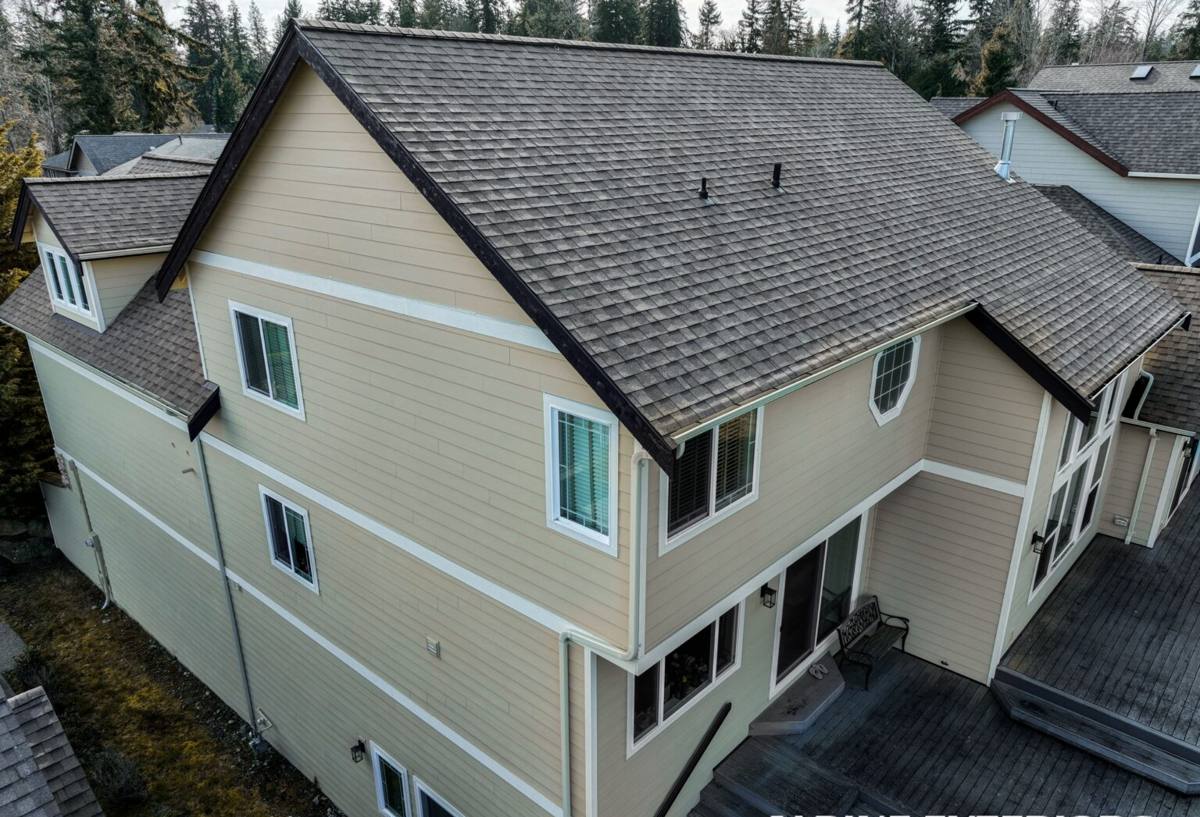
What Whatcom County's Climate Actually Does to a Deck Over Time
It helps to understand the specific mechanisms at work, because they drive almost every decision a builder makes on a Sunnyland project.
Moisture that doesn't fully leave
Bellingham gets a lot of rain, but it's the pattern that matters more than the total. Long, low-intensity soaking rain followed by cool, overcast days means wood and even engineered decking stay damp far longer than they would after a quick summer downpour somewhere drier. Shaded lots — common in Sunnyland thanks to mature trees — extend that drying time even further. Any structural component that can't shed water and dry out becomes a slow-motion problem.
Moss and organic growth
Moss doesn't just grow on roofs. Given a shaded, damp deck surface with limited airflow, it will colonize decking boards, stair treads, and the tops of railings. Beyond looking bad, a mossy deck surface is a genuine slip hazard, especially on stairs, and moss holds moisture against the board surface longer than bare wood or composite would on its own.
Salt air and corrosion
Bellingham's marine air carries enough salt content to accelerate corrosion on fasteners, brackets, and hardware — especially on decks with any western or southwestern exposure that catches weather off the water. Standard zinc-coated screws and joist hangers that would be fine in a landlocked climate can start showing rust bleed through the decking within a couple of seasons here.
Choosing the Right Decking Material for a Sunnyland Lot
There's no single "best" decking material — there's a best material for your specific site, sun exposure, budget, and how much maintenance you're willing to do. Here's how the common options actually compare once you factor in our climate rather than a manufacturer's brochure.
| Material | Upfront Cost | Maintenance | Moisture & Moss Resistance | Realistic Lifespan Here |
|---|---|---|---|---|
| Pressure-treated pine/fir | Lowest | High — annual cleaning, periodic sealing | Fair; needs consistent upkeep to resist moss and rot | 10-15 years with maintenance |
| Cedar | Moderate | Moderate-high — regular sealing to hold color and resist graying | Naturally more rot-resistant than pine, but still needs care in shade | 15-20 years with maintenance |
| Capped composite | Higher | Low — occasional washing | Good; capped surface resists moss adhesion better than bare wood | 25-30+ years |
| Cellular PVC | Highest | Lowest — no sealing, minimal washing | Best; fully synthetic, doesn't absorb moisture | 30+ years |
For a shaded, moisture-heavy lot, we lean toward capped composite or PVC for the walking surface, particularly on stairs where a mossy tread is a real fall risk. That said, plenty of homeowners want the look and feel of real wood, and cedar can absolutely work here — it just needs an honest conversation up front about the sealing schedule required to keep it performing, not a sales pitch that glosses over it.
Framing lumber is a separate decision from decking
Regardless of what surface material you choose, the framing underneath should be pressure-treated lumber rated for ground contact where applicable, with cut ends field-treated before assembly. This is one of the most commonly skipped steps on lower-bid deck jobs — a factory-treated board that gets cut and drilled on site has exposed, untreated wood at every joint unless someone takes the extra few minutes to seal it.
Framing and Substructure: The Part Nobody Sees After Completion
A deck's surface material gets all the attention, but the framing underneath is what determines whether the structure is still sound in fifteen years. This is also where climate-driven shortcuts do the most long-term damage, because problems here are invisible until they're expensive.
Ledger board flashing
Where a deck attaches to the house, the ledger board needs proper flashing that directs water away from the rim joist and wall sheathing — not just a bead of caulk. In a climate with as much sustained rain as ours, an improperly flashed ledger is one of the leading causes of hidden rot damage to the house itself, not just the deck.
Joist protection and airflow
Joist tape or a comparable moisture barrier on top of each joist keeps fasteners from sitting in a pocket of trapped water where the decking board meets the frame. Under shaded, low-airflow decks, we also pay attention to spacing and skirting design so air can actually move underneath — a fully enclosed deck skirt on a shaded Sunnyland lot is a recipe for a permanently damp crawlspace under the deck.
Footings and drainage
Footings need to be set below frost depth and, just as importantly, positioned so surface water doesn't pool against the post base. On sloped or poorly draining yards — not unusual in older Bellingham neighborhoods with a mix of clay and compacted soils — we'll sometimes add gravel drainage at footing locations even when it's not strictly required, because it's cheap insurance against long-term post rot.
Railings, Fasteners, and Hardware That Actually Hold Up
Hardware is the least glamorous part of a deck estimate and the part most likely to get quietly downgraded on a cheap bid. Given the corrosion pressure from salt-tinged marine air, we don't treat this as optional upgrade territory — it's the standard.
- Fasteners: stainless steel or high-grade coated deck screws rated for treated lumber contact, not generic exterior screws
- Structural hardware: joist hangers, post bases, and ledger bolts rated for the corrosion exposure category appropriate to a coastal-influenced climate
- Fastening pattern: hidden fastener systems on composite/PVC decking where the product supports it, both for appearance and to reduce surface penetration points
- Railings: posts properly through-bolted to framing, not just lag-screwed to a rim joist — this is a common failure point that shows up as wobble within a year or two
Cutting corners on hardware doesn't save much money on the total job cost, but it's exactly the kind of thing that turns into a safety issue or a rust-streaked deck surface a few years down the line.
Our Deck Building Process, Start to Finish
We run the same process on every Sunnyland deck project, whether it's a simple ground-level platform or a multi-level deck with stairs and railings.
- On-site assessment: we walk the property, check sun/shade exposure, grade and drainage, and how the deck will attach to the house
- Design and material discussion: honest tradeoffs between wood and composite/PVC options based on your specific site, not a one-size-fits-all recommendation
- Written estimate: clear scope, materials, and timeline before any work starts
- Permitting: we handle the permit application and inspections required for the project
- Demolition/prep: removal of any existing structure and site prep, including grading for drainage where needed
- Framing: footings, posts, beams, ledger flashing, and joist protection installed to code and to our own moisture-management standards
- Decking, railings, and stairs: installed with corrosion-resistant hardware and attention to airflow and drainage details
- Final walkthrough: we go over the finished deck with you, including a basic maintenance rundown specific to the material you chose
Permits and Code Requirements in Bellingham and Whatcom County
Most new deck construction in Bellingham and unincorporated Whatcom County requires a building permit, particularly for anything structurally attached to the house or elevated more than a modest height above grade. Guardrail height, stair geometry, and structural connection requirements are governed by the residential building code the jurisdiction has adopted, and inspections are typically required at the framing stage before decking goes down and again at final completion.
Requirements can shift over time and depend on specifics like deck height, footprint, and whether it's attached or freestanding, so we don't quote code details from memory on a proposal — we pull the current requirements for your specific project and handle the permit application as part of the job. If you've had a contractor offer to "skip the permit to save time," that's not a shortcut we take; an unpermitted deck can complicate a future home sale and isn't something we're willing to put our name on.
Seasonal Maintenance Checklist for Sunnyland Deck Owners
Whatever material you choose, a small amount of seasonal attention goes a long way in this climate. Here's what we recommend to every homeowner after a build:
- Sweep leaves and debris off the deck surface regularly through fall, especially under mature trees
- Scrub or power-wash (on a low setting) any moss or algae buildup at the start of spring, before it spreads
- Check that gutters and downspouts near the deck are directing water away, not onto the deck or framing below
- Inspect stair treads and any shaded, low-airflow areas for slickness after long wet stretches
- For wood decking, re-seal on the schedule appropriate to the product — typically every 1-2 years
- Walk the railing posts and stair stringers once a year and check for any looseness at connection points
- Confirm skirting or under-deck areas still have airflow and haven't become fully enclosed by landscaping
Why It Matters That Your Crew Already Works in Sunnyland
A deck built from a generic national spec sheet, without accounting for shade patterns, drainage on older Bellingham lots, or marine-air corrosion, will look fine on installation day and start showing problems within a few seasons — usually right around when the workmanship warranty has expired. Working regularly in Sunnyland and the surrounding Bellingham neighborhoods means we already know which details matter here: where moss tends to take hold first, which framing details prevent hidden rot under mature tree cover, and how to spec hardware that won't be bleeding rust by the third winter. That local, repeated experience is the difference between a deck that's built to code and a deck that's actually built for this climate.
If you're planning a new deck or need an honest opinion on an existing one, we're happy to come take a look. Reach out for a free, no-pressure estimate using the form below.