 Bellingham Siding
 Why Sudden Valley Roofs Wear Differently
Sudden Valley sits in a wooded, lakeside setting along Lake Whatcom, and that setting shapes what a roof up there actually has to survive. Heavy tree canopy means shade that never fully burns off, needles and debris that pile up in valleys and behind chimneys, and moss that gets a head start every fall and doesn't let go until late spring. Add in the driving rain that comes through Whatcom County in long, low-pressure stretches, plus the salt-laden air that reaches inland from the Sound on a west wind, and you have a roof environment that's harder on materials than most inland Washington neighborhoods.
None of that means a roof up there is destined to fail early. It means the repair work has to account for moisture retention, biological growth, and metal fatigue in ways a drier, more open lot wouldn't. A patch job that would hold fine in a sunny, open subdivision can fail fast under a tree canopy if it doesn't account for how long that section of roof stays wet after every storm.
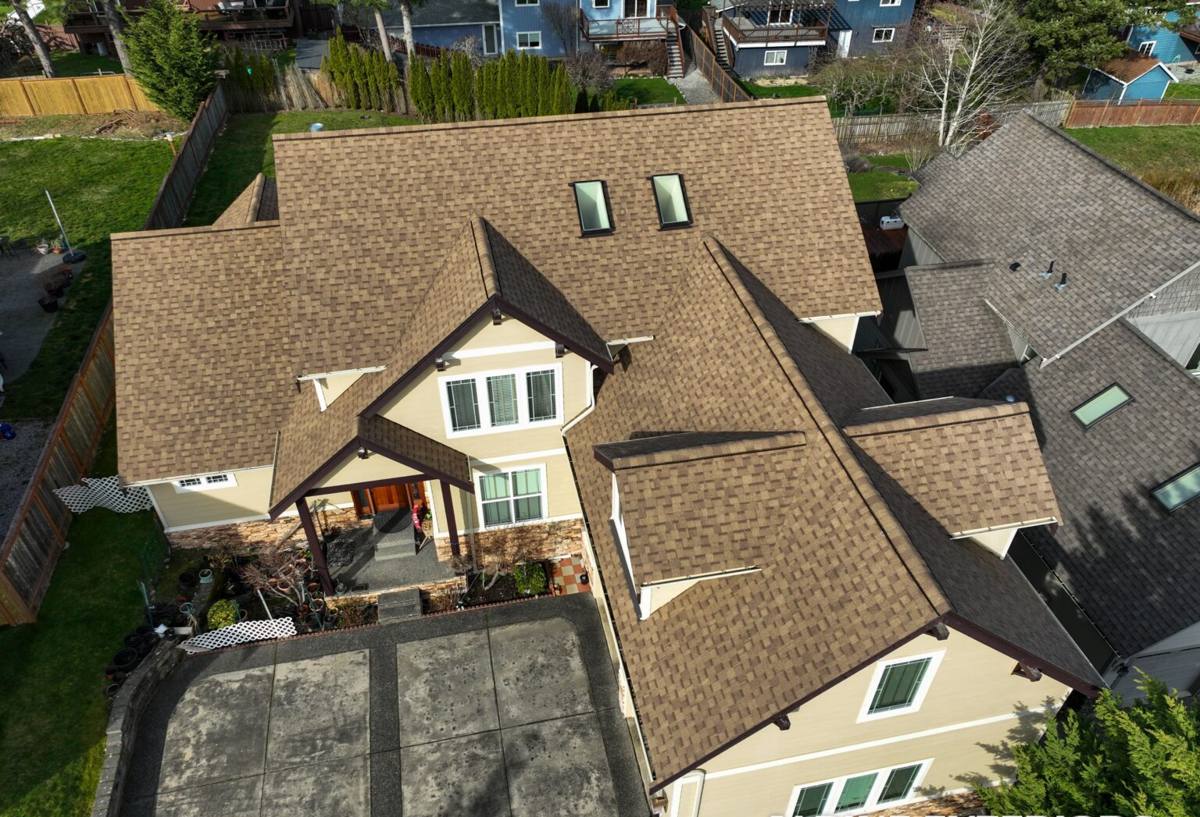
The Climate Factors That Actually Matter
Moss and Organic Growth
Moss isn't just cosmetic. Once it establishes on a shingle or shake roof, it holds water against the surface long after the rest of the roof has dried out. That constant dampness breaks down asphalt granules, rots wood shakes from the surface down, and works itself under shingle tabs, lifting them just enough for wind-driven rain to get underneath. In a tree-heavy setting like Sudden Valley, moss isn't a once-in-a-while problem — it's a seasonal cycle that needs to be part of the repair plan, not an afterthought.
Driving Rain and Wind-Driven Moisture
Bellingham-area storms don't just fall straight down. Wind pushes rain sideways and up under flashing, ridge caps, and shingle edges that were never designed to shed water from that angle. A repair that only addresses the visible failure point — a cracked shingle, a gap in flashing — without checking the surrounding underlayment for wind-driven intrusion often leads to a callback within a year or two.
Salt Air and Metal Fatigue
Coastal-influenced air corrodes exposed fasteners, flashing, and metal roof-jacks faster than it corrodes in drier inland climates. On a repair, that means checking every nail head, vent boot, and piece of step flashing near the repair area — not just replacing what's visibly failed, but catching what's about to fail next.
Signs a Sudden Valley Roof Needs Repair, Not Just a Look
- Dark streaking or thick green moss cover on north-facing or shaded slopes
- Granules collecting in gutters or at the base of downspouts
- Soft spots or slight sagging when walked, especially near valleys or chimneys
- Water stains on interior ceilings, particularly after a heavy wind-driven storm
- Curling, cracked, or missing shingles concentrated on one slope
- Rusted or lifted flashing around chimneys, skylights, and roof-to-wall joints
- Daylight visible through the roof deck from inside an attic
- Debris buildup that never fully clears, even in dry stretches
Any one of these on its own might just need monitoring. Two or three together, especially combined with visible moss or a shaded slope, usually means active moisture intrusion that's already past the point of a wait-and-see approach.
What a Correct Repair Actually Involves
A repair that holds up in this environment goes past swapping out damaged shingles. It means pulling back enough surrounding material to inspect the underlayment and decking for hidden rot, checking that flashing laps correctly with the water flow instead of against it, and making sure any moss or algae growth is treated at the source, not just scraped off the surface.
| Repair Element | Minimum Approach | Correct Approach for This Climate |
|---|---|---|
| Damaged shingles | Replace visible tabs only | Replace tabs plus inspect underlayment beneath and adjacent courses |
| Moss removal | Scrape or pressure-wash surface | Soft-wash treatment plus zinc or copper strip consideration to slow regrowth |
| Flashing | Re-seal existing flashing | Replace corroded or improperly lapped flashing entirely |
| Decking | Skip unless visibly rotted | Probe and sound-test decking in the repair zone before closing it up |
| Fasteners | Leave existing nails | Replace corroded fasteners near the repair with corrosion-resistant hardware |
The difference between these two columns is usually the difference between a repair that lasts one wet season and one that lasts a decade.
How Our Process Works
1. On-Site Assessment
We walk the roof and the attic when access allows, not just the ground-level view. Shaded slopes, valleys, and anything near mature trees get extra attention since that's where moisture problems concentrate first.
2. Honest Scope, in Writing
You get a written explanation of what's actually failing, what's at risk of failing soon, and what can reasonably wait. We separate "needs to happen now" from "worth planning for next season" so you're not pressured into more than the roof needs.
3. The Repair Itself
We remove and replace only what's compromised, but we check everything adjacent to it. If we open up a section for a leak repair, we're looking at the decking, the underlayment, and the flashing in that same area before we close it back up.
4. Moss and Debris Treatment
Where moss or heavy debris buildup is part of the problem, we treat it as part of the job, not a separate upsell. That includes a proper wash and, where it makes sense, discussing longer-term moss control options with you.
5. Final Walkthrough
We show you what was found, what was fixed, and what to keep an eye on going forward, especially if tree cover or slope orientation means that section will always be more moisture-prone than the rest of the roof.
Cost Factors for This Kind of Repair
| Factor | Why It Affects Price |
|---|---|
| Extent of moss or moisture damage | Hidden decking rot found under moss-covered areas adds material and labor |
| Roof pitch and access | Steeper slopes and wooded lots with limited equipment access take longer to safely work |
| Age and type of roofing material | Older shake or aging asphalt often needs broader replacement than a single-spot patch |
| Number of penetrations | Chimneys, skylights, and vents each add a flashing detail that has to be done correctly |
| Tree canopy coverage | Heavier shade means more moss pretreatment and, sometimes, ongoing maintenance recommendations |
We don't publish a flat number for roof repair because the honest range depends entirely on what we find once we're up there. A small flashing repair might be a modest fix measured in a few hundred dollars; a section with hidden rot from long-term moss cover is a different job entirely. We'd rather give you a real number after looking than a guess that doesn't match your roof.
Why a Crew That Already Works Sudden Valley Matters
A neighborhood like this has its own practical realities: private roads, gate or access considerations, mature trees close to structures, and homes built at different points over the years with different roofing standards. A crew that's already familiar with the area knows to bring the right equipment for tree-lined lots, understands how HOA or community guidelines can affect scheduling and material choices, and isn't learning the terrain for the first time on your roof.
Local familiarity also means we've seen how roofs in this specific setting age — which slopes fail first, which flashing details tend to give out under this rain pattern, and where moss reliably comes back if it isn't addressed at the root. That's the kind of pattern recognition that only comes from working the same conditions repeatedly, not from a one-size-fits-all repair checklist.
Maintenance Between Repairs
- Clear moss and debris from valleys and behind chimneys at least once a year, ideally before the wet season sets in
- Keep gutters and downspouts clear so water isn't backing up under the roof edge
- Trim overhanging branches where practical to reduce shade and debris buildup
- Have flashing and penetrations checked every few years, since these fail before the field of the roof usually does
- Address small leaks immediately rather than waiting for visible interior damage
A little maintenance between repairs goes a long way in this climate. Roofs here don't usually fail all at once — they fail slowly, in the shaded corners and behind the chimney, right where nobody's looking until it shows up as a stain on the ceiling.
When Repair Makes Sense vs. When It Doesn't
Not every roof issue calls for a full repair project, and not every roof should be repaired instead of planned for replacement. If the damage is isolated — a section of flashing, a handful of shingles, a moss patch that hasn't been there long — repair is usually the right call and the more economical one. If we find widespread granule loss, multiple areas of decking rot, or a roof that's simply reached the end of its expected service life for its material type, we'll tell you that directly rather than patching something that needs a bigger conversation. Our job is to give you an accurate read on which situation you're in, not to sell you the bigger job by default.
If your Sudden Valley home has a roof issue you've been meaning to look at, we're glad to come take an honest look. Fill out the form below for a free, no-pressure estimate — we'll tell you plainly what we see and what it would take to fix it right.