 Bellingham Siding
 Why Sudden Valley Roofs Wear Differently Than Roofs Closer to Town
Sudden Valley sits back in the trees near Lake Whatcom, and that setting is exactly what makes roofing here different from a typical in-town Bellingham job. Mature conifer cover keeps a lot of lots in shade for much of the day, the lake adds humidity to the air, and the terrain means many roofs sit under overhanging branches that drop needles, cones, and debris year-round. Add in Whatcom County's long wet season, driving rain off the water, and salt-tinged marine air moving in from the Sound, and you've got a roof that has to shed moisture fast and resist moss the entire time it's doing it.
A shingle roof that would be fine on an open, sun-exposed lot in Ferndale or Blaine can struggle in Sudden Valley if it wasn't built with the shade and moisture in mind. We're not describing a different product line — it's the same asphalt shingle roof, installed with the details that matter most for this specific setting.
Moss Is the Number One Local Enemy
Shade plus moisture plus organic debris (needles, cone litter, leaf mulch) is a moss factory. Moss doesn't just look bad — it holds water against the shingle surface, works its way under tabs and along nail lines, and over time lifts shingles and breaks the granule seal that protects the asphalt underneath. On a shaded Sudden Valley roof, moss can establish itself in a single wet season if the roof isn't detailed and maintained for it.
Driving Rain and Wind-Driven Water
Storms coming off Lake Whatcom and the broader Sound can push rain sideways, not just straight down. That matters at every seam, valley, and penetration on the roof — flashing and underlayment have to handle water moving uphill and sideways under wind pressure, not just water running downhill in a calm rain.
Tree Cover Changes the Drying Cycle
An open roof dries out between storms. A shaded, tree-covered roof stays damp longer after every rain, which is exactly the condition moss, moisture-driven granule loss, and slow wood rot need to take hold. This is the single biggest reason a "one-size-fits-all" roofing approach doesn't hold up as well out here.
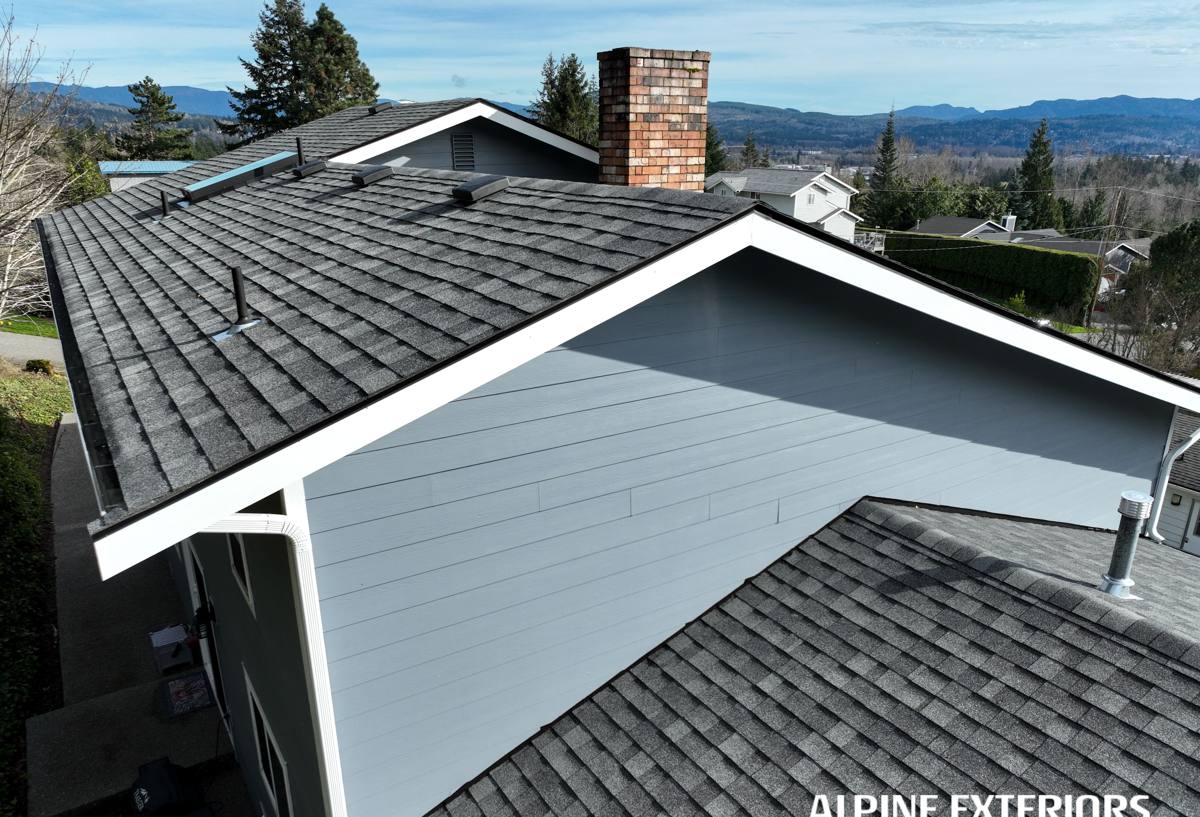
What a Correctly Installed Shingle Roof Includes Here
A roof that's going to hold up in Sudden Valley's conditions needs more than shingles nailed to plywood. The parts most homeowners never see are the parts doing the most work.
- Ice-and-water shield membrane at eaves, valleys, and around every penetration — the areas where wind-driven rain and standing moisture do the most damage.
- Synthetic underlayment across the full deck, which holds up to prolonged dampness far better than old-style felt paper.
- Balanced attic ventilation (intake at the eaves, exhaust at the ridge) so moisture from inside the house doesn't condense against the underside of the deck — a real issue on shaded roofs that already stay damp longer from the outside.
- Properly lapped step and counter-flashing at chimneys, walls, and any roof-to-roof transitions, since these are the spots most likely to leak first in wind-driven rain.
- Algae-resistant (AR) shingles where moss and streaking are a known issue, which is most of Sudden Valley given the tree cover.
- Correct nailing pattern and fastener count for the wind exposure of the specific lot — an open ridge lot near the lake needs a different fastening approach than a tucked-in, tree-sheltered lot.
Skip any one of these and the roof will likely still look fine for a season or two. The failures show up two, five, or ten years in — as a leak at a valley, a soft spot at the eave, or moss that keeps coming back no matter how many times it's cleaned off.
Signs Your Sudden Valley Roof Needs Attention
Because so much of the neighborhood is shaded and tree-covered, roof problems here often show up as moisture and organic growth issues before they show up as obvious storm damage. Worth checking for:
- Green or black streaking, especially on the shaded (usually north-facing) slopes
- Visible moss clumps, particularly near valleys, around chimneys, and along the lower edge of the roof
- Granules collecting in gutters or at the base of downspouts
- Shingle edges that look curled, cupped, or lifted rather than lying flat
- Dark staining on interior ceilings, especially after a heavy wind-driven rain event
- Debris buildup in valleys that doesn't clear on its own between rains
- Soft or spongy spots when walking the roof (a sign of deck moisture damage, not something to ignore)
None of these mean the roof needs full replacement on the spot — but every one of them is worth a real inspection rather than a guess.
Shingle Options and Cost Factors
Most Sudden Valley homes end up choosing between standard three-tab shingles and heavier architectural (laminate) shingles. Both are legitimate options; the right call depends on the roof's exposure, the home's age and style, and budget.
| Factor | 3-Tab Shingles | Architectural Shingles |
|---|---|---|
| Typical lifespan | 15–20 years | 25–35 years |
| Wind resistance | Lower — a real consideration on exposed lake-facing lots | Higher, rated for stronger gusts |
| Moss/algae resistance | Available in AR versions | Available in AR versions, usually standard on better lines |
| Appearance | Flat, uniform look | Dimensional, heavier shadow lines |
| Upfront cost | Lower | Moderate to higher |
| Best fit | Budget-driven projects, secondary structures | Primary residences, especially shaded or exposed lots |
Given how much shade and moisture the average Sudden Valley roof deals with, we generally steer homeowners toward algae-resistant architectural shingles for main houses — the longer lifespan and better moss resistance tend to pay for the price difference over time. That said, a 3-tab AR shingle is a perfectly sound choice for a shed, detached garage, or a lot with less tree cover. We'll walk through the real trade-offs for your specific roof rather than push one option across the board.
Our Process, Start to Finish
1. On-Site Assessment
We walk the roof and the attic, not just look up from the driveway. On a shaded lot, we're checking deck moisture, ventilation balance, and how badly moss or debris have already worked into the existing shingles before we scope the job.
2. Tear-Off and Deck Inspection
Full tear-off lets us actually see the decking. Any soft, delaminated, or moisture-damaged plywood gets replaced before a single new shingle goes down — installing over a compromised deck just hides the problem for a future owner to find.
3. Underlayment, Flashing, and Ventilation
This is where the roof's real durability comes from. Ice-and-water membrane at the vulnerable areas, synthetic underlayment across the field, correctly lapped flashing at every penetration and wall transition, and ventilation checked and corrected if it's not balanced.
4. Shingle Installation
Shingles go down with the fastening pattern matched to the lot's wind exposure, with extra attention at valleys, hips, and ridge lines — the spots most exposed to wind-driven rain coming off the lake.
5. Cleanup and Final Walkthrough
Magnetic sweep for nails, gutters cleared of tear-off debris, and a walkthrough where we show you the finished work and explain the warranty coverage in plain terms.
Why a Crew That Already Works Sudden Valley Matters
Roofing logistics in Sudden Valley aren't the same as a flat, open lot in town. Many properties have steep driveways, limited staging space, tree canopy close to the roofline, and community access considerations. A crew that's already worked the neighborhood knows how to stage material and equipment without tearing up a driveway or damaging landscaping, how to work safely around low-hanging branches, and what the typical drying and moss conditions look like on that side of the county.
That local experience also shows up in smaller ways homeowners appreciate — knowing which slopes on a given home style tend to hold moisture longest, or recognizing early when a shaded roof needs extra ventilation rather than just more frequent moss treatment. It's the difference between a crew solving the problem in front of them and a crew that's seen this exact problem on a dozen other roofs nearby.
Maintenance That Actually Extends Roof Life Here
A well-installed shingle roof still needs upkeep in this climate — arguably more than a roof on an open, sunny lot elsewhere in Whatcom County.
- Clear gutters and valleys of needle and leaf debris at least twice a year, more often under heavy tree cover
- Have moss treated (not scraped or pressure-washed, which can strip granules) as soon as it appears rather than waiting for a full season of growth
- Trim back overhanging branches to cut down on both debris load and the shade that keeps the roof damp
- Check attic ventilation periodically — blocked or unbalanced vents accelerate moisture problems from the inside out
- Schedule a roof inspection after any major windstorm, especially one with heavy rain off the lake
None of this is expensive or complicated, but it's the difference between a shingle roof that reaches the top of its expected lifespan and one that needs early repairs because moisture and moss got ahead of it.
Get a Straight Answer on Your Roof
If you're not sure whether your Sudden Valley roof needs a repair, a maintenance visit, or a full replacement, we're glad to take a look and give you an honest answer — no pressure, no upsell. Use the form below to request a free estimate and we'll get back to you to schedule a time.