 Bellingham Siding
 South Hill's Siding Takes a Different Kind of Beating
South Hill sits up above downtown Bellingham with clear exposure to Bellingham Bay, and that view comes with a trade-off: the same wind that carries salt air off the water also drives rain sideways into whatever siding is facing it. Add Whatcom County's long, damp shoulder seasons — where surfaces stay wet for days at a time and moss gets a real foothold on north- and shade-facing walls — and you have a climate that is genuinely harder on exterior siding than most of the country deals with. It's not any one factor. It's salt air slowly working at fasteners and finishes, driving rain finding every gap in flashing and caulk, and moss holding moisture against the wall long after a storm has passed.
None of that means South Hill homes need to be re-sided constantly. It means that when siding does fail, it usually fails in specific, recognizable ways — and a repair that doesn't account for those causes will just fail again in the same spot.
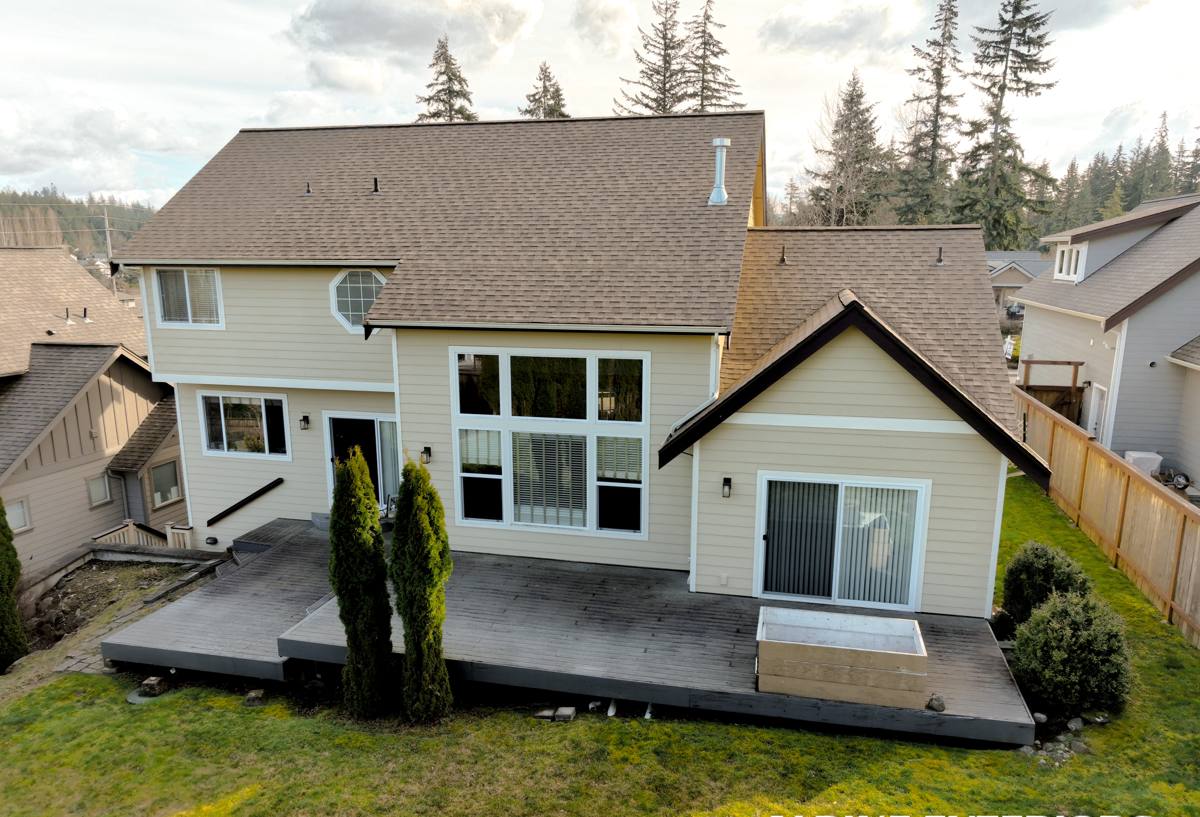
What South Hill's Housing Stock Means for Repairs
South Hill has a mix of home ages and styles, from older character homes to more recent builds, many on sloped lots with real wind exposure and limited access on at least one side. That mix matters for repair work in a few practical ways.
Older homes
Older siding systems on the hill were often installed with the materials and detailing standards of their era — sometimes without the housewrap, flashing, or ventilation gaps that current best practice calls for. A repair on a home like this isn't just "replace the damaged board." It's an opportunity to check whether the underlying moisture management is doing its job, because a new board over a bad water path just delays the next repair.
Hillside exposure and access
Elevated, view-facing walls catch more wind-driven rain than sheltered ones, and sloped lots can mean scaffolding or careful ladder work instead of simple ground-level access. That changes how a crew plans the job, and it's part of why hiring people who already work this terrain saves time and reduces risk.
Signs Your Siding Needs Repair — Not a Full Re-Side
Most siding problems on South Hill show up as localized damage, not whole-house failure. Catching them early is usually the difference between a repair and a much bigger project. Look for:
- Soft, spongy, or crumbling siding when you press on it, especially near the bottom of walls or below windows
- Visible cracking, chipping, or delamination on individual boards or panels
- Persistent moss or dark staining concentrated in one area rather than spread evenly across the wall
- Paint or finish failure — peeling, bubbling, or chalking — isolated to certain sections
- Gaps opening up at seams, corners, or trim where caulking has shrunk or pulled away
- Warping or buckling near downspouts, roof valleys, or other spots where water concentrates
- Soft trim or fascia boards near the siding, which often signals water has been getting behind the cladding
If damage is scattered across most of the house rather than concentrated in a few areas, or if you're finding soft sheathing underneath when a board is pulled, that's usually a sign the whole wall system needs attention rather than a single fix.
What a Correct Siding Repair Actually Involves
A repair that lasts on South Hill has to address the cause of the damage, not just its appearance. That means a few things happen every time, whether the job is one board or a whole elevation.
Diagnosing before cutting
Before anything is removed, we find out why that section failed — a flashing gap, a caulk joint that opened up, a downspout dumping water against the wall, or age-related wear. Replacing the board without fixing the cause just buys a few more years before the same spot fails again.
Matching material and finish
Patched-in siding that doesn't match the surrounding panels in profile, texture, or color is an obvious problem on a wall people see every day, especially with the softer, muted tones common in this area. Getting a clean match matters as much as structural soundness.
Rebuilding the water path
Flashing, housewrap, and proper overlap at seams and penetrations get repaired or upgraded as part of the job — not just the visible siding. This is the step that's easy to skip and the one that determines whether the repair actually holds up through another wet season.
Fastening and sealing to spec
Correct fastener type, placement, and spacing, plus sealant only where it belongs — over-caulking a fiber cement joint can trap moisture just as easily as under-caulking lets it in. Repairs get finished to the same standard as new installation, not shortcut because it's "just a patch."
Repair or Replace? How We Make the Call
Homeowners often assume any siding damage means a full re-side, but that's frequently not true — and sometimes it's the opposite, where a repair would just be a stopgap. Here's how we weigh it:
| Factor | Favors Repair | Favors Full Replacement |
|---|---|---|
| Extent of damage | Localized to one or a few sections | Spread across most or all elevations |
| Underlying sheathing | Solid, dry when exposed | Soft, stained, or rotted in multiple areas |
| Age of existing siding | Well within expected lifespan | Near or past end of service life |
| Cause of damage | One-time or isolated (impact, one bad flashing detail) | Systemic (original installation defects, wrong material for the climate) |
| Material match available | Yes, close visual match achievable | Discontinued profile or color, poor match likely |
We'll tell you honestly which side of that table your home falls on. If a repair is the right call, we do the repair — there's no reason to sell a full re-side when a targeted fix solves the problem.
Why We Only Work in James Hardie Fiber Cement
This company installs and repairs James Hardie fiber cement siding exclusively — we don't install vinyl, LP SmartSide, primed spruce, cedar, or other fiber cement brands. That standard shapes how we handle repairs, too.
Fiber cement is non-combustible and dimensionally stable in the wet-dry cycling that's constant on South Hill, which matters more here than in drier climates. Hardie's ColorPlus factory finish is baked on under controlled conditions and backed by its own finish warranty, so a well-matched repair holds its color instead of visibly fading against older panels within a season or two — a common frustration with field-painted patches. Hardie's HZ5 product line is engineered specifically for wet, marine-influenced climates like ours, and the company's transferable limited warranty gives homeowners real protection if something in the material itself fails down the line.
If your existing siding is a different material, we'll still give you an honest assessment of what a repair in that material would involve — but we won't install anything other than Hardie ourselves, and for larger repairs or partial re-sides, we'll explain why matching your existing siding to Hardie, where feasible, is usually the better long-term move rather than perpetuating a system we don't believe in installing new.
Our Process for South Hill Repair Calls
- On-site assessment. We look at the damaged area and the surrounding wall system — not just the obvious problem spot — to find the actual cause.
- Honest scope and quote. You get a clear explanation of what needs to happen, what it costs, and why — including if we think a repair isn't the right long-term answer.
- Water management first. Any flashing, wrap, or drainage issue we find gets addressed before new siding goes back on.
- Material match and installation. Repairs are installed and finished to the same standard as new work, fastened and sealed correctly for our climate.
- Final walk-through. We show you what was done and what to watch for going forward.
Timeline and cost factors
Most single-section repairs on South Hill are a one- to two-day job once material is on hand; the bigger variable is usually access on steep lots and whether hidden water damage turns up once a section is opened. We'll flag that possibility upfront rather than surprise you with it mid-job.
Why a Crew That Already Works South Hill Matters
South Hill's mix of older homes, hillside lots, and steady exposure to wind and rain off the bay isn't unique to Bellingham, but it is specific enough that experience here shows. A crew that regularly works this neighborhood already knows to check for the moisture patterns typical of homes at this elevation and exposure, has a feel for the access challenges on sloped lots, and isn't guessing at how quickly moss reestablishes itself on shaded walls through a Whatcom County winter. That's less time spent diagnosing and more time spent fixing the actual problem correctly the first time.
Keeping Repaired Siding Ahead of Moss and Rain
A good repair buys you time, but a little upkeep protects that investment through the wet months:
- Keep gutters and downspouts clear so water isn't sheeting down walls it wasn't designed to handle
- Trim back vegetation that shades siding and keeps it damp longer than it should be
- Rinse visible moss or algae growth before it gets a chance to establish, rather than scrubbing hard once it has
- Re-check caulking at trim and seams every couple of years — it's cheap to redo and expensive to ignore
- Walk the exterior after major windstorms to catch new damage early, while it's still a repair and not a replacement
If you've got a soft spot, a cracked panel, or a section of siding on your South Hill home that just isn't holding up the way the rest of the wall is, we're happy to take a look. We'll give you a straight answer on what's actually going on and what it would take to fix it right — no pressure, no upsell, just an honest estimate.