 Bellingham Siding
 Building Decks for Happy Valley's Particular Climate
Happy Valley sits inside Bellingham, and like the rest of Whatcom County it deals with a specific combination of weather that most deck-building guides never mention: marine salt air drifting in off Bellingham Bay, long stretches of driving, wind-pushed rain rather than gentle vertical rainfall, and a moss season that can stretch from late fall through spring. None of that makes a deck impossible to build well here. It just means the build has to account for things a contractor working in a dry climate would never think twice about.
The Three Local Stressors
Salt-laden air accelerates corrosion on fasteners, brackets, and any metal hardware that isn't properly rated for it. Driving rain gets pushed sideways and upward under railings, ledger boards, and stair stringers in ways that straight-down rain never would, so flashing and gap details matter more here than in a lot of the country. And moss, which thrives in the shade and moisture of mature tree cover common in older Bellingham neighborhoods, doesn't just look bad on horizontal deck boards — it holds moisture against the wood and turns a dry surface into a slip hazard after the first cold snap.
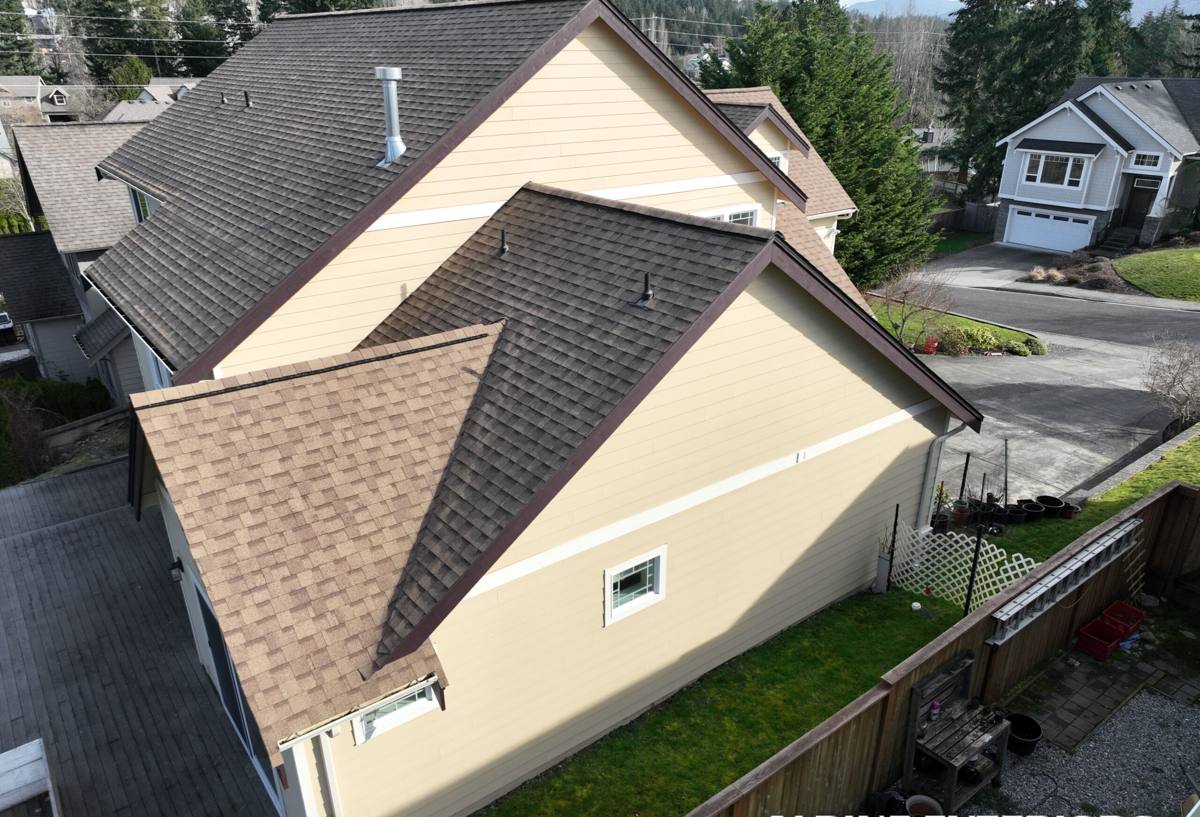
What a Correctly Built Deck Looks Like Here
A deck that's going to hold up in this climate is built differently at almost every stage, not just finished with a different top layer of boards.
Ledger Attachment and Framing
Where the deck attaches to the house is the single most common failure point we see on older decks in this area. A correct ledger installation uses a continuous moisture barrier behind the board, proper flashing that directs water out and away from the house wall, and structural fasteners sized and spaced to code — not just lag screws driven wherever seemed convenient. Joist tape over the top of every joist keeps standing water from soaking into end grain, which is where rot almost always starts first.
Fastener and Hardware Selection
Standard galvanized hardware corrodes faster near the coast than most homeowners expect. We spec stainless steel or hot-dip galvanized fasteners and connectors rated for coastal exposure, and we're careful about mixing metals — dissimilar metals in contact with each other in a damp environment set up galvanic corrosion that can weaken a joint from the inside, long before it shows on the surface.
Choosing Decking Material for This Climate
There's no single "best" decking material — there's a best material for a given budget, sun exposure, and how much upkeep a homeowner actually wants to do. Here's how the common options hold up under Bellingham's rain and moss conditions specifically:
| Material | Moisture & Moss Behavior | Maintenance | Typical Lifespan Here |
|---|---|---|---|
| Cedar | Naturally rot-resistant but still needs sealing; moss will grow on shaded, damp boards without upkeep | Annual cleaning and re-sealing recommended | 15–20 years with upkeep |
| Pressure-treated pine | Treated for rot but end cuts and fastener holes are vulnerable; moss takes hold quickly in shade | Regular sealing; boards can cup or warp over time | 10–15 years |
| Capped composite | Sheds moisture well, resists moss staining, doesn't absorb water into the core | Occasional wash-down, no sealing or staining | 25+ years |
| Uncapped composite | Can absorb moisture at the core over time in a consistently wet climate | Low but not zero — surface can still mildew | 15–20 years |
For homes in shadier parts of Happy Valley with heavy tree cover, we lean toward capped composite or well-maintained cedar over uncapped composite or bare pressure-treated boards, simply because the moss and moisture exposure is higher under a canopy than out in the open.
Drainage, Slope, and Moss Prevention
Most moss and rot problems on local decks trace back to water that has nowhere to go. Board spacing needs to be wide enough to let water drain through rather than pool on the surface, and the deck itself needs a slight slope away from the house. On sites with any grade — common on the hillier, tree-covered lots typical of established Bellingham neighborhoods — we also grade the ground under and around the deck so runoff doesn't collect against footings or posts. Under-deck drainage systems are worth discussing if you want usable dry space below a raised deck, since Whatcom County's rainfall totals make that space unusable without one.
Our Process for a Happy Valley Deck Build
- Site visit and design conversation. We look at sun exposure, tree cover, slope, and how you actually plan to use the space before recommending a material or layout.
- Honest estimate. You get a written scope and price range before any work is scheduled — no surprise change orders for things we should have caught on the first visit.
- Permitting. We handle the City of Bellingham permit application and inspection scheduling so you're not the one tracking down paperwork.
- Footings and framing. Footings are set to local frost and load requirements, and framing is inspected before decking goes down.
- Decking, railing, and finish work. Fasteners, flashing, and gap spacing are done to the standard described above, not just "to code minimum."
- Final walkthrough. We go over care and maintenance specific to the material you chose before we consider the job finished.
Permits and Site Realities
Bellingham requires a building permit for most new deck construction, and decks attached to the house typically also require an inspection of the ledger connection before it's covered up. Depending on lot slope and setback lines, some Happy Valley properties will also need a site plan showing the deck's footprint relative to property lines. We factor permit timelines into the project schedule from the start rather than treating them as an afterthought — it's one of the advantages of working with a crew that already knows the city's process instead of learning it for the first time on your job.
Maintenance: What Actually Keeps a Deck Looking Good Here
Even the best-built deck needs some seasonal attention in this climate. This is the realistic minimum for keeping moss and moisture damage from taking hold:
- Sweep debris (leaves, needles, seed pods) off the deck surface regularly through fall — trapped organic matter is what moss actually feeds on
- Rinse or wash the deck surface at least once or twice a year, more often in heavily shaded areas
- Check and clear gaps between boards so water keeps draining instead of pooling
- Inspect railing posts and stair connections annually for loose hardware or early corrosion
- Re-seal wood decking (cedar or pressure-treated) on the manufacturer's recommended schedule — don't wait until it looks dry and gray
- Keep nearby shrubs and low tree limbs trimmed back to cut down on shade and moisture retention on the deck surface
What Drives the Cost of a Custom Deck
Every deck project is priced around its own specifics, but these are the factors that move the number the most:
| Factor | Why It Matters |
|---|---|
| Decking material | Composite and PVC cost more upfront than wood but less over time in maintenance |
| Height and footings | A raised deck on a sloped lot needs more substantial footings and framing than a ground-level deck |
| Railing style | Cable, glass, and custom metal railings cost more than standard wood or composite balusters |
| Access and site conditions | Tight side-yard access or heavy tree cover can add time for material staging and protection |
| Under-deck drainage | Adding a dry-space drainage system under a raised deck adds cost but adds usable square footage |
| Size and layout complexity | Multi-level decks, built-in benches, and custom shapes take more labor than a simple rectangle |
We give straight, itemized estimates so you can see exactly where the money is going and where there's room to adjust scope if the budget needs it.
Why Local Experience Actually Matters on This Job
A deck built by a crew that hasn't worked in this specific climate before will often look fine the day it's finished and start showing problems within a year or two — moss creeping across shaded boards, corrosion streaks around fasteners, soft spots where the ledger meets the house. A crew that already works in Bellingham and the surrounding Whatcom County neighborhoods has already seen how the driving rain, salt air, and moss season play out over the long term, and builds accordingly from day one rather than learning the hard way on your project.
If you're planning a new deck or replacing one that's showing its age in Happy Valley, we're glad to walk the site with you and give you a free, no-pressure estimate — just fill out the form below.