 Bellingham Siding
 South Hill's Climate Is Hard on Decks
South Hill sits up above Bellingham Bay, and that elevation cuts both ways. The views are part of why people live there, but the same exposure that gives you a view also gives your deck a steady diet of salt-laden air, wind-driven rain, and long stretches of shade under mature trees. In Whatcom County, that combination adds up over the years in ways that aren't always obvious until a board finally gives way underfoot.
Salt air accelerates corrosion on any metal fastener, bracket, or ledger connection that isn't rated for it. Driving rain doesn't just fall straight down here — it gets pushed sideways under railings and into end-grain cuts, ledger boards, and stair stringers where a lot of older decks were never properly flashed to begin with. And the long moss season that runs from fall through spring keeps deck surfaces damp for weeks at a time, which is exactly the environment wood rot and slick, mossy film need to take hold. None of this means a deck can't last — it means it has to be built and replaced with this specific climate in mind, not with a generic approach that might work fine somewhere drier.
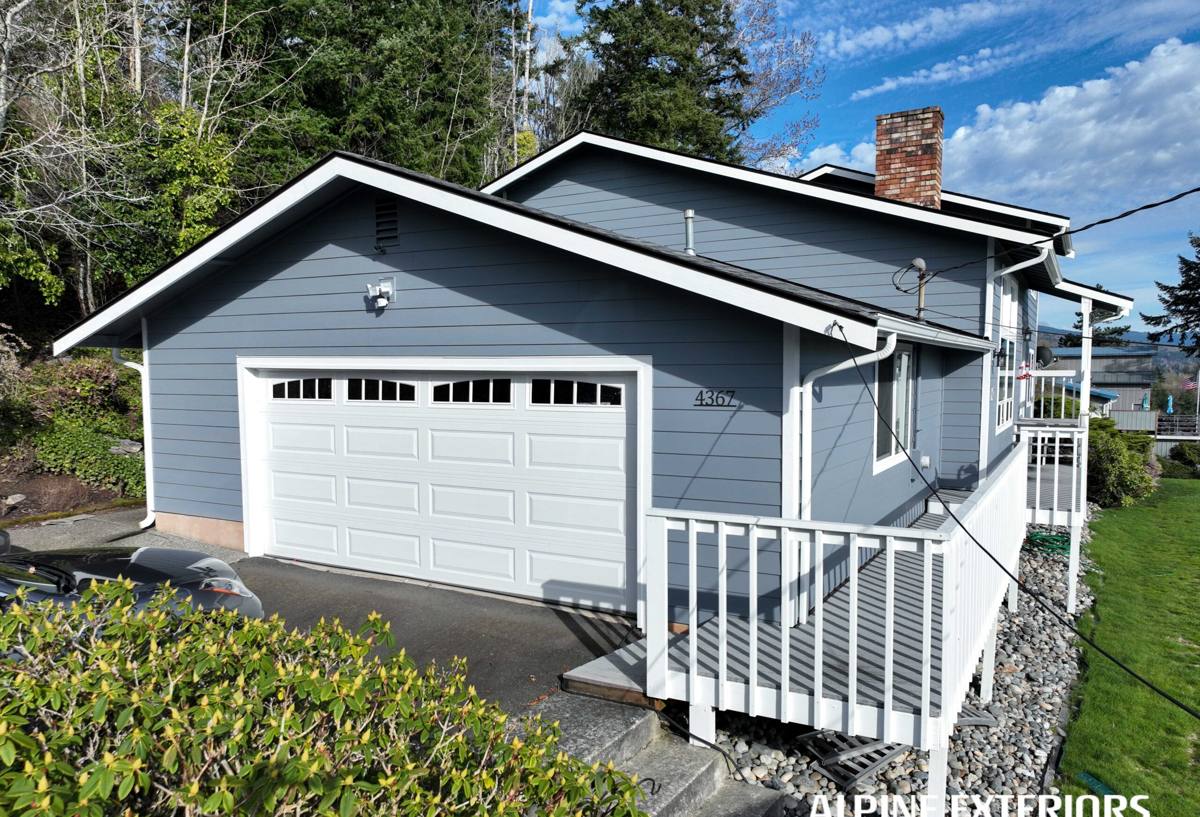
Signs Your South Hill Deck Has Reached the End of Its Life
Not every tired-looking deck needs full replacement — sometimes a repair genuinely is enough. But there's a point where patching individual boards is just delaying a bigger problem, and spending money on cosmetic fixes over a failing structure is money wasted. Here's how we tell the difference during an inspection.
Structural Red Flags
- Soft, spongy, or spring-back decking when you walk across it, especially near the ledger or stairs
- Visible rot or dark staining at the ledger board where the deck meets the house
- Rusted, corroded, or loose fasteners and joist hangers
- Posts that wobble, or footings that have visibly shifted or heaved
- Railings that flex or feel loose when pushed on
- Persistent moss or algae growth that keeps coming back no matter how often it's cleaned
Cosmetic vs. Structural
Faded color, surface graying, or minor splintering on the top of the boards is often just weathering — that can sometimes be addressed without a full tear-out. But if the problem is at the framing level — joists, ledger, posts, or footings — replacement is almost always the more honest recommendation, because repairing around a compromised frame just means paying twice.
What a Proper Deck Replacement Actually Involves
A deck replacement isn't just pulling up old boards and screwing down new ones. Done right, it's a structural project, and in a climate like ours the details underneath the decking matter more than the decking itself.
The Structural Layer
This starts with the ledger board connection to the house, which has to be properly flashed so water is directed away from the wall framing rather than trapped behind it — this is one of the most common failure points we find on older decks in this area. From there it's joist spacing sized correctly for the decking material and expected loads, footings set to the appropriate depth for our frost conditions, and posts anchored with hardware rated to actually hold up outdoors, not just indoors-grade fasteners that were convenient at the time.
Fasteners and Hardware
Given the salt air this area gets, we use hot-dip galvanized or stainless fasteners and connectors rather than standard coated screws, which corrode faster here than they would further inland. It costs a little more upfront and saves a full round of loose boards and rust streaks a few years down the line.
Guardrails and Stairs
Any deck replacement is a chance to correct railing height, baluster spacing, and stair geometry that may have been out of code on the original build — a lot of older decks in established neighborhoods like South Hill predate current guardrail and spacing requirements entirely.
Choosing the Right Decking Material for This Climate
There's no single right answer here — it depends on your budget, how much upkeep you're willing to do, and how long you want to go before thinking about it again. What we won't do is put a material on your deck that we know performs poorly in wet, shaded conditions just because it's cheaper upfront; that's a decision we walk homeowners through honestly rather than let them find out the hard way.
| Material | Moisture Performance Here | Maintenance | Typical Lifespan Locally |
|---|---|---|---|
| Pressure-treated wood | Fair — needs consistent sealing to resist our rain and moss cycle | Annual cleaning, periodic staining/sealing | 10–15 years with upkeep |
| Cedar | Good natural rot resistance, but still needs sealing against driving rain | Regular cleaning and refinishing | 15–20 years with upkeep |
| Capped composite | Very good — the cap layer resists moisture and moss staining well | Occasional washing, no sealing or staining | 25+ years |
| PVC decking | Excellent — fully synthetic, doesn't absorb moisture | Lowest maintenance of the group | 25+ years |
Wood costs less to install but asks more of the homeowner every year in cleaning and sealing — skip that upkeep in this climate and moss and rot show up faster than they would in a drier region. Composite and PVC cost more upfront but largely take that maintenance burden off your plate, which is why we see more homeowners on the hill choosing them for replacements even when the original deck was wood.
Our Deck Replacement Process
- On-site assessment: We check the ledger connection, framing, footings, and drainage before recommending replacement over repair.
- Written estimate: A clear scope and price before any work starts — no surprise add-ons once we're into the tear-out.
- Tear-out and disposal: Old decking, railings, and any compromised framing come out, with the site protected and debris hauled off.
- Structural rebuild: New ledger flashing, joists, footings, and posts sized and spaced for your decking choice and our local conditions.
- Decking, railing, and stairs installed: Fastened with corrosion-resistant hardware appropriate for salt-air exposure.
- Final walkthrough: We go over the finished deck with you, including care instructions specific to whatever material you chose.
Permits and Code Considerations
Most deck replacement projects in Bellingham and Whatcom County that involve structural changes — new footings, altered framing, or a deck built to a different height or footprint than before — require a permit, and inspections happen at set points during construction. Guardrails are generally required once a deck surface sits a certain height above grade, and footings need to be set below the local frost depth to stay stable through winter freeze-thaw cycles. We handle the permit process as part of the job rather than leaving it for the homeowner to sort out, and we build to pass inspection the first time, not to squeak by.
What Deck Replacement Costs in South Hill
Every deck is different, so a real number only comes from an on-site look. But these are the factors that move the price up or down, and it's worth understanding them before you start comparing quotes.
| Factor | How It Affects the Project |
|---|---|
| Deck size and footprint | More square footage means more decking, framing, and labor |
| Height above grade | Taller decks need more substantial posts, footings, and stair runs |
| Decking material chosen | Wood costs less upfront; composite and PVC cost more but need less upkeep |
| Condition of existing framing | Rotted ledger, joists, or footings add rebuild scope beyond the surface |
| Access to the site | Hillside lots and tight side yards can add labor time for material handling |
| Railing and stair complexity | Custom railing styles or multiple stair sections add cost |
As a rough guide, a straightforward wood deck replacement tends to land at the lower end of the cost range, while a larger composite or PVC deck with updated railings runs higher. We'll give you the real number in writing after we've seen the site — we don't do ballpark phone quotes on structural work.
Maintenance That Actually Extends the Life of a New Deck
Whatever material you choose, a little regular attention goes a long way in a climate that stays damp as much of the year as ours does.
- Sweep leaves and debris off the surface regularly, especially in fall — trapped organic matter holds moisture and feeds moss
- Rinse or gently wash the deck surface a couple of times a year to keep moss and algae from establishing
- Check railings and stair connections annually for looseness
- For wood decks, reseal or restain on the manufacturer's recommended schedule — don't wait until it's visibly failing
- Keep gutters and downspouts near the deck clear so runoff isn't dumping extra water onto or under it
- Trim back overhanging branches where practical to cut down on shade-driven moss growth and debris
Why Hire a Crew That Already Works This Neighborhood
South Hill's older housing stock, hillside lots, and tree cover mean the decks up here fail in fairly predictable patterns — we've seen the same ledger rot, the same underbuilt railings, and the same moss-driven surface damage enough times to know what to check first and what to build differently the second time around. A crew that's worked this specific area also knows the local permitting process, understands how site access and slope affect a rebuild, and isn't guessing at how Bellingham's rain and salt air will treat a given material over time. That familiarity shows up in fewer surprises during the job and a deck that's actually built for where it sits, not just built to a generic spec.
If your deck is showing its age, we're happy to take a look and give you a straight answer about whether it needs full replacement or just targeted repair. Reach out for a free, no-pressure estimate using the form below.