 Bellingham Siding
 Decks Built for South Hill's Climate, Not Just Its Views
South Hill sits up on the slope above downtown Bellingham, which means most homes here get a real payoff for outdoor living space: views toward Bellingham Bay, the islands, and Western Washington University's campus below. It also means decks up here take a real beating. The elevation catches wind off the bay, driving rain comes in sideways more often than homeowners expect, and the tree cover that makes South Hill's older streets so pleasant also means shade, damp leaf litter, and moss season that runs longer than it does on more open lots. A deck built without those specifics in mind will look fine for a year or two and then start showing problems: soft spots, green film on the boards, fasteners bleeding rust streaks, railings that wobble because the posts were never really isolated from ground moisture.
We've built and repaired decks throughout Bellingham and Whatcom County long enough to know South Hill's particular mix of older homes, steep-ish lots, and mature trees changes the job. This page covers what a deck actually needs to hold up here, what a correct build looks like from the ground up, and how we run the project from first look to final walkthrough.
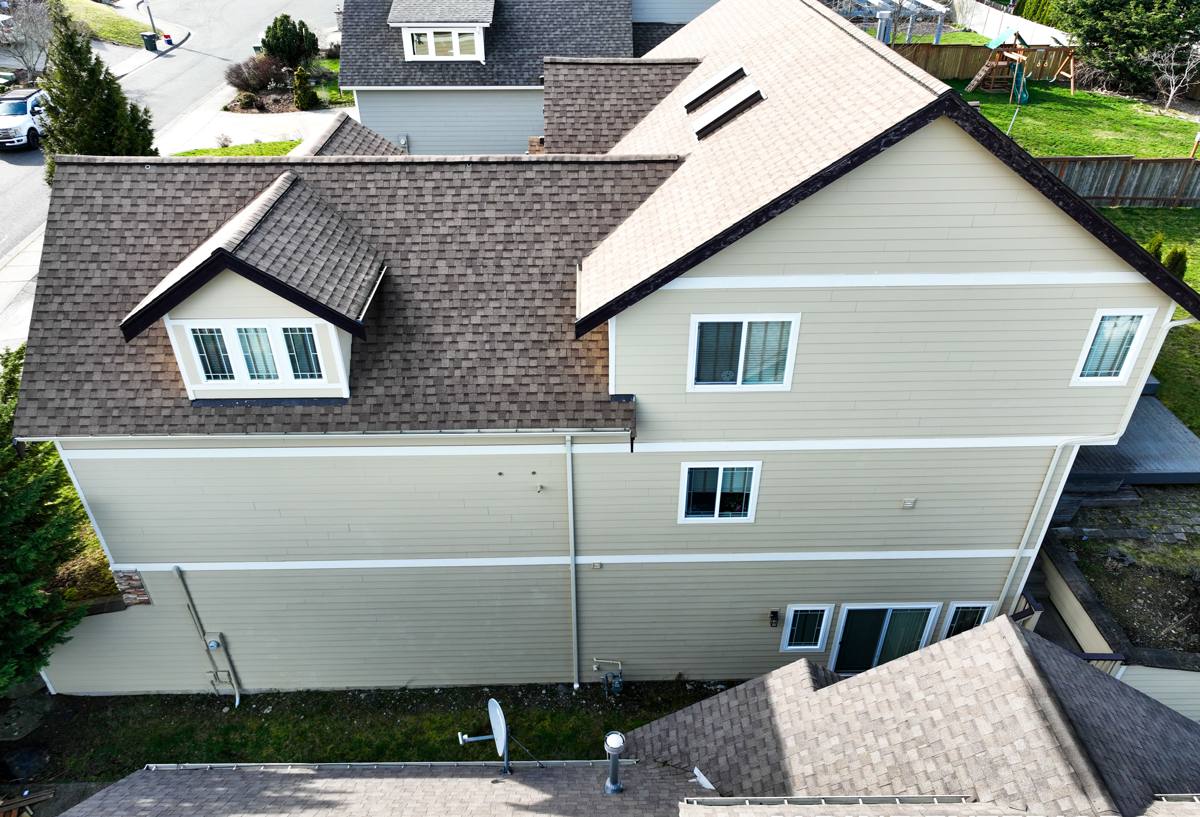
What Whatcom County Weather Does to an Unprotected Deck
Bellingham's marine climate is generally mild, but "mild" doesn't mean gentle on wood and fasteners. A few things stack up specifically in South Hill:
- Salt-laden air off Bellingham Bay accelerates corrosion on any hardware that isn't rated for it — screws, joist hangers, post bases, and bolts all suffer faster than inland installations.
- Driving rain during fall and winter storms doesn't just fall straight down; on exposed or elevated South Hill lots it gets pushed sideways into ledger boards, railing joints, and stair stringers where water can sit if there's no drainage path.
- Long moss and algae season on shaded or tree-covered lots keeps deck surfaces damp for extended stretches, which is exactly the environment moss, mildew, and rot organisms want. Moss also holds moisture against the board surface even after the air around it has dried out.
- Freeze-thaw cycles, while not as harsh as inland Washington, still happen enough in winter to work water in and out of any joint or crack that wasn't sealed correctly, gradually loosening connections over several seasons.
None of this means a deck can't last decades in South Hill. It means the design and material choices have to account for water shedding, airflow underneath, and hardware that won't corrode — from the first framing member up.
Design Decisions That Matter More on a South Hill Lot
Site Grading and Airflow Under the Deck
A lot of South Hill's housing stock sits on grades that are gentle in front and drop off in back, or vice versa. Low clearance under a deck, combined with tree shade and damp Whatcom County winters, is a recipe for trapped moisture and slower drying between rain events. Where clearance allows, we build in enough airflow underneath to let the structure actually dry out between storms rather than staying perpetually damp — that single decision does more for long-term deck health than almost any material upgrade.
Ledger Attachment and Flashing
The ledger board — where the deck ties into the house — is the single most common failure point we find on older decks in this area, and it's almost always a flashing problem, not a framing problem. Water works its way behind an improperly flashed ledger and rots the rim joist or sheathing behind it, sometimes for years before it's visible from outside. Correct flashing (metal flashing plus a self-adhering waterproof membrane behind it) is not optional on any deck we attach to a house, especially with the rain patterns this area sees.
Fastener and Hardware Selection
Given the salt air off the bay, we spec exterior-rated, corrosion-resistant fasteners and structural hardware (hot-dip galvanized or stainless, depending on the connection and decking material) rather than standard coated deck screws. It costs a little more up front. It's a lot cheaper than a homeowner finding rust-streaked, weakening hardware at the eight or ten year mark.
Decking Material: What Actually Works Here
There's no single "best" decking material — it depends on budget, how much maintenance a homeowner actually wants to do, and how shaded the lot is. Here's how the common options hold up specifically under South Hill's tree cover and moss pressure:
| Material | How it handles moss/shade | Maintenance | Typical lifespan |
|---|---|---|---|
| Pressure-treated wood | Needs regular cleaning and sealing in shaded spots or moss gains a foothold fast | Annual cleaning, re-sealing every 2-3 years | 15-20 years with upkeep |
| Cedar | Naturally moisture- and insect-resistant, but still needs cleaning in damp, shaded areas | Cleaning and re-staining every 2-4 years | 20-25 years with upkeep |
| Composite decking | Won't rot, but can still grow surface moss/mildew in constant shade — needs periodic washing | Occasional washing, no sealing/staining | 25-30+ years |
| PVC decking | Fully synthetic, doesn't absorb moisture, easiest to keep moss-free with a rinse | Lowest — occasional washing | 30+ years |
For lots with heavy tree cover — common on parts of South Hill — we generally steer homeowners toward composite or PVC if low maintenance is the priority, or cedar if they want a natural look and don't mind the upkeep. Pressure-treated is still a reasonable budget option, but it's the one that punishes neglect fastest in a shaded, damp environment.
Railings, Stairs, and Fasteners
Railing posts are another spot where South Hill's moisture load causes early failures if they're not detailed correctly — post bases need to be isolated from standing water, not just bolted straight to the deck surface. Stair stringers, which take the brunt of runoff during heavy rain, should use the same corrosion-resistant hardware as the rest of the structure. We treat these as structural safety items, not just finish details.
What a Correct Deck Build Actually Involves
- Site assessment — grade, drainage, sun/shade exposure, tree proximity, and how the deck ties into the existing structure.
- Permitting — most deck projects in Bellingham and unincorporated Whatcom County require a permit depending on height and size; we handle that process rather than leaving it to the homeowner.
- Footings and framing — sized and spaced for the actual load and local frost depth, not just code minimums.
- Ledger flashing — done correctly the first time, since it's the hardest part to fix once decking is installed.
- Corrosion-resistant hardware throughout — joist hangers, fasteners, post bases.
- Decking installation — proper spacing for drainage and seasonal expansion, especially important with wood species.
- Railings and stairs — built to current code for spacing and load, with the same hardware standard as the frame.
- Final walkthrough — we go over care and cleaning specific to whatever material was installed, including how to manage moss if the lot is shaded.
Repair, Rebuild, or New Build: How We Sort It Out
Not every deck problem in South Hill means starting over. We look at three things before recommending a path:
- Framing condition — if the ledger, joists, and posts are sound, we can often replace decking and railings without touching the structure underneath.
- Ledger and flashing history — if there's evidence of water intrusion at the house connection, that needs to be corrected regardless of what else is done, since it's a structural and moisture problem for the house itself, not just the deck.
- Age and code changes — older decks, especially ones built before current railing and stair code requirements, sometimes need railing or stair updates even if the deck surface itself is in decent shape.
A straightforward decking and railing refresh is a different scope, timeline, and cost than a full rebuild from new footings up — we tell you which one you actually need before we quote anything.
A Homeowner's Pre-Project Checklist
- Note where the deck gets full shade for most of the day — that's where moss and mildew pressure will be worst.
- Check for soft or spongy spots underfoot, especially near the house connection.
- Look for rust streaking around fasteners or hardware.
- Check railing posts for any wobble or movement.
- Know roughly how the deck will be used — dining, grilling, hot tub, entertaining — since load and layout affect framing decisions.
- Have a rough budget range in mind before the estimate visit so we can talk through realistic material options within it.
Why Hire a Crew That Already Works South Hill
A deck built to a generic spec sheet can still fail here if it ignores the specifics: the salt air off the bay, the driving rain angle on exposed lots, the shade and moss load under South Hill's tree canopy, and the permitting process specific to Bellingham and Whatcom County. We've built and repaired decks across this area long enough to know which details actually matter locally — ledger flashing, hardware corrosion resistance, and airflow underneath — rather than treating every deck the same regardless of where it sits. That local pattern recognition is what separates a deck that needs attention again in five years from one that just quietly works for two or three decades.
If you're planning a new deck or need an honest read on an existing one in South Hill, we're happy to come take a look. Fill out the form below for a free, no-pressure estimate — we'll walk the site, talk through material options for your specific lot, and give you a straight answer on what it'll take.