 Bellingham Siding
 Siding Installation in Bellingham's Sunnyland Neighborhood
Sunnyland is one of Bellingham's older, established residential neighborhoods — a mix of early- and mid-century homes alongside newer infill, many sitting on lots with mature tree canopy. That combination of age and tree cover means the siding on a lot of Sunnyland houses is working harder than siding on a similar home in a newer, more open subdivision. Add in Whatcom County's marine climate — the salt air drifting off Bellingham Bay, the driving rain that comes with our winter storms, and a moss season that runs longer here than almost anywhere else in the state — and you have an exterior that needs to be installed correctly the first time, not patched together and hoped for the best.
This page is about that one job, done right, in this one neighborhood: what Sunnyland homes actually need from a siding installation, what correct work looks like underneath the surface, and why the difference between a fast install and a right install shows up in five years, not five days.
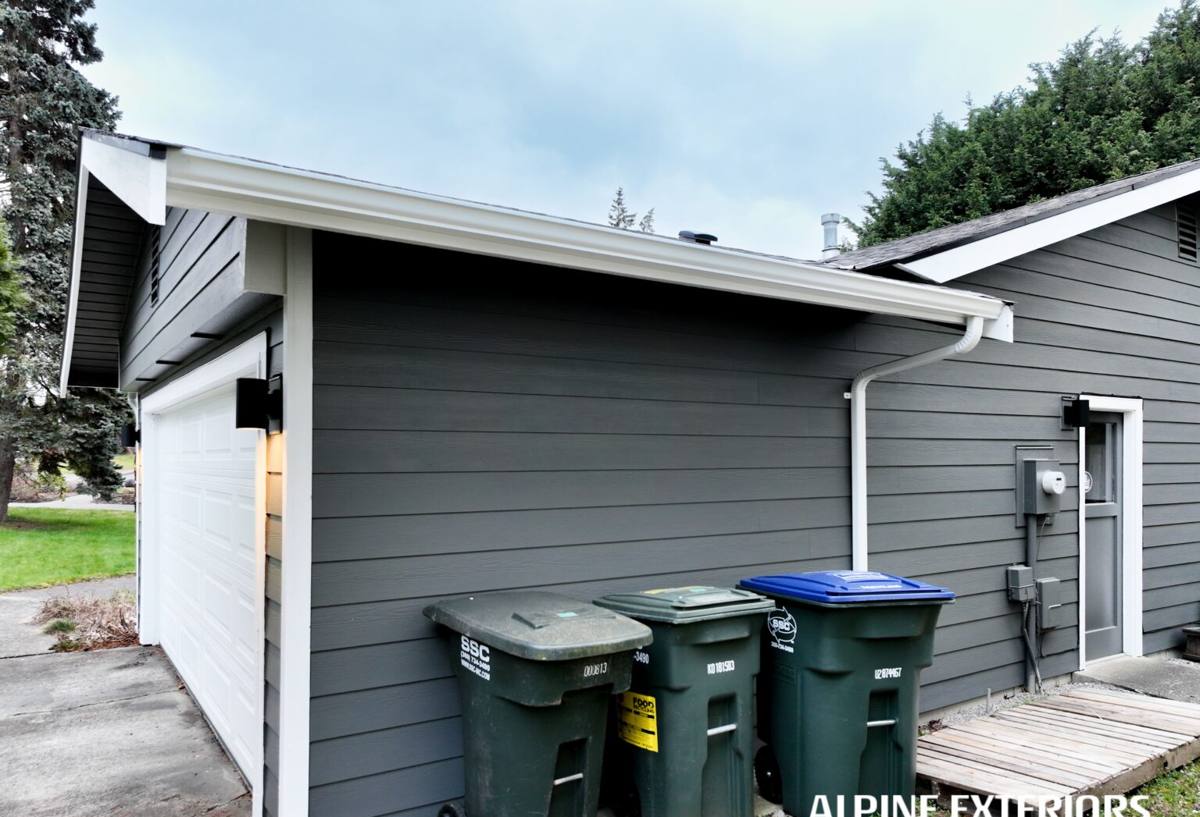
What Whatcom County's Marine Climate Does to Exterior Siding
Salt Air
Bellingham sits on the water, and Sunnyland is close enough that salt-laden air is a fact of life, not an occasional event. Salt air accelerates corrosion on fasteners, flashing, and metal trim, and it breaks down cheaper paint films faster than an inland climate would. Siding that isn't finished with a coating built to hold up to that exposure starts chalking, fading, and flaking years ahead of schedule.
Driving Rain
Winter storms off the Sound don't just drop rain straight down — they push it sideways, driving water into laps, seams, corner boards, and anywhere a penetration wasn't flashed correctly. Siding is a system, not a single layer. The plank or panel is only as good as the weather-resistive barrier, flashing, and gaps behind and around it. Most siding failures we get called out to inspect aren't a problem with the siding material itself — they're a problem with what was (or wasn't) done underneath it.
The Long Moss Season
Tree-covered, shaded lots — which describes a good share of Sunnyland — stay damp longer after every rain than an open, sun-exposed lot does. That extended dampness is exactly what moss and algae need to take hold on north-facing and shaded walls. On some siding materials that's a cosmetic nuisance you pressure-wash off. On others, sustained moisture sitting against the material is how rot and delamination start underneath a surface that still looks fine from the sidewalk.
Signs a Sunnyland Home's Siding Is Falling Behind
Because a lot of siding damage develops behind the surface, it's worth knowing what to look for before a small problem becomes a full re-side. Common warning signs on homes in this neighborhood include:
- Paint that's chalking, peeling, or needs repainting far more often than it should
- Soft or spongy spots when you press on a wall, especially near the bottom courses or around windows
- Visible gaps opening up at butt joints, trim, or corner boards
- Persistent moss or dark streaking on shaded or north-facing walls that comes right back after cleaning
- Cupping, warping, or bowing boards, particularly on wood-based or engineered wood products
- Nail heads popping or rust bleeding through the paint film
Any one of these on its own might just mean a repaint or a spot repair. Several at once, especially on a home that's had the same siding for a couple of decades, usually means the material is nearing the end of what it can handle in this climate.
Why This Crew Installs Only James Hardie Fiber Cement
We don't install vinyl, LP SmartSide, Cemplank, Allura, primed spruce, or cedar, and that's a deliberate standard, not a lack of options. Every one of those products has legitimate strengths, but every one also comes with a trade-off — moisture sensitivity, a maintenance burden, or a finish that doesn't hold up — that we've watched play out on homes in exactly this kind of climate. Wood and engineered-wood products need consistent, careful maintenance to keep moisture out of the substrate; vinyl can warp and fade under UV and temperature swings and doesn't offer the fire resistance some homeowners want. Once you're dealing with salt air, driving rain, and a long damp season all at once, those trade-offs stop being theoretical.
James Hardie fiber cement is non-combustible, dimensionally stable, and doesn't feed rot the way wood-based sidings can. Its ColorPlus finish is baked on in a factory-controlled environment rather than field-applied, which means better adhesion and more consistent color retention over time than a job-site paint job can match. James Hardie also engineers different formulations for different climate zones, including versions built specifically for wetter, marine environments like ours, and backs the product with a strong, transferable warranty. Installed correctly, it's the material we're comfortable standing behind on a Sunnyland home for the long haul.
What a Correct Siding Installation Actually Involves
Weather-Resistive Barrier and Flashing
Before a single piece of siding goes up, the wall needs a continuous, properly lapped weather-resistive barrier, and every window, door, and penetration needs flashing detailed to shed water outward and downward. This is the step that determines whether driving rain stays out or works its way in over the next twenty years — and it's the step that's invisible once the job is finished, which is exactly why it has to be done right the first time.
Fastening, Clearances, and Gaps
James Hardie publishes specific fastening patterns, nail types, and clearance requirements — ground clearance, roofline clearance, gaps at butt joints and trim — and those specs exist for a reason in a climate like this. Fastening too tight or too loose, skipping clearance at grade, or butting boards without the correct gap all create places for water to sit or for the material to be stressed as it expands and contracts. This is also where a lot of the warranty depends on documented, to-spec installation, not just on the product itself.
Finish Work and Sealant
Trim, caulking, and touch-up paint at cut edges are the last line of defense at every joint and penetration. Using the sealant and touch-up products the manufacturer specifies — rather than whatever's on the truck — keeps that defense consistent with how the rest of the system is engineered to perform.
Our Installation Process, Start to Finish
- On-site assessment. We walk the exterior, check for existing moisture damage or soft sheathing, and note anything the tree cover or grading on the lot is contributing to wear.
- Tear-off and sheathing check. Old siding comes off and the sheathing underneath gets inspected before anything new goes up — covering over hidden rot just moves the problem, it doesn't solve it.
- Weather barrier and flashing. A continuous weather-resistive barrier goes on, with flashing detailed at every window, door, and penetration.
- James Hardie installation to manufacturer spec. Planks or panels go up following Hardie's fastening pattern, clearances, and gap requirements.
- Trim, caulking, and touch-up. Corners, trim boards, and cut edges get finished with the specified sealant and touch-up products.
- Final walk-through and cleanup. We review the finished job with the homeowner and clear the site of debris and old material.
Comparing Cladding Options for a Marine Climate
Every siding material behaves differently once you factor in salt air, driving rain, and long stretches of shaded dampness. Here's a general comparison of how the main categories hold up under those specific conditions:
| Factor | James Hardie Fiber Cement | Vinyl | Wood / Engineered Wood |
|---|---|---|---|
| Moisture tolerance | High — doesn't rot or absorb water like wood | Moderate — won't rot, but seams and fasteners can let water behind it | Low to moderate — needs consistent maintenance to keep moisture out |
| Moss/algae resistance | Good with routine cleaning | Moderate; can trap moisture behind panels | Lower — moisture sitting on the surface can lead to rot underneath |
| Salt air / fastener corrosion | Low risk with correct fastener specification | Low risk to the panel itself | Fasteners and finish are both vulnerable over time |
| Finish durability | Factory-cured ColorPlus finish, long color retention | Color is through-body but can fade and chalk with UV exposure | Field-applied paint or stain, needs recoating on a regular cycle |
| Fire resistance | Non-combustible | Melts/deforms under heat | Combustible |
| Typical maintenance | Periodic cleaning and inspection | Low, but limited repair options if damaged | Regular painting/staining and moisture monitoring |
What Drives the Cost of a Siding Installation
There's no honest flat rate for a siding job — cost depends on the specifics of the house and the site. These are the factors that move the number most on a typical Sunnyland home:
| Cost Factor | Relative Impact |
|---|---|
| Home size and number of stories | High |
| Removal and disposal of existing siding | Medium to High |
| Sheathing repair from hidden moisture damage | Variable — can be significant if found |
| Trim, corner, and architectural detail complexity | Medium |
| Siding profile and plank width selection | Low to Medium |
| Site access — trees, fencing, grade, setbacks | Medium |
The only way to get an accurate number for your home is a walk-around and a real look at what's under the existing siding — which is exactly what a free estimate is for.
Why a Crew That Already Works Sunnyland Matters
A contractor who's already worked on this side of Bellingham knows the housing stock — the era most Sunnyland homes were built in, the kinds of sheathing and framing details that come with that, and how tree cover on a given lot tends to affect moisture and moss patterns. That familiarity shows up in faster, more accurate estimates and fewer surprises once tear-off starts. It also matters for the boring-but-important parts of the job: knowing the City of Bellingham's permitting requirements, being reachable for a punch-list item after the job is done, and having a track record in the neighborhood that a homeowner can actually verify.
Before you hire anyone for a siding installation in this area, it's worth asking a few direct questions:
- Are you a certified James Hardie installer, and can you show documentation of that?
- Will the manufacturer's warranty be registered in my name after the job is complete?
- Can you walk me through your flashing and weather-barrier details before the siding goes on, not just after?
- Do you have references from other jobs in Bellingham or Whatcom County I can actually check?
- What's your plan if you find hidden moisture damage once the old siding comes off?
A contractor who answers those questions clearly and specifically, without hedging, is one who's done this enough times in this climate to know exactly what's involved.
If your Sunnyland home's siding is showing its age — or you're just planning ahead — we're glad to come take a look and talk through what your house actually needs. The estimate is free, there's no pressure attached to it, and you can use the form below to get started.