 Bellingham Siding
 Why Edgemoor Homes Need a Different Approach to Siding
Edgemoor sits close enough to Bellingham Bay that the air itself works against your siding. Salt-laden moisture rides in on the wind, settles into seams and fastener heads, and starts a slow corrosion process that most homeowners never see until paint is bubbling or trim is soft. Add Whatcom County's driving winter rain — often blown sideways off the water rather than falling straight down — and you have a siding environment that punishes anything with a weak moisture barrier or a marginal installation detail.
Then there's the shade. Many Edgemoor lots carry mature trees and enough tree cover that north- and west-facing walls stay damp for days after a storm passes. That's exactly the condition moss and algae need to take hold, and once organic growth gets a foothold on a wall, it holds moisture against the substrate even longer. It's a cycle, and the siding material and installation method you choose either breaks that cycle or feeds it.
This page is specifically about installing siding correctly for this neighborhood's conditions — not a generic rundown of siding options. If you live in Edgemoor, or anywhere along the Bellingham Bay shoreline with similar exposure, the details below apply directly to your house.
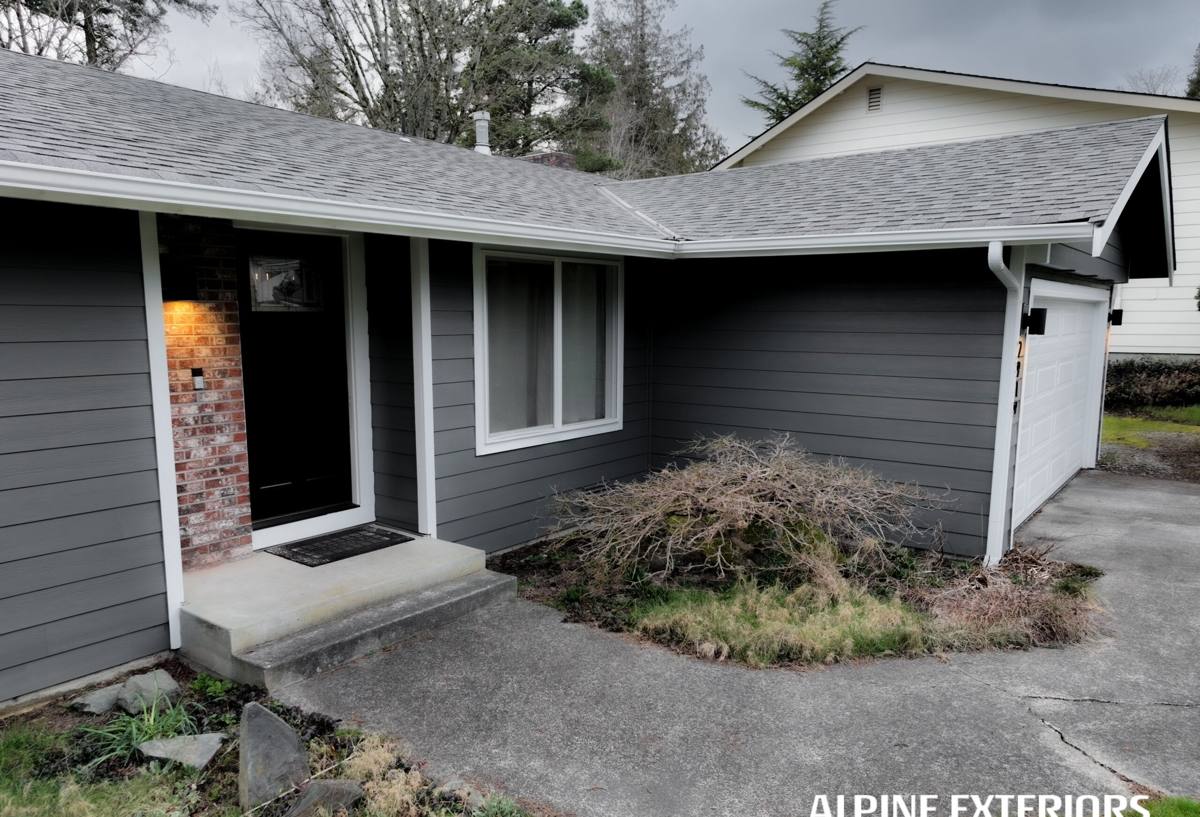
What Salt Air, Rain, and Moss Actually Do to a Wall
Salt Air and Metal Fasteners
Coastal salt exposure accelerates corrosion on anything metal — nail heads, flashing, trim fasteners. When corrosion starts at a fastener, it doesn't stay contained; rust stains bleed down the face of the siding and the fastener's grip on the substrate weakens over time. This is why fastener selection and flashing details matter more here than they would on a house twenty miles inland.
Driving Rain and Wind-Driven Moisture
Water that hits a wall at an angle behaves differently than water that just runs down a vertical face. It gets pushed up under laps, into butt joints, and behind trim that isn't properly flashed. A siding job that would hold up fine in a calmer climate can fail within a few years here if the water-resistive barrier, flashing, and lap details weren't built for wind-driven rain.
Moss, Algae, and Prolonged Dampness
Bellingham's long wet season means shaded and north-facing walls can stay damp for extended stretches, especially under tree canopy common in Edgemoor. Moss and algae thrive in that environment, and once they're established on a wall, they trap moisture against the surface, degrade paint finishes, and accelerate rot in anything that isn't genuinely moisture-resistant to the core.
What a Correct Siding Installation Involves Here
A siding job that's going to hold up in Edgemoor's climate isn't just about the panel you choose — it's about a system of details working together. Here's what we consider non-negotiable on every install in this area:
- A continuous, properly lapped water-resistive barrier behind the siding, installed shingle-style so water is always directed outward and down.
- Correctly flashed windows, doors, and penetrations — every opening in the wall is a place water wants to get in, and flashing has to be sequenced correctly with the barrier, not just caulked over.
- Rain screen or drainage gap where conditions call for it, giving any moisture that does get behind the siding a path to drain and dry out instead of sitting against the sheathing.
- Corrosion-resistant fasteners rated for the coastal exposure, driven to the manufacturer's specified depth and pattern — not just close enough.
- Proper clearance at grade, decks, and roof lines so siding isn't sitting in standing water or trapped moisture from day one.
- Factory-finished panels rather than field-primed or field-painted siding, so the protective coating isn't dependent on job-site weather conditions during installation.
Skip any one of these and you haven't installed siding for this climate — you've installed siding for a milder one and hoped for the best.
Why We Install Only James Hardie Fiber Cement
We standardized on James Hardie fiber cement siding for every job we take on, including here in Edgemoor, and it comes down to how the material behaves in exactly the conditions described above. Fiber cement is non-combustible, dimensionally stable, and doesn't absorb and swell with moisture the way wood-based or wood-adjacent products can. That matters enormously in a climate where a wall can stay damp for days at a stretch.
Hardie's ColorPlus factory finish is baked on under controlled conditions before the product ever reaches the site, which means the color coat isn't dependent on field weather, and it holds up better against UV and moisture cycling than most field-applied paint. Hardie also engineers specific product lines (their "HZ" designations) for different climate zones, which is directly relevant to a marine, high-moisture environment like Whatcom County.
We don't install LP SmartSide, vinyl, Cemplank, Allura, primed spruce, or cedar. Every one of those products has legitimate uses and, in some cases, real strengths — cedar's appearance, vinyl's price point, engineered wood's workability. But in a salt-air, high-rain, moss-prone environment, they each carry a maintenance burden or moisture vulnerability that we're not willing to put our name behind. We'd rather install one product exceptionally well than offer five options and let a homeowner unknowingly pick the wrong one for their specific wall exposure.
Quick Comparison: Why Material Choice Matters in This Climate
| Factor | Wood-Based / Engineered Wood | Vinyl | James Hardie Fiber Cement |
|---|---|---|---|
| Moisture absorption | Can swell, delaminate, or rot at cut edges over time | Doesn't absorb, but can warp or crack in temperature swings | Does not absorb water into the substrate; dimensionally stable |
| Finish durability | Field-applied paint often needed; recoat cycles required | Color molded in but can fade; can't be effectively repainted long-term | Factory-applied ColorPlus finish, warrantied separately from the substrate |
| Fire resistance | Combustible | Can melt/deform under heat exposure | Non-combustible |
| Performance in salt air / driving rain | Higher maintenance burden; joints and cut ends are vulnerable | Seams and fastener slots can allow water intrusion | Engineered climate-specific (HZ) lines built for moisture exposure |
Our Installation Process for Edgemoor Properties
Because we already work in this neighborhood and the broader Bellingham Bay-facing areas, our process is tuned to the conditions rather than a one-size-fits-all install script.
1. On-Site Assessment
We look at wall orientation, tree cover, existing moisture damage, and how the current siding (if any) has held up. A wall that's taken years of driving rain from the water side often needs different flashing detail work than a more sheltered wall on the same house.
2. Substrate and Barrier Inspection
Before any new siding goes up, we check what's underneath. If sheathing has taken on moisture damage from a prior failure, that gets addressed first — new siding over a compromised substrate just delays the same problem.
3. Barrier, Flashing, and Drainage Detail Work
This is where most siding jobs succeed or fail long-term, and it's the least visible part of the work once it's done. We install the water-resistive barrier, window and door flashing, and drainage provisions to the standard this climate actually requires — not the minimum code allows.
4. Hardie Panel Installation to Manufacturer Spec
Fastener type, spacing, and drive depth follow James Hardie's published installation requirements. Installing Hardie siding incorrectly — overdriven nails, wrong fastener type, insufficient clearance at grade — can void the product warranty and undermine the very durability you're paying for. This is a big part of why installer experience matters as much as material choice.
5. Final Walkthrough
We go over the finished work with the homeowner, including any maintenance basics specific to their site — things like keeping vegetation trimmed back from walls to reduce shade and moisture retention.
Why Local Installation Experience Matters
Siding installation isn't uniform across Whatcom County, let alone across Washington state. A crew that's mostly worked drier, inland, or more sheltered jobs may not instinctively over-build the flashing and drainage details that a bay-exposed Edgemoor wall actually needs. A crew that already works this specific area knows which wall orientations take the worst of the weather, how much clearance to leave given typical grade and landscaping conditions here, and where moss tends to establish first on a finished job.
That local pattern recognition doesn't replace following manufacturer specs — it supplements it. The spec tells you the minimum; local experience tells you where to go beyond the minimum because you've seen what happens when a job doesn't.
What to Ask Before Hiring Anyone for This Job
- Are you a certified or factory-trained installer for the specific siding product you're proposing?
- What water-resistive barrier and flashing sequence will you use, and can you explain why?
- Will the fasteners you use be rated for coastal/marine exposure?
- Do you carry manufacturer-backed warranty coverage in addition to your own labor warranty, and is it transferable if I sell the house?
- Can you walk me through how you'll handle drainage and clearance at grade, decks, and roof intersections?
- Have you installed siding on other homes in this specific area or similar coastal-exposure conditions?
Cost Factors for Edgemoor Siding Installation
Every siding estimate should be based on an actual walkthrough of your specific house, but a few factors consistently move the price on jobs in this area:
| Factor | Why It Affects Cost |
|---|---|
| Existing substrate condition | Moisture-damaged sheathing found during tear-off adds repair scope before new siding can go on |
| Wall exposure and orientation | Walls facing prevailing wind/rain off the bay may need additional flashing and drainage detail |
| House size and complexity | Cut-ups, dormers, and multiple gables add labor time and material waste |
| Trim and accessory scope | Fascia, soffit, and trim replacement alongside siding changes overall project cost |
| Access and site conditions | Mature landscaping, slopes, or limited staging area can affect labor time |
We provide honest, walkthrough-based estimates rather than rough phone quotes, because the factors above genuinely vary house to house even within the same neighborhood.
If you're planning a siding project in Edgemoor and want a straightforward, no-pressure look at what your home actually needs, we're happy to walk the property with you and give you a real estimate — just fill out the form below.