 Bellingham Siding
 Siding Repair Built for Sehome's Conditions
Sehome sits close enough to Bellingham Bay and the rest of Whatcom County's marine weather pattern that siding here ages differently than it would forty miles inland. Homes in this part of Bellingham deal with a steady mix of salt-tinged air, long stretches of driving rain off the water, and a moss season that can run eight or nine months out of the year in shaded yards and north-facing walls. None of that is unusual for the neighborhood — but it does mean siding repair has to account for more than just a cracked board or a loose panel. It has to account for what's happening underneath.
We do repair work throughout Bellingham, and Sehome is one of the areas we're in regularly. That matters more than it sounds like it should. A crew that already knows how the older housing stock in this part of town was built, and how the local climate tends to attack it, spots problems faster and fixes them right the first time — instead of patching a symptom and leaving the cause in the wall.
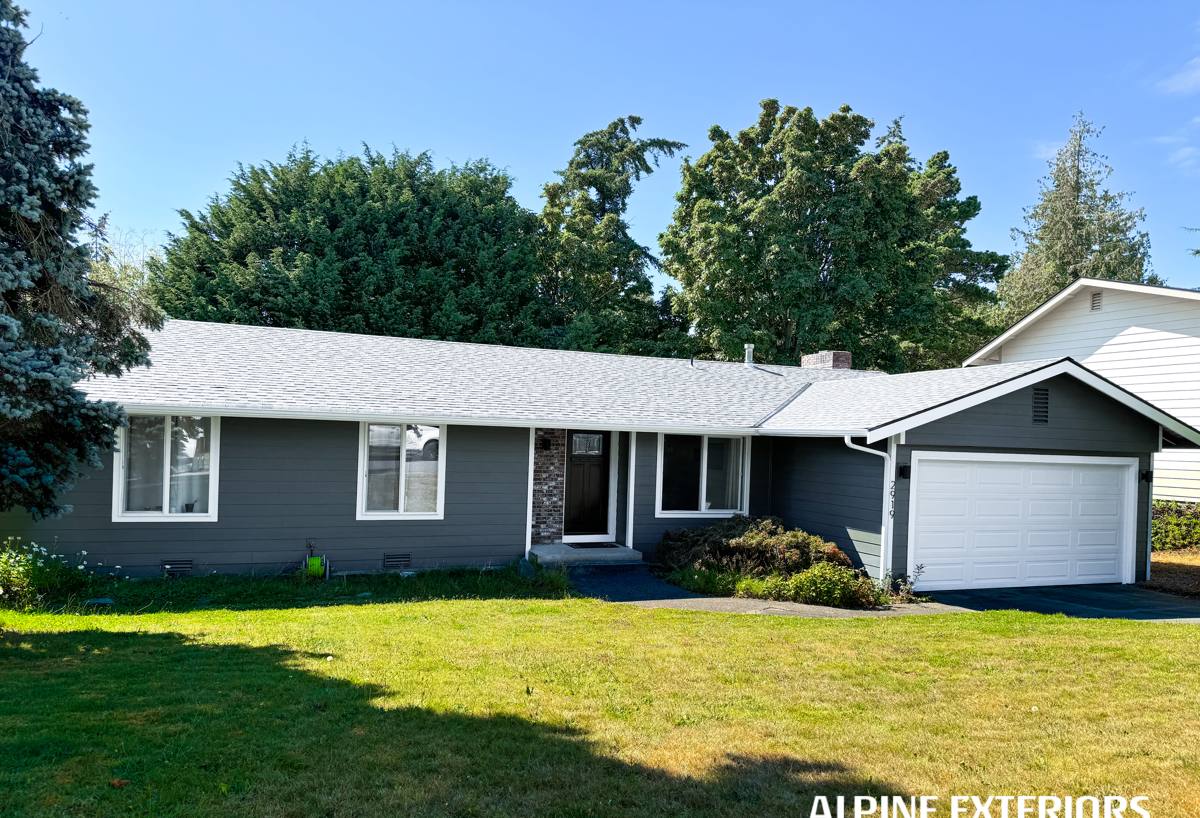
Why Siding Fails Faster in This Part of Bellingham
Salt Air and Moisture Load
Proximity to the bay means siding, trim, and fasteners take on a low but constant dose of salt-laden moisture. Over years, that accelerates corrosion in exposed metal fasteners and flashing, and it keeps wood-based products damp longer after every rain event than the same product would stay in a drier inland town. Damp-longer is the key phrase — it's not one big soaking that causes rot, it's siding that never fully dries between storms.
Driving Rain and Wind-Driven Wetting
Bellingham gets rain that doesn't just fall straight down — it comes sideways off the water during winter storm systems. That pushes moisture into laps, seams, and butt joints that would stay dry in a calmer climate. Any siding repair that doesn't re-establish a proper water-shedding lap or reseal a joint correctly will fail again within a season or two under this kind of exposure.
Moss, Shade, and Slow Drying
Sehome has a good tree canopy in places, and mature landscaping is part of the neighborhood's character — but shade plus moisture equals moss, algae, and mildew growth on siding surfaces, especially on north- and west-facing walls that get less direct sun. Moss holds moisture against the siding surface far longer than an exposed wall would otherwise experience, which speeds up whatever damage is already starting underneath.
What a Correct Repair Actually Involves
A siding repair that only replaces the visibly damaged board is a cosmetic fix. A correct repair addresses what let the damage happen in the first place. Here's what we check on every repair call in this area:
- Underlying sheathing and framing — soft spots, staining, or rot behind the siding that indicates water has already gotten past the surface layer
- House wrap and flashing continuity — gaps, tears, or improperly lapped flashing around windows, doors, and penetrations that let water behind the cladding
- Fastener condition — corroded or backed-out nails and screws, especially in older installations that predate corrosion-resistant fastener standards
- Caulking and sealant integrity — cracked or missing sealant at joints, trim, and penetrations, which is one of the most common entry points for wind-driven rain
- Drainage plane function — whether water that does get behind the siding has a path to drain back out, rather than sitting against the sheathing
Skipping any of these means the repair looks finished but isn't actually solved. We've opened up plenty of siding sections where a previous patch job covered rot that had already spread into the sheathing — the new board looked fine on day one, but the wall behind it was still failing.
Repair vs. Replacement: How We Make That Call
Not every damaged section needs full replacement, and we don't push a full re-side when a targeted repair will genuinely hold up. The decision comes down to how far the damage has spread and what's causing it.
| Situation | Typical Approach | Why |
|---|---|---|
| Isolated cracked or damaged board, sound sheathing underneath | Spot repair — replace the board, correct the lap and flashing | The problem is contained; no sign of wider moisture intrusion |
| Rot or soft sheathing found behind one section | Localized tear-out, repair sheathing, re-side that section | Fixing the cause, not just the visible damage |
| Recurring moss and moisture staining across multiple walls | Broader inspection, possible multi-section repair | Points to a systemic drainage or ventilation issue, not a one-off |
| Widespread failure, product past its service life | Full siding replacement | Repairing old, failing material section by section costs more over time than replacing it |
We'll tell you honestly which category your home falls into. If a repair will hold, we say so. If the damage is widespread enough that repair is a short-term patch, we'll explain why and what full replacement would look like — no pressure either way.
Why We Repair With — and Recommend — James Hardie
When a repair calls for new siding material, whether it's a few boards or a full section, we install James Hardie fiber cement exclusively. We don't install vinyl, LP SmartSide, or other engineered wood products, and in a climate like Bellingham's, that's a deliberate standard, not a sales preference.
The Reasoning
- Moisture behavior: Fiber cement doesn't swell, delaminate, or absorb water the way engineered wood substrates can when repeatedly wetted, which matters directly given how long this area's siding stays damp between storms.
- Factory-applied finish: Hardie's ColorPlus finish is baked on at the factory and backed by its own finish warranty, which holds up better against the area's damp, shaded conditions than field-applied paint that has to cure in marine-layer humidity.
- Non-combustible: Fiber cement won't contribute fuel to a fire, which is a meaningful long-term durability and insurance consideration regardless of climate.
- Climate-engineered product lines: Hardie makes HZ5 product specifically formulated for climates like the Pacific Northwest's, which is what we install here.
We're upfront that Hardie costs more upfront than vinyl or engineered wood siding. What we're not willing to do is install a product on a Sehome home that we know struggles against this exact climate, then have the homeowner dealing with the consequences in five to ten years.
Our Repair Process
- On-site inspection — We look at the damaged area and check surrounding sections, flashing, and any signs the problem extends beyond what's visible from the ground.
- Honest diagnosis — We tell you what's actually going on: is this a contained repair, or a sign of a bigger moisture problem in that wall assembly?
- Written scope and estimate — You get a clear explanation of what we'll do, what material we're using, and why, before any work starts.
- Repair the cause, not just the symptom — Damaged sheathing gets addressed, flashing gets corrected, drainage gets restored — not just a new board nailed over the old problem.
- Match and finish — Where we're patching into existing Hardie siding, we match profile and color as closely as the product line allows.
Warning Signs Sehome Homeowners Shouldn't Ignore
- Soft or spongy spots when you press on the siding, especially near the bottom courses or around windows
- Visible cracking, buckling, or gaps at board joints and corners
- Persistent moss or dark streaking that keeps coming back after cleaning
- Paint or finish that's peeling, bubbling, or failing faster than the rest of the house
- Any musty smell or interior staining on walls that back up to exterior siding showing damage
Catching these early is almost always cheaper than waiting. A board that needs replacing today can turn into sheathing and framing repair in another wet winter or two if the moisture path isn't addressed.
Why a Crew That Already Works Sehome Is Worth Choosing
Siding repair isn't just carpentry — it's diagnosing how water is moving through a wall assembly, and that diagnosis is faster and more accurate when the crew already understands the conditions specific to this part of Bellingham. We're not learning Whatcom County's rain patterns, moss cycles, or the quirks of the area's housing stock on your job. We already know what to check first, because we've checked it on homes nearby.
That local familiarity, combined with sticking to one siding system we trust in this climate, is the whole reason we run the business this way. Fewer product lines, more depth in the ones we install, and a crew that isn't guessing at what Bellingham weather does to a wall over time.
If you've got a section of damaged, cracked, or moisture-stained siding in Sehome, we're happy to take a look and give you a straight answer on what it needs. Reach out for a free, no-pressure estimate using the form below.