 Bellingham Siding
 Why Sehome's Siding Takes More Punishment Than People Expect
Sehome sits close enough to Bellingham Bay that salt-laden air is a daily fact of life for the exterior of a home, not an occasional nuisance. Add in the driving, wind-pushed rain that comes through Whatcom County for much of the year and a moss season that can run from fall into late spring, and you have three separate stresses working on your siding at the same time: corrosion-prone hardware, sustained moisture exposure, and organic growth that holds water against the surface long after a storm has passed. Most siding failures we see in this part of Bellingham aren't dramatic — they're slow. A fastener starts to weep rust down a board, a north-facing wall stays damp for days after every rain, moss creeps into a seam and keeps it wet, and years later the underlying material has softened or delaminated before anyone realized there was a problem.
None of that is unique to any one house in Sehome — it's the shared climate reality of living this close to the water in western Washington. What changes the outcome is the material and the installation, not the weather. That's the whole point of this page: what fiber cement siding needs to do in this specific environment, and what it actually takes to get that right.
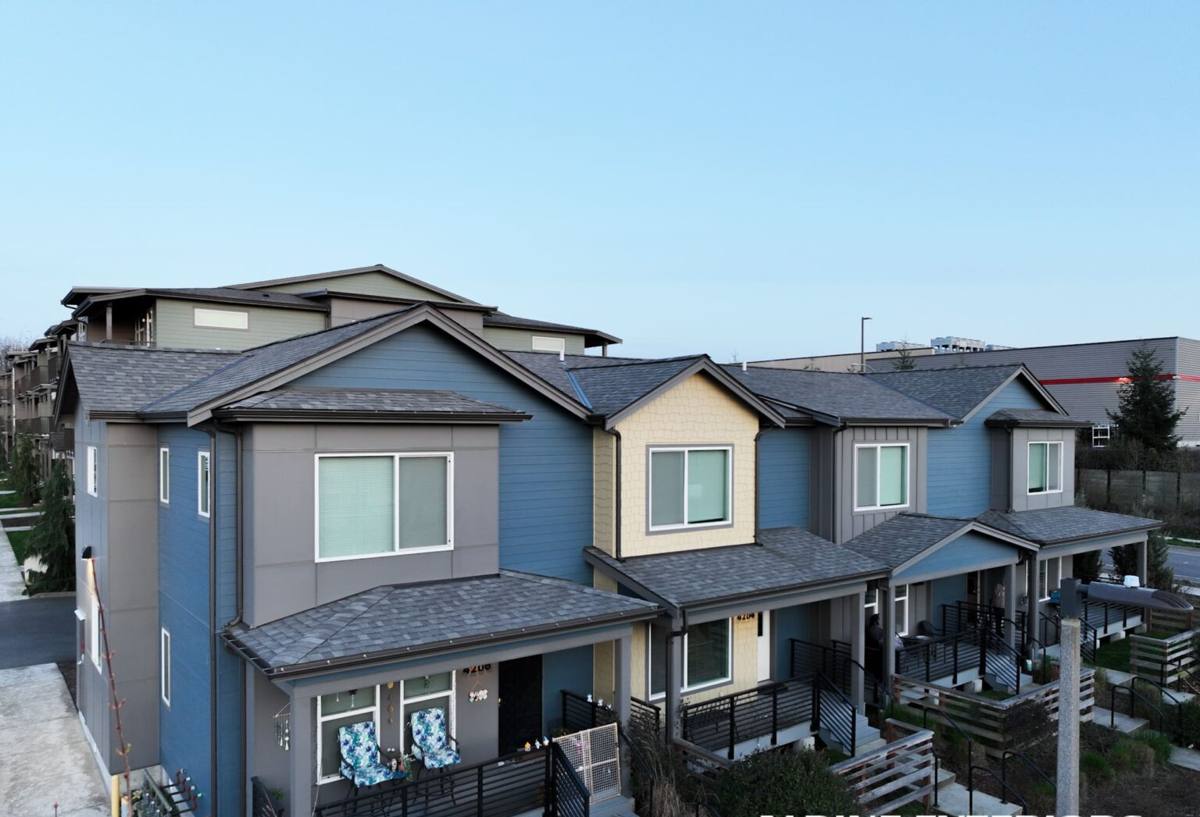
What Fiber Cement Needs to Do in This Environment
Handle Salt Air Without Corroding From the Inside Out
Salt air accelerates corrosion on anything metal — fasteners, flashing, trim connectors. Fiber cement itself doesn't rust or corrode, which is a real advantage over materials with more exposed metal components, but the siding is only as good as the hardware holding it up. Standard fasteners that are fine fifteen miles inland can start showing rust bleed within a few years this close to the bay. Correct installation in Sehome means corrosion-resistant fasteners and flashing specified for coastal exposure, not whatever came in the standard box.
Shed Driving Rain Instead of Absorbing It
Wind-driven rain doesn't just fall on a wall — it gets pushed sideways into laps, seams, and penetrations. Fiber cement is dense and dimensionally stable, so it doesn't swell and warp the way wood-based products can when they take on water repeatedly. But the material's resistance to moisture only matters if the water is being directed away from the wall assembly in the first place. That's a function of lap spacing, flashing details, and the drainage plane behind the siding — not the board itself.
Resist Moss and Organic Growth Without Constant Scrubbing
Whatcom County's moss season is long, and moss doesn't just sit on a surface — it holds moisture against it and can work into gaps over time. A ColorPlus factory finish gives fiber cement a hard, consistent surface that's genuinely easier to keep clean than a porous or textured material, but no siding is moss-proof if it's installed too close to grade, tight against landscaping, or without enough airflow at the bottom edge. Good installation reduces how often moss becomes a maintenance chore; it doesn't eliminate the need to occasionally rinse it down.
Why This Company Only Installs James Hardie
We don't install LP SmartSide, vinyl, Cemplank, Allura, primed spruce, or cedar, and that's a deliberate standard, not an oversight. Each of those products has legitimate strengths — cedar looks great fresh off the wall, vinyl is inexpensive, engineered wood siding is lighter to handle. But in a climate that combines salt exposure, sustained rain, and heavy moss pressure, we've seen the trade-offs of those products play out on real homes: wood-based products that need more diligent moisture management than most homeowners realize going in, vinyl that can't compete on longevity or fire resistance, and engineered products with warranty structures that don't hold up the same way over decades of coastal weather.
James Hardie fiber cement is non-combustible, holds its factory finish for years longer than field-applied paint typically lasts, and is engineered in HZ product lines specifically for climate zones like ours — meaning the formulation is matched to how much moisture and freeze-thaw cycling the Pacific Northwest actually delivers. It's backed by a strong, transferable warranty that matters if you ever sell the house. We'd rather install one product exceptionally well, understand its behavior in this exact climate, and stand behind it fully than offer a menu of options where every choice is a compromise we'd have to explain away later.
What Correct Installation Actually Involves
Fiber cement is not a forgiving material to install wrong. It's manufacturer-engineered, and James Hardie publishes specific installation requirements for a reason — deviating from them is the single biggest cause of premature siding failure, regardless of how good the material itself is. A correct job in Sehome includes:
- A weather-resistant barrier installed and lapped correctly behind the siding, not just present
- Proper clearance between the bottom edge of the siding and grade, decks, and roof lines — six inches minimum from grade, two inches from roofing, per manufacturer spec
- Correct fastener type, spacing, and penetration depth — over-driven or under-driven nails are a leading cause of cracking and loosening over time
- Flashing at every window, door, and penetration, integrated with the water-resistive barrier rather than just caulked over
- Proper lap and joint treatment, with factory-cut or correctly field-cut edges sealed per Hardie's specifications
- Adequate gap and sealant at butt joints to allow for the material's minor expansion and contraction
Skipping any one of these doesn't necessarily show up in year one. It shows up in year five or eight, as staining, soft spots, or fastener failure — usually right around when a homeowner assumed they were done thinking about their siding for another two decades.
Our Process for a Sehome Project
1. Walk-Through and Assessment
We start by looking at the whole exterior, not just the siding surface — grade clearance, existing flashing, moisture staining, trim condition, and any areas where the current cladding has clearly been fighting a losing battle with the weather. This tells us whether we're dealing with a straightforward re-side or whether there's underlying sheathing or moisture damage that needs to be addressed before new siding goes up.
2. Honest Scope and Estimate
You get a clear breakdown of what's being replaced, what product lines and profiles are being used, and why. If we find something during the walk-through that changes the scope, we tell you before we start, not after.
3. Prep and Weather Barrier
Old siding comes off, sheathing is inspected and repaired as needed, and a new weather-resistive barrier goes on correctly lapped, with flashing integrated at every opening. This step is invisible once the job is done, which is exactly why it's the step most likely to get shortcut by crews that don't know this climate.
4. Installation to Manufacturer Spec
Hardie boards go up with correct clearances, fastening, and joint treatment, built for the HZ zone rating that matches our region's moisture and temperature profile.
5. Final Walk-Through
We go over the finished work with you, point out anything you should know for long-term care, and make sure you know what regular maintenance in a moss-heavy environment actually looks like — which, done right, is minimal.
Cost Factors for a Sehome Fiber Cement Project
Every home is different, but the variables that actually move the price on a Sehome project tend to be the same ones each time:
| Factor | Why It Matters Here |
|---|---|
| Extent of moisture or sheathing damage found during tear-off | Salt air and driving rain make hidden damage more common on older siding near the bay |
| Trim, siding profile, and ColorPlus color selection | Wider board reveals, shingle-style accents, and premium colors all affect material cost |
| Number and complexity of window/door penetrations | Each one needs individual flashing work, which is labor, not just material |
| Home height and access | Multi-story sections near property lines or slopes require more scaffolding and time |
| Grade clearance corrections | Homes with siding installed too close to grade may need minor regrading or trim adjustments to meet spec |
We'd rather walk your specific home and give you real numbers than quote a broad range that doesn't mean much until we've seen what we're working with.
Living With Fiber Cement in Sehome: What Ongoing Care Looks Like
One of the real advantages of a correctly installed Hardie system is how little it asks of you afterward. That said, "little" isn't "nothing," especially in a moss-prone, salt-air environment:
- Rinse the siding down with a garden hose once or twice a year, more often on shaded or north-facing walls where moss tends to establish first
- Keep landscaping and mulch beds pulled back from direct contact with the bottom edge of the siding
- Check gutters and downspouts each fall so overflow isn't running down a wall section repeatedly through the wet months
- Look at caulked joints around trim and penetrations every couple of years — sealant is the one component that wears out well before the siding does
- Address any small hardware rust spots early rather than letting them streak and stain the ColorPlus finish
That's meaningfully less than what wood siding demands in this climate, and it holds up better over time than what most engineered wood products can promise once their factory coating starts to age.
Signs Your Current Siding Is Losing the Fight
Homeowners in Sehome usually come to us after noticing one or more of the following: soft or spongy spots when you press on a wall section, persistent moss or algae staining that comes right back after cleaning, visible rust streaking below fasteners, paint that's failing faster than it should on a wall that gets more weather exposure, or boards that have started to cup, crack, or separate at the joints. Any one of these on its own might just need a repair. Several of them together, especially on a home that's fifteen-plus years old, usually means the siding system as a whole is past the point where patching makes sense.
Why It Matters That We Already Work Sehome
A crew that's worked this specific pocket of Bellingham knows the difference between a house that's fully exposed to bay wind and one that's more sheltered by surrounding lots and mature trees — and that difference actually changes install decisions like flashing detail and clearance around vulnerable corners. It also means we're not guessing at how a product will hold up here; we're basing the recommendation on how James Hardie siding has actually performed on homes facing this same salt air, this same rain pattern, and this same moss season, year after year. That local track record is worth more than a general climate zone rating on a spec sheet.
If you're weighing a siding replacement in Sehome, we're glad to walk your home, look at what your exterior is actually dealing with, and give you a straight, no-pressure estimate using the form below.