 Bellingham Siding
 Why Decks in Puget Take More Than a Standard Build
Puget sits close enough to the water and the marine weather patterns that move through Whatcom County that a deck built the way it would be in a drier inland climate simply won't hold up the same way here. Salt-tinged air, long stretches of driving rain, and a moss season that can run from fall through spring all work on a deck at the same time — corroding fasteners, wicking into end grain, and turning shaded boards slick and green if the deck wasn't designed to shed water and dry out. A deck that looks fine on installation day can start showing problems within a year or two if those factors weren't accounted for from the framing up.
None of this means a deck in Puget has to be over-built or expensive. It means the decisions that don't matter much in a dry climate — fastener coating, flashing detail, board spacing, ventilation under the frame — matter a lot here, and skipping them is usually what turns a normal maintenance job into a full rebuild ten years early.
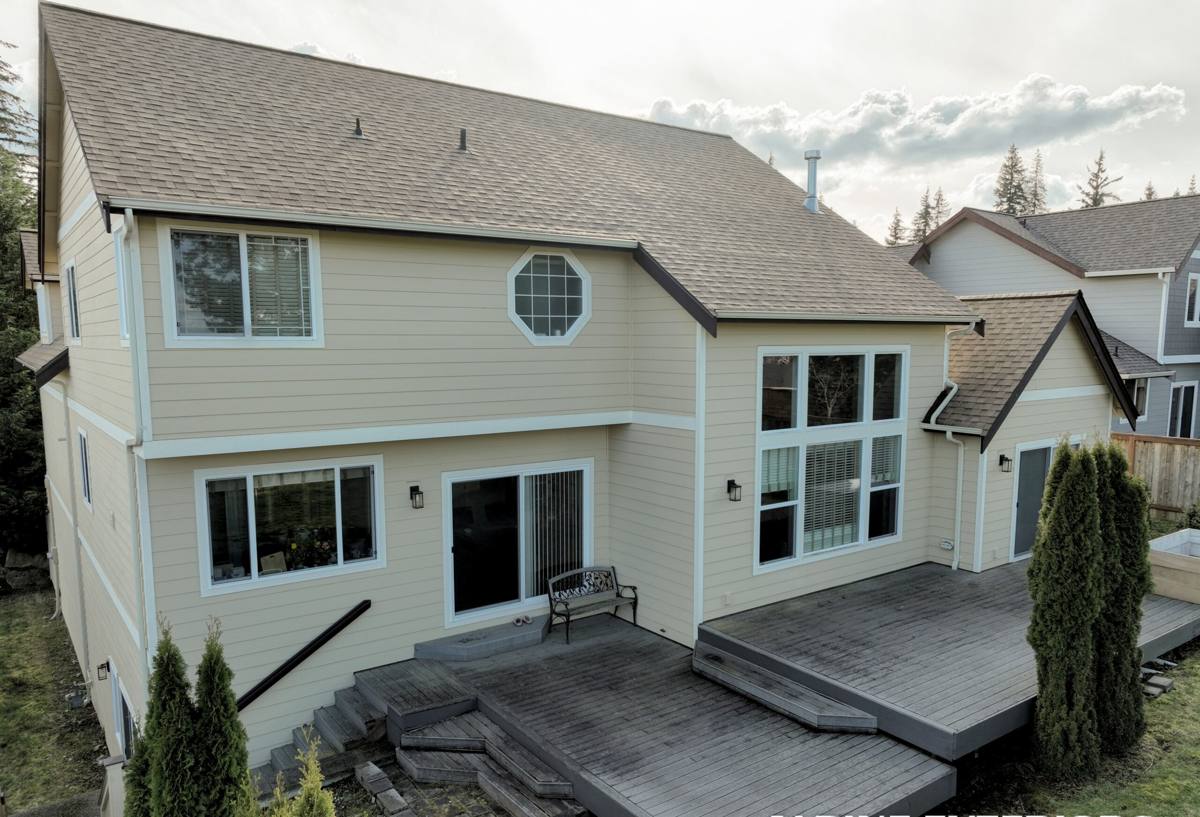
What Actually Fails First on Bellingham-Area Decks
Ledger Board and House Connection
The ledger board — where the deck attaches to the house — is the single most common failure point we see on older decks in this area, and it's almost always a flashing problem, not a framing problem. Without proper flashing that directs water out and away from the house band joist, rain that runs down the siding and collects at that joint has nowhere to go but into the wood. In a climate with as much sustained rain as ours, that slow leak can rot out a ledger and the framing behind it long before anything looks wrong on the surface.
Fasteners and Hardware
Standard fasteners corrode faster in salt-influenced marine air than most homeowners expect, and a corroding fastener doesn't just look bad — it loses holding strength. Structural hardware (joist hangers, post bases, ledger bolts) needs a corrosion-rated coating matched to the wood treatment being used, and mixing incompatible metals (for example, the wrong hanger with certain treated lumber) accelerates corrosion instead of preventing it. This is a detail that's invisible once the deck is finished, which is exactly why it gets skipped on rushed jobs.
Trapped Moisture Under the Boards
Decking that's laid tight, over a frame with no airflow, in a spot that gets afternoon shade, is close to a guaranteed setup for moss and slow rot in this climate. The gap between boards, the height of the deck off grade, and whether there's any cross-ventilation under the structure all affect how fast the frame dries out after a normal Whatcom County rain event — and how fast it doesn't.
Choosing Decking Material for a Puget Site
There's no single right answer here — it depends on how much sun the deck gets, how much upkeep you want to do, and budget. What matters is picking with the real climate in mind rather than a catalog photo.
| Material | How It Handles This Climate | Maintenance | Typical Lifespan Here |
|---|---|---|---|
| Pressure-treated wood | Affordable, needs a real finish schedule to resist moss and graying | Annual cleaning, refinish every 2-3 years | 10-15 years with upkeep |
| Cedar | Naturally rot-resistant but still needs sealing in a wet climate; shows moss if shaded | Cleaning and sealing every 1-2 years | 15-20 years with upkeep |
| Capped composite | Resists moisture absorption well; cap layer sheds algae easier than raw wood | Periodic wash, no sealing/staining | 25-30+ years |
| PVC / cellular decking | No wood fiber to absorb moisture at all; best in shaded, damp, moss-prone spots | Occasional wash | 25-30+ years |
We generally steer shaded, low-airflow sections of a deck toward composite or PVC rather than raw wood, simply because those products don't give moss and mildew organic material to take hold in. That's a maintenance and moisture-behavior call, not a knock on wood decking done right in a sunnier spot.
Moss, Algae, and Slip Safety
A long moss season is one of the more predictable challenges of building and maintaining a deck in this part of Washington. Moss and algae need shade and standing moisture to establish, so the two biggest levers we control at the design stage are board spacing (so water actually drains through instead of sitting on the surface) and orientation relative to sun exposure. A deck that gets even a few hours of direct sun a day will stay far cleaner than one tucked entirely in shade.
Surface texture matters too. A smooth, tightly grained board that's been sealed but not maintained gets slick fast once a thin film of algae forms — that's a real slip hazard on stairs and near doorways, not just a cosmetic issue. Textured or grooved composite/PVC boards, or wood with a properly maintained non-slip finish, hold up better underfoot through the wet months.
Drainage: The Part Nobody Sees
Where the water goes after it hits the deck is as important as what the deck is made of. On a raised deck, that means grading and drainage at the posts and footings so water doesn't pool against the substructure. On a low deck or one built over a patio, it means enough clearance and airflow underneath that the frame can actually dry between storms. In Whatcom County's rain pattern — frequent rather than occasional — a deck that never fully dries out between storms is a deck that's rotting slowly no matter what species of wood or grade of composite is on top.
Permits and Local Code
Most new decks and many deck replacements in and around Bellingham require a building permit — the exact threshold depends on the deck's height above grade, its footprint, and whether it attaches to the house. Guardrail height, stair geometry, footing depth, and ledger attachment are all inspected items, and inspectors here are familiar with what marine-climate rot and undersized flashing look like on a re-deck. We handle the permit process as part of the job rather than leaving it for the homeowner to sort out, and we build to the code the local jurisdiction actually enforces, not a generic national minimum.
Our Process for a Puget Deck
- Site walk: we look at sun exposure, drainage, existing structure (if replacing), and how the deck ties into the house before recommending materials.
- Design and material selection: board type, framing height, railing style, and any shaded-area material swaps are decided together with you, with real numbers, not just a mood board.
- Permit and engineering as needed: we pull what's required for the site and scope rather than skipping it to save time.
- Demo (if replacing): old decking, framing, and ledger connection are inspected as they come off — this is often where hidden rot from a bad original flashing job shows up.
- Framing and flashing: ledger flashing, corrosion-rated hardware, and proper joist spacing/hangers go in before a single deck board is placed.
- Decking, railing, and finish: boards, railing, and any stairs are installed and, for wood, sealed before the crew leaves the site.
- Walkthrough: we go over basic maintenance specific to the material you chose so the deck actually reaches its expected lifespan.
Maintaining a Deck in This Climate
Every deck material needs some upkeep here — the difference is how much and how often. A short seasonal routine keeps most problems from ever starting:
- Sweep leaves and debris off the deck surface regularly, especially in fall — trapped organic matter is what feeds moss and stains boards.
- Wash the deck surface (and railings) at least once a year with a deck-safe cleaner to knock back algae before it takes hold.
- Check and clear any gaps between boards so water keeps draining through rather than pooling.
- For wood decking, reseal on the schedule for that species — waiting until it visibly grays means the wood has already been unprotected for a while.
- Look at the ledger board area and any post bases once a year for early signs of staining, softness, or corrosion on hardware.
- Keep vegetation trimmed back from the deck edges so airflow underneath and around the structure isn't blocked.
What Drives Deck Building Cost in Puget
Costs vary a lot by size, material, and site conditions, but the main factors are consistent from job to job:
| Factor | Why It Affects Cost |
|---|---|
| Size and shape | Square footage plus any multi-level or angled sections adds material and labor |
| Material tier | Pressure-treated, cedar, composite, and PVC all sit at different price points and lifespans |
| Height and substructure | Taller decks need deeper footings, more framing, and guardrails; more engineering complexity |
| Site access and demo | Removing an old deck, working around slopes, or limited equipment access adds labor |
| Railing and stairs | Style and material of railing/stairs can range from simple to a significant share of total cost |
We give a real, itemized number after seeing the site — broad online price ranges rarely account for what a specific Puget lot actually needs in terms of framing and drainage.
Why It Matters to Hire a Crew That Already Works This Area
A deck built to a generic national spec will pass a quick look, but it's the details tuned to Whatcom County's rain and moss pattern — flashing detail, fastener grade, board spacing, material choice by sun exposure — that determine whether it's still solid in fifteen years or needs major repair in five. A crew that regularly works decks in Puget and the surrounding Bellingham area has already seen which builds hold up through our wet season and which ones don't, and builds accordingly from the start rather than learning that lesson on your project.
If you're planning a new deck or need to replace one that's showing its age, we're happy to take a look and talk through honest options for your site. Reach out for a free, no-pressure estimate using the form below.