 Bellingham Siding
 Composite Decking Built for Puget's Marine Climate
Puget sits close enough to the water and the tree line that a deck out here takes a different kind of beating than one across town. Salt-laden air works into fasteners and hardware. Driving rain off the Sound finds every gap in a ledger board or a poorly flashed rim joist. And the long, wet moss season coats anything shaded or low to the ground within a year or two of install. Composite decking doesn't solve all of that by itself, but it's the right starting material — the rest comes down to how the substructure, drainage, and hardware are handled underneath it.
We're a Bellingham-based crew, and Puget is part of our regular service area, not a once-a-year drive-by. That matters more with decks than with most exterior work, because deck failures are almost always substructure failures — moisture trapped where it can't dry, fasteners that corrode faster than the board they're holding, framing that was never designed to shed water in the first place.
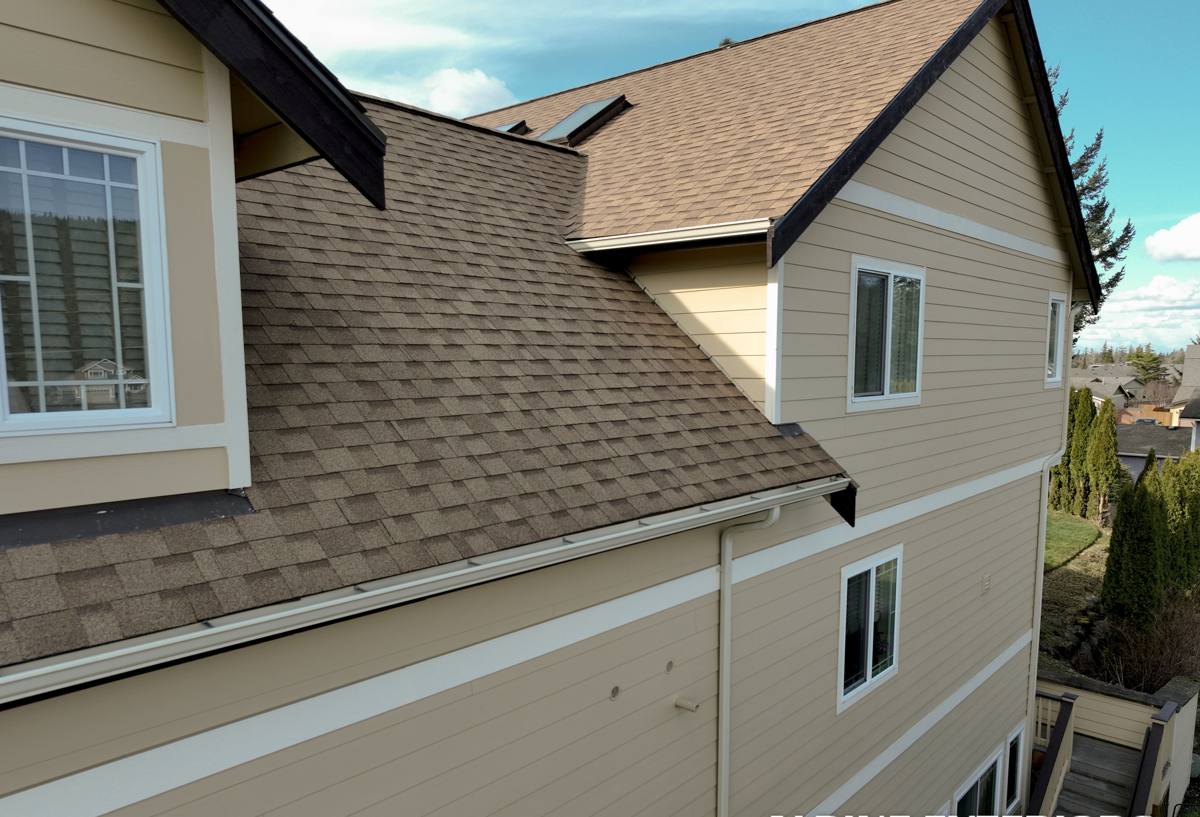
What Whatcom County's Climate Actually Does to a Deck
Salt Air and Hardware
Even a few miles inland from the water, airborne salt accelerates corrosion on anything less than fully rated fasteners and connectors. Standard electro-galvanized screws and joist hangers can start showing rust streaks and pitting within a couple of seasons in this environment. That corrosion doesn't stay cosmetic — it weakens the connection between the decking and the frame long before the boards themselves show any wear.
Driving Rain and Wind-Driven Moisture
Rain here rarely falls straight down. Wind off the water pushes it sideways, up under fascia boards, and into ledger connections that were flashed for a gentler climate. A ledger board attached to the house without proper flashing is one of the most common failure points we find on older decks in this area — moisture gets behind the siding and works on the rim joist for years before anyone notices.
Moss and Shade
Bellingham's tree cover and long overcast stretches mean moss and algae growth is a near-guarantee on any deck surface that doesn't get regular sun and airflow, especially on the north or shaded side of a house. Moss holds moisture against the board surface and, on wood decks, feeds rot. On composite, it's mostly a slip hazard and a maintenance nuisance — but the board's surface texture and the airflow underneath both affect how bad it gets.
Composite vs. the Alternatives — Honest Trade-Offs
| Material | How It Handles Our Climate | Maintenance | Where It Falls Short |
|---|---|---|---|
| Wood (cedar/treated) | Needs regular sealing to resist the rain and salt air; rot risk rises fast once finish wears off | Annual cleaning and re-sealing | Highest long-term upkeep; splinters and cupping over time |
| Composite | Doesn't absorb moisture into the board itself; color-stable in UV and salt exposure | Periodic cleaning, no sealing | Surface can still get slick with moss film if underventilated; upfront cost higher than wood |
| PVC/Capped Polymer | Fully moisture-resistant; performs well in coastal conditions | Low, similar to composite | Can feel and sound different underfoot; higher cost tier; color range more limited |
We install composite for most Puget-area homeowners because it strikes the balance most people are after — real resistance to what this climate throws at it, without the ongoing sealing schedule wood demands or the premium of full PVC systems. We're upfront about where wood or PVC might make sense for a particular budget or look, and we'll walk through that honestly during the estimate rather than push one product line.
What a Correct Composite Deck Installation Actually Involves
The composite boards are the visible 10% of the job. The other 90% is what determines whether the deck is still solid in fifteen years.
Framing and Joist Spacing
Composite boards flex differently than wood and most manufacturers require tighter joist spacing than a traditional wood deck — commonly 12" on center for angled or diagonal board patterns. Building to wood-deck spacing with composite boards is one of the more common shortcuts we see, and it shows up as bounce and premature sagging.
Ledger Flashing
Where the deck attaches to the house, we install proper flashing that sheds water away from the rim joist and wall assembly — not just a bead of caulk. Given how much wind-driven rain this area gets, this single detail does more for long-term durability than almost anything else in the build.
Fasteners and Hardware
We use stainless or otherwise corrosion-rated fasteners and joist hangers throughout, particularly for anything within a few miles of saltwater exposure. It costs more than standard galvanized hardware. It also doesn't need to be replaced in five years.
Drainage and Ground Clearance
Low-lying or shaded decks in this area need real attention to under-deck drainage and airflow — standing water and stagnant air underneath are exactly what feed moss and mildew on the board undersides and the framing itself.
Our Process for Puget Composite Decking Projects
- On-site assessment — we look at existing framing (if replacing an old deck), drainage patterns on the lot, sun exposure, and how close the site is to salt air influence.
- Board and hardware selection — matched to the home's exposure and your maintenance preferences, with honest trade-offs explained up front.
- Framing and structural work — new or reinforced substructure built to the spacing and fastening the composite manufacturer requires, not generic deck-building defaults.
- Flashing and moisture detailing — ledger connections, post bases, and any transitions against the house are sealed and flashed properly before a single board goes down.
- Installation — hidden or face-fastened per the board system, with attention to expansion gaps since composite moves with temperature more than people expect.
- Final walkthrough — we go over basic care specific to your site's shade and moisture exposure before we leave.
Board Color and Texture Considerations for This Climate
Darker composite boards run hotter in direct sun but tend to show moss film less obviously than lighter tones. Lighter boards stay cooler underfoot but can show green or black staining sooner in shaded, low-airflow areas — common on the north-facing decks we see around Bellingham. Textured or wood-grain embossed surfaces provide better wet-weather traction than smooth caps, which is worth prioritizing on any deck that doesn't get much direct sun. We'll talk through samples against your home's actual sun exposure rather than just showing a color chart.
Maintenance Puget Homeowners Should Actually Do
- Rinse or sweep debris and organic buildup off the deck surface a few times a year, more often under trees
- Clean with a composite-safe cleaner (not a pressure washer on high pressure directly against the board grain) when moss film starts to appear
- Check that gaps between boards and around the perimeter stay clear so water and airflow keep moving underneath
- Inspect ledger flashing and any visible fasteners once a year for corrosion or gaps in sealant
- Trim back overhanging branches where possible to reduce shade and organic debris load
Cost Factors for a Puget-Area Composite Deck
| Factor | Why It Moves the Price |
|---|---|
| Substructure condition | Replacing rotted or undersized framing costs more than building on solid existing structure |
| Board tier | Entry-level composite vs. capped premium lines carries a meaningful price spread |
| Fastening system | Hidden-fastener systems cost more in materials and labor than face-screwed boards |
| Site access and grade | Sloped lots or limited access near the water add labor time |
| Railing and stair scope | Composite or metal railing systems add to the total beyond the deck surface itself |
Most composite deck projects in this size range land in a broad mid-to-upper range compared to a basic wood deck rebuild — the difference is mostly in board cost and hardware upgrades, not labor complexity. We'll give you real numbers for your specific site rather than a generic per-square-foot estimate that doesn't account for what's actually underneath your existing deck.
Why a Crew That Already Works Puget Matters
Deck problems in this specific pocket of Whatcom County tend to repeat themselves — the same drainage patterns, the same shaded north sides, the same salt exposure depending on how close a lot sits to the water. A crew that's built and repaired decks in this exact area already knows which framing shortcuts fail here and which fastener grades are worth the extra cost, instead of applying a one-size-fits-all spec sheet. We're not commuting in from out of town to learn Puget's conditions on your project — we already build to them.
If you're considering a new composite deck or replacing one that's showing its age, we're happy to come take a look and give you a straightforward, no-pressure estimate — use the form below to get started.