 Bellingham Siding
 Metal Roofing in Lynden: Suited to the Nooksack Valley
Lynden sits inland in the Nooksack River valley, in the northern end of Whatcom County near the Canadian border. It doesn't take a direct hit from Puget Sound weather the way some closer-in Bellingham neighborhoods do, but it still sits inside the same marine-influenced climate: moist air moves up the valley off the water, rain arrives wind-driven more often than straight-down, and mild temperatures give moss and algae a long growing season on any roof that stays shaded or damp. That combination of salt-tinged air, driving rain, and moss pressure is exactly the kind of environment metal roofing was built to handle — but only when the panels, flashing, and fasteners are chosen and installed correctly for it.
Bellingham Siding Contractors installs and services metal roofing across Whatcom County, and Lynden is a regular part of that work. This page covers what a metal roof actually needs to perform here, what a correct installation involves, and how we run a metal roofing project from first look to final walkthrough.
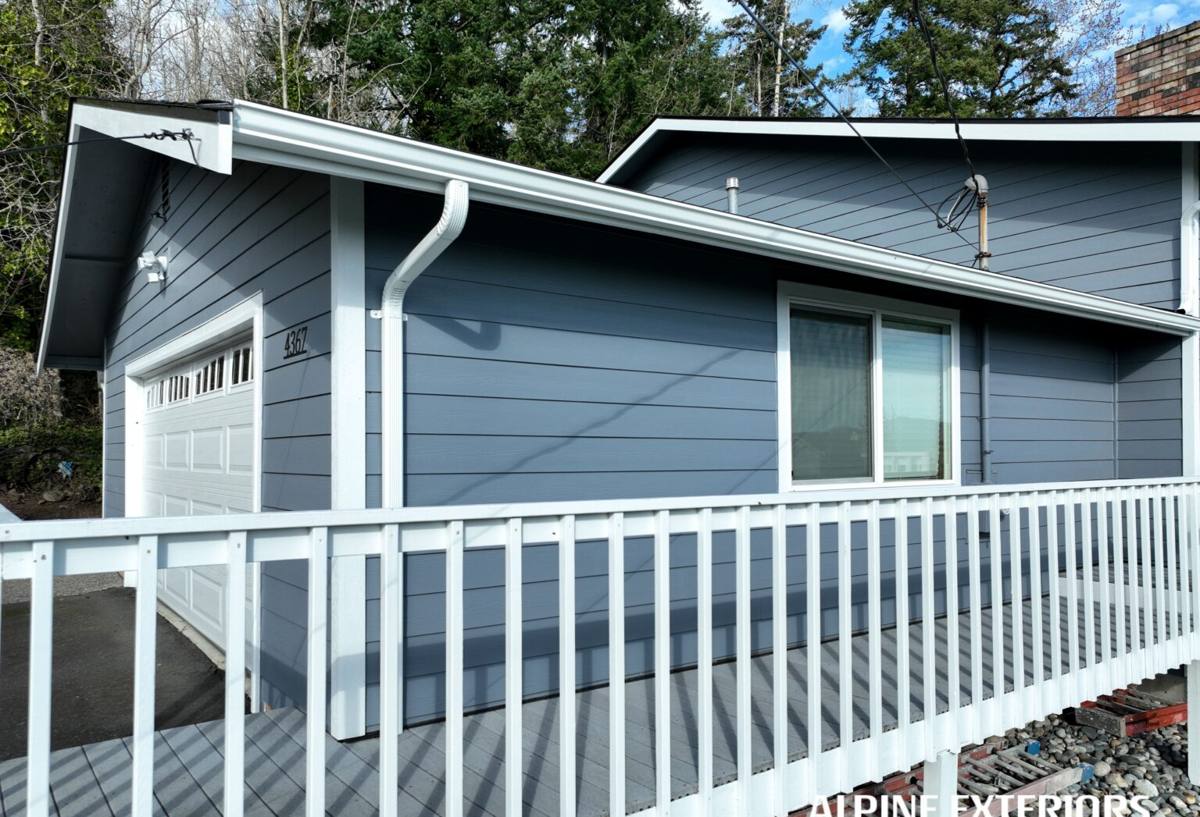
Why Metal Makes Sense for a Lynden Roof
Metal isn't the right choice for every homeowner or every budget, but for this climate specifically it solves problems that asphalt and wood roofing struggle with over time.
Moss and Moisture Resistance
Moss needs a surface it can grip and hold moisture against. A smooth, non-porous metal panel gives it almost nothing to attach to, and the steep pitch and slick surface of most metal roofs shed water fast enough that moss rarely gets the sustained dampness it needs to establish. That matters in a valley climate where shaded roof planes stay wet for days at a time during the fall and winter.
Long Service Life
A correctly installed metal roof in this region routinely outlasts two or three asphalt roofing cycles. That doesn't mean it's maintenance-free — fasteners, sealants, and flashing details still age and need periodic attention — but the base material itself isn't degrading from moisture absorption the way organic shingle mat or untreated wood does.
Wind and Wind-Driven Rain
Rain in this valley doesn't always fall straight down; wind pushes it sideways into valleys, around penetrations, and under poorly lapped edges. Metal panel systems, when installed with the right underlayment and flashing details, handle that lateral water pressure better than most other roofing types because the panels themselves are continuous, interlocking barriers rather than overlapping individual pieces.
Standing Seam vs. Exposed Fastener Panels
Most residential metal roofing in this area falls into one of two categories, and the difference matters more than most homeowners realize going in.
| Panel Type | How It's Fastened | Moisture Behavior | Typical Lifespan Here |
|---|---|---|---|
| Standing seam | Concealed clips; no exposed screws through the panel face | Best performance — no fastener penetrations for water to find | 40-60 years |
| Exposed fastener (corrugated/ribbed) | Screws driven through the panel face with rubber-washer sealing | Good, but washers age and need periodic inspection/replacement | 25-40 years, longer with washer maintenance |
Standing seam costs more upfront because of the labor and specialized tooling involved, but it removes the single most common long-term failure point on a metal roof: aging fastener washers. Exposed fastener panels are a legitimate, lower-cost option and hold up well here when installed correctly and checked periodically — we'll walk through the honest trade-off for your budget and roofline rather than defaulting to one or the other.
What a Correct Metal Roof Installation Involves
Metal roofing has a reputation for being low-maintenance, and it is — but only if what's underneath and around the panels is done right. Most metal roof problems we get called out to inspect trace back to shortcuts taken during the original install, not to the panels themselves.
Underlayment and Moisture Barrier
Metal panels aren't the only line of defense — a high-temperature synthetic or self-adhered underlayment underneath handles any moisture that works past seams, penetrations, or ice damming at eaves. In a climate with this much sustained dampness, that underlayment layer isn't optional or a place to cut cost.
Flashing at Every Transition
Valleys, chimneys, vent pipes, skylights, and roof-to-wall transitions are where the large majority of leaks originate on any roof, metal included. Flashing has to be properly lapped, sealed, and in some cases custom-bent to fit the actual roofline rather than forced from a stock piece.
Fastener and Panel Material Choices
Because this area sits close enough to Puget Sound to carry some salt content in the air, dissimilar-metal corrosion is a real consideration. Fasteners, flashing, and trim need to be matched to the panel material — mixing incompatible metals (for example, uncoated steel fasteners against aluminum panels) sets up galvanic corrosion that can stain and eventually compromise the roof years before the panels themselves would fail.
Ventilation
Metal sheds water well on the outside, but trapped moisture in the attic still needs somewhere to go. Proper ridge and soffit ventilation keeps condensation from forming on the underside of the deck, which matters in a climate where indoor-outdoor temperature and humidity differences are common for much of the year.
Coatings and Finishes: What They Actually Do
The paint or coating system on a metal panel isn't just about color — it's the layer that determines how well the panel resists fading, chalking, and corrosion over decades of exposure.
| Finish Type | What It Resists | Trade-Off |
|---|---|---|
| Standard polyester (SMP) | Basic UV and weather exposure | Lower cost; fades and chalks faster over time |
| PVDF/Kynar-type coatings | UV fading, chalking, and coastal air exposure | Higher upfront cost; holds color and finish far longer |
| Galvalume/bare metal substrate | General corrosion via aluminum-zinc coating | Needs a quality topcoat in salt-influenced air; bare finish weathers to a dull patina over time |
Given how much moisture and how many mild, damp months this region sees, we generally steer homeowners toward the better-performing coating systems on any roof that's going to be a long-term investment, even though it costs more at install. A cheaper coating that needs repainting or shows corrosion in half the panel's structural lifespan isn't actually the cheaper option once you count the redo.
Our Process for a Lynden Metal Roofing Project
- On-site assessment: We look at your existing roof deck, pitch, shading, and any problem areas — valleys, chimneys, low-slope sections — before recommending a panel type or coating.
- Tear-off vs. overlay decision: Metal can sometimes go over an existing roof in the right conditions, but we'll tell you honestly when the deck or existing roofing needs to come off first rather than defaulting to whichever is faster for us.
- Deck prep and underlayment: Any soft or damaged decking gets replaced before underlayment goes down — panels installed over a compromised deck don't hold fasteners correctly no matter how good the panel is.
- Panel installation and flashing: Panels are installed to the manufacturer's fastening pattern and spacing, with flashing custom-fit at every valley, penetration, and transition.
- Final inspection and walkthrough: We check seams, fastener torque, flashing laps, and ventilation before calling the job done, and walk you through what maintenance (if any) the specific system you chose will need.
Problems We See on Existing Metal Roofs in This Area
When we're called out to inspect an older metal roof in Lynden or the surrounding valley, the issues tend to repeat:
- Backed-out or worn fasteners on exposed-fastener panels — the rubber washer degrades faster than the screw itself, and once it fails, water finds the hole.
- Oil-canning — a visible waviness in wide, flat panel sections, usually from a substrate that was too thin or a deck that wasn't flat enough underneath.
- Dissimilar-metal staining and corrosion where the wrong fastener or flashing metal was used against the panel material.
- Sealant failure at penetrations where exposed caulk or sealant was used instead of a proper mechanical flashing detail, and it dried out or cracked years later.
- Debris buildup in valleys — even a moss-resistant surface can trap needles and leaves in a tight valley, and standing debris holds moisture against the panel edge.
None of these are reasons to avoid metal roofing — they're reasons to make sure the install is done correctly the first time, since most of them are prevention problems, not material problems.
Maintenance: What a Metal Roof Actually Needs
One of the real advantages of metal is how little ongoing maintenance it needs compared to shingle or wood roofing — but "low-maintenance" isn't "no-maintenance."
- Clear debris from valleys and around penetrations once or twice a year, especially after fall leaf drop
- Check exposed fasteners for backing-out or washer wear every few years on exposed-fastener systems
- Look at flashing and sealant at chimneys, vents, and skylights for cracking or gaps annually
- Keep gutters clear so water sheds off the roof edge instead of backing up under the panel edge
- After any major windstorm, a quick visual check for lifted panels or dented sections is worth the time
Why Hire a Crew That Already Works in Lynden
Metal roofing installation is less forgiving of shortcuts than shingle roofing — a fastener pattern that's slightly off, a flashing detail that's improvised instead of properly fabricated, or an underlayment that's skipped to save time won't show up as a problem on day one. It shows up as a leak or a corrosion stain three, five, or ten years later, often after the crew that installed it is long gone. Working regularly in this specific valley climate — with its combination of salt-influenced air, wind-driven rain, and a moss season that runs most of the year — means we're building details for conditions we see repeatedly, not guessing at what a manufacturer's installation guide assumes for a drier region.
We also carry that same standard through material selection: we'll tell you plainly when a lower-cost coating or fastener system is a reasonable trade-off for your budget, and when it's a corner that will cost more to fix than it saved to install.
If you're weighing a metal roof for a Lynden home, we're glad to come take a look, walk the roofline with you, and give you a straightforward estimate — no pressure, no sales script. Fill out the form below to get started.