 Bellingham Siding
 Why Asphalt Shingle Roofs Take a Beating in Lynden
Lynden sits out on the open farmland north of Bellingham, and that setting cuts both ways for a roof. You're further from Bellingham Bay than waterfront neighborhoods, so direct salt spray is less of a factor here than it is closer to the water — but you trade that for long, unbroken wind runs across open fields that drive rain sideways into every exposed edge, valley, and vent boot. Add in the same long moss season that hits the whole region, and you've got a roof that's rarely just sitting there drying out between storms.
What that means in practice: shingles here don't fail because of one big storm. They fail slowly, from months of standing moisture at the edges, moss holding water against the granule surface, and wind working at fasteners and flashing that weren't detailed for this kind of exposure. A shingle roof built for a drier climate, or installed with shortcuts that would be fine somewhere else, tends to show its age early out here.
The Three Things Working Against Your Roof
- Driving rain: wind-blown rain finds gaps at valleys, chimneys, skylights, and roof-to-wall transitions that a calmer climate would never test.
- Moss and moisture: shaded slopes and north-facing roof planes stay damp for weeks at a time, giving moss and algae the conditions they need to take hold.
- Temperature swings: shingles expand and contract through wet winters and warmer summers, which stresses seals and fasteners over years of cycles.
What a Correctly Installed Shingle Roof Needs Out Here
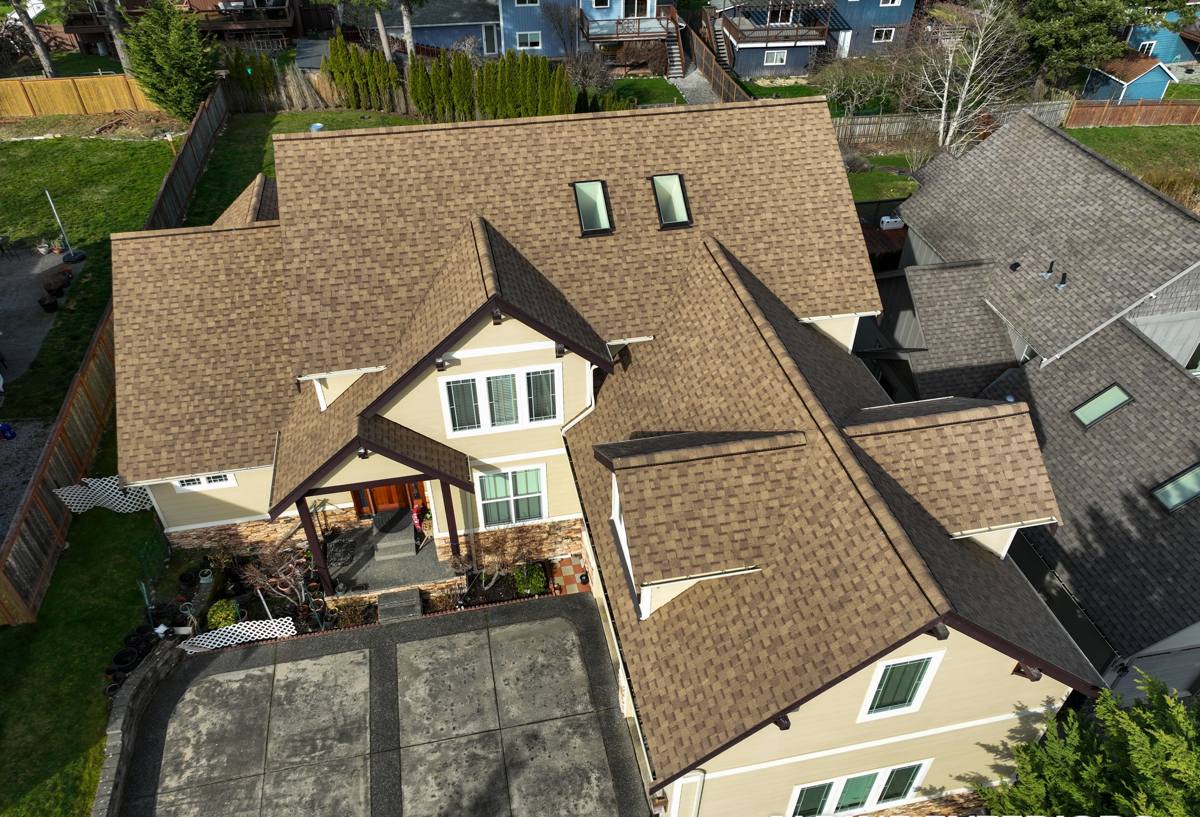
A shingle roof isn't just shingles nailed to plywood. In a climate like Whatcom County's, the layers underneath the shingle are doing as much work as the shingle itself. A roof built right for Lynden includes:
- Ice-and-water shield at vulnerable points — valleys, eaves, and around penetrations — not just at the eave line, since wind-driven rain can push water uphill under shingles in a way gravity-only assumptions don't account for.
- A full synthetic underlayment across the whole deck, not scattered felt, as the actual water-shedding layer if wind ever gets under a shingle tab.
- Properly lapped and sealed flashing at every chimney, skylight, and wall intersection — this is where most leaks we get called out for actually start, not in the open field of the roof.
- Balanced attic ventilation so moist interior air isn't condensing on the underside of the deck and rotting it from below while moss works on it from above.
- Starter strip and hip/ridge shingles rated for the same wind exposure as the field shingles, since these edges are where wind gets its first grip.
Skip any one of these and the roof will still look fine on install day. The problems show up two, five, or ten winters later — which is exactly why so many roof failures get blamed on "bad shingles" when the real issue was how the roof was put together underneath them.
Signs a Lynden Roof Needs Attention
Most homeowners don't get on their own roof, and they shouldn't have to. Here's what's usually visible from the ground or from a ladder at the eave line:
| What You See | What It Usually Means |
|---|---|
| Dark streaks or green/black patches on north-facing slopes | Algae or moss growth — cosmetic at first, but it holds moisture against the shingle over time |
| Granules collecting in gutters or at downspout outlets | Shingles are wearing; heavier loss usually means the roof is past its middle age |
| Curling or lifting shingle edges | Aging asphalt, heat cycling, or ventilation problems in the attic below |
| Moss growing thick along ridges or in shaded valleys | Trapped moisture that can lift shingle edges and work under the tabs |
| Water stains on interior ceilings, especially near chimneys or skylights | A flashing or underlayment failure, not necessarily the shingles themselves |
| Visible sagging in the roof plane | A structural or long-term moisture issue that needs a closer look right away |
How We Approach an Asphalt Shingle Roof in Lynden
1. Inspection and honest assessment
We start on the roof, not with a sales pitch. We're checking the deck condition, existing ventilation, flashing details, and how much life is actually left versus what a homeowner might assume from ground-level moss and staining. Sometimes a roof that looks rough just needs moss treatment and a few flashing repairs. Sometimes it needs a full tear-off. We'll tell you which one it is.
2. Tear-off and deck check
For a full re-roof, we remove the old roofing down to the deck rather than layering over it. That's the only way to actually see the plywood or sheathing underneath — moisture damage from a long-term leak doesn't show up until the old shingles are off, and it's far cheaper to catch and fix at this stage than to find out later.
3. Underlayment and flashing first
This is the step that determines whether the roof performs in a wet climate or just looks good until the first real storm. We install underlayment across the full deck, ice-and-water membrane at the vulnerable spots, and new flashing at every penetration rather than reusing old flashing that's already fatigued.
4. Shingle installation to spec
Shingles go down following the manufacturer's nailing pattern and exposure — not a faster pattern that saves labor but leaves the roof under-fastened for wind. Starter strips, hip and ridge caps, and ventilation components are matched to the field shingles so the whole system is rated together, not mismatched.
5. Final walk-through
We walk the finished roof with you, cover what maintenance actually matters going forward, and make sure you know what's under warranty and what to watch for.
Choosing a Shingle for This Climate
Asphalt shingles come in a few tiers, and the right choice depends on how long you plan to be in the home and how much roof is exposed to wind and moss-prone shade.
| Shingle Type | Typical Lifespan | Best Fit |
|---|---|---|
| 3-tab (economy) | Shorter end of the range | Budget-driven projects; lower wind rating, so exposed sites need extra attention to fastening |
| Architectural / laminate | Mid-to-long range | Most Lynden homes — better wind resistance, thicker profile sheds water better on low-slope sections |
| Premium / designer | Longer range | Homeowners wanting a heavier look and the manufacturer's longest warranty tier |
We steer most Lynden homeowners toward architectural shingles rather than 3-tab. It's not that 3-tab is a bad product — it's that the wind exposure and moisture load here reward the extra wind rating and thickness, and the price difference is usually smaller than people expect relative to the total job cost.
Ventilation and Moisture: The Part You Can't See
A shingle roof and an attic are one connected system. If the attic can't breathe — intake at the eaves, exhaust at the ridge, moving air the whole distance between — moisture from daily living gets trapped against the underside of the roof deck. In a climate that's already damp outside, a poorly ventilated attic adds a second moisture source from inside. Over time that shows up as premature shingle aging from below, and sometimes as mold or wood rot on the deck itself, which won't show up until you're re-roofing and pull the old material off. We check intake and exhaust balance as part of every roofing job here, not as an upsell — it's part of doing the roof correctly.
What Affects the Cost of a Lynden Re-Roof
| Factor | Why It Matters |
|---|---|
| Roof size and number of planes | More area and more valleys/hips mean more material and more labor-intensive flashing detail |
| Existing layers to remove | Tear-off of multiple old layers takes longer and may reveal deck repairs |
| Deck condition | Rotted or soft plywood found during tear-off needs replacement before shingles go down |
| Shingle tier chosen | 3-tab, architectural, and premium products carry different material costs |
| Roof pitch and access | Steep or hard-to-access roofs take longer and require more safety setup |
| Ventilation upgrades | Adding or correcting intake/exhaust venting is worth doing during a re-roof, not after |
Most straightforward asphalt shingle re-roofs on a typical Lynden home run from the mid-thousands into the high five figures depending on the factors above — we won't quote a number without seeing the roof, because guessing over the phone does homeowners a disservice.
Maintenance That Actually Extends Roof Life Here
A shingle roof in this climate isn't maintenance-free, but the upkeep is manageable if it's done on schedule instead of after a problem shows up.
- Keep gutters clear so water isn't backing up under the eave line during heavy rain
- Have moss treated before it thickens into mats that hold water against the shingle
- Trim back overhanging branches to reduce shade and debris buildup on north-facing slopes
- Get flashing around chimneys and skylights checked every few years, since these seals age faster than the shingle field
- Have the attic checked periodically for proper airflow and any sign of moisture staining on the underside of the deck
- Schedule a roof inspection after any major windstorm, even if nothing looks obviously wrong from the ground
Why It Matters to Hire a Crew That Already Works This Area
Roofing crews that mostly work drier climates size up ventilation, underlayment, and flashing differently than the job actually calls for here — not out of carelessness, just because it's not what their normal jobs demand. A crew that works Whatcom County roofs regularly already knows which details matter on an open, wind-exposed lot versus a shaded, moss-prone one, and doesn't need to relearn that on your roof. We've built our process around this specific climate — long wet seasons, wind-driven rain, and moss that doesn't take a season off — rather than treating it as an exception to a standard job.
If your roof is showing moss, granule loss, or you just want an honest read on how many years it's got left, we're glad to take a look. Fill out the form below for a free, no-pressure estimate — we'll tell you what we actually see, not what's easiest to sell.