 Bellingham Siding
 Sudden Valley's Climate Is Harder on Siding Than It Looks
Sudden Valley sits in a heavily wooded, lake-adjacent pocket of Whatcom County, and that setting is a mixed blessing for the outside of a house. The tree canopy that makes the neighborhood shady and quiet also keeps siding damp longer after every rain. Add in the marine air that moves through this part of Washington off the Sound, driving rain that comes in sideways during winter storms, and a moss season that can run most of the year in the shadiest lots, and you have a climate that punishes any siding product with weak points at the seams, fasteners, or finish.
Homeowners here usually don't notice a siding problem until it's visible — a soft spot near a downspout, dark streaking under a roofline, or paint that's peeling in the same six-inch band every year. By the time it's visible, moisture has usually been working underneath for a while. Siding in this neighborhood needs to be chosen and installed with that reality in mind, not just picked for looks.
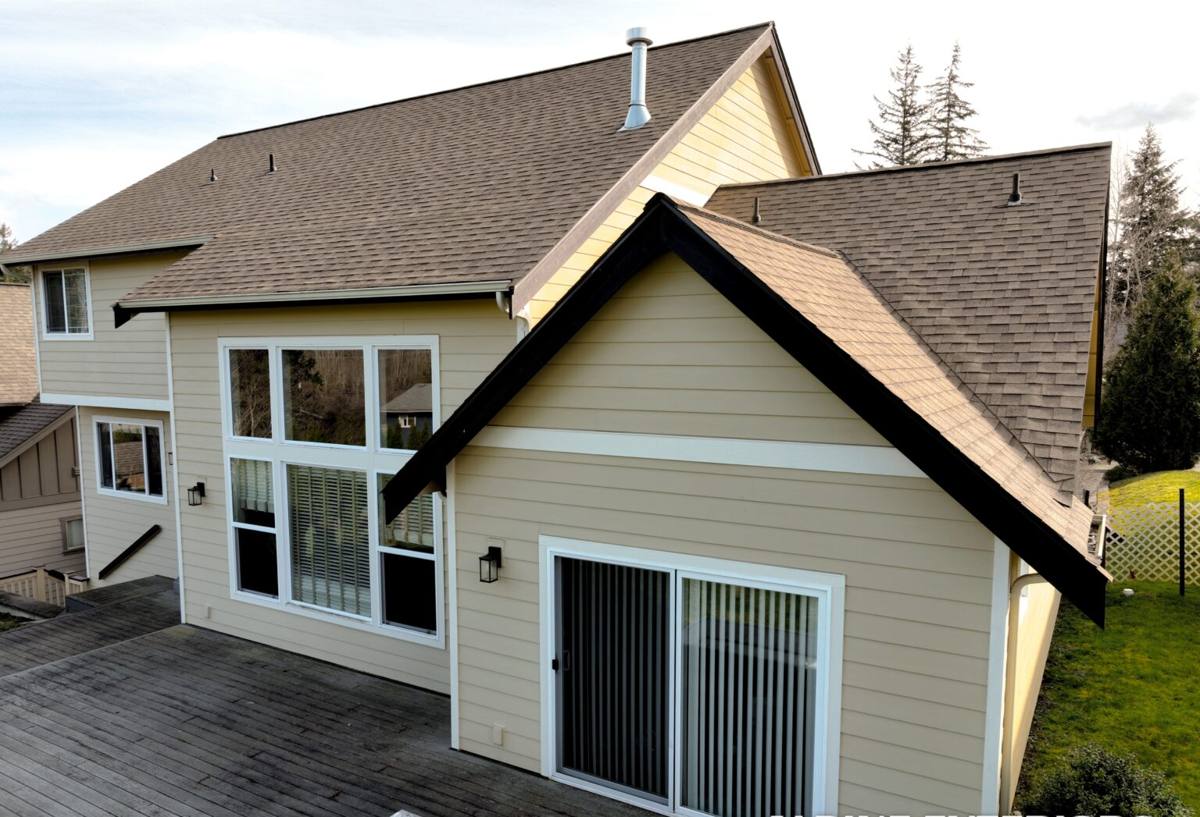
Why Moss and Moisture Are the Real Test for Siding Here
Moss Isn't Just Cosmetic
On a lot with heavy tree cover, north-facing walls and anything shaded by conifers can stay damp for days after a storm. Moss and algae take hold in that dampness, and once established they hold moisture directly against the siding surface. On products that absorb water or swell at the seams, that's a slow path to rot and delamination. On siding that's dimensionally stable and properly sealed at every joint, moss is mostly a surface issue that washes off.
Driving Rain Finds Every Gap
Wind-driven rain in this region doesn't just fall on siding — it gets pushed sideways and upward under laps, around trim, and behind poorly flashed penetrations. A siding job that looks fine from the ground can still be letting water into the wall assembly if the flashing details and caulking were rushed. This is where installation quality matters as much as the product itself.
Why We Install Only James Hardie Fiber Cement
We don't install vinyl, LP SmartSide, or unfinished wood siding, and Sudden Valley's climate is a big part of why. Vinyl expands and contracts with temperature swings and can warp or crack over time, and its seams rely on overlap rather than a sealed joint. Engineered wood products use wood fiber as their core, which means any breach in the factory coating gives moisture a path into material that can swell. Cedar and primed spruce look good on day one but need ongoing maintenance — sealing, painting, moss treatment — to hold up in a wet, shaded climate, and that upkeep gets expensive and easy to fall behind on.
James Hardie fiber cement is cement, sand, and cellulose fiber. It doesn't rot, it isn't a food source for moss or algae the way wood is, and it holds its shape through wet-dry cycles instead of swelling. The ColorPlus factory finish is baked on under controlled conditions and holds color and adhesion far better than field-applied paint, which matters a lot in a neighborhood where a house might not get direct sun for days at a stretch to help paint cure and dry.
Product Comparison for a Climate Like This
| Factor | James Hardie Fiber Cement | Vinyl | Wood / Engineered Wood |
|---|---|---|---|
| Moisture response | Dimensionally stable, won't rot | Doesn't rot, but seams can let water track behind panels | Absorbs moisture; core can swell if coating fails |
| Moss/algae resistance | Not a food source; washes clean | Resistant but traps moisture behind panels | Susceptible, especially in shaded areas |
| Finish durability | Factory-baked ColorPlus, long fade resistance | Color molded in, can fade and chalk | Field-applied paint needs recoating every few years |
| Maintenance in shade/moisture | Occasional wash | Occasional wash | Regular inspection, recoating, moss treatment |
| Fire resistance | Non-combustible | Combustible | Combustible |
The Hardie Products That Fit This Neighborhood
Most Sudden Valley homes do well with HardiePlank lap siding in the HZ5 formulation, which is engineered for the Pacific Northwest's wet, moderate climate rather than a drier or hotter region's version of the product. HZ5 is built to resist moisture intrusion and hold up through repeated freeze-thaw and wet-dry cycling, which is exactly what this area sees over a winter.
For homes with more architectural detail — gables, dormers, mixed rooflines common on lake-area lots — HardieShingle or HardieTrim boards can be used as accents against the primary lap siding, giving depth without introducing a second material that ages differently. Color choice matters too: in a shaded, moss-prone setting, darker ColorPlus tones tend to show less green tinting between cleanings than very light colors, though any color will need an occasional rinse in a heavily treed yard.
What a Correct Installation Involves
The product only performs as well as the install. In a climate like Sudden Valley's, a handful of details separate a job that lasts decades from one that fails early:
- Weather-resistive barrier installed and lapped correctly before any siding goes on, with no gaps at seams or penetrations
- Flashing at every window, door, and roofline transition, directing water out and away rather than behind the siding
- Proper fastener placement and spacing per Hardie's installation specifications — not "close enough," since misplaced fasteners can split the board or fail to hold under wind load
- Correct clearance between the bottom of the siding and grade, decks, walkways, or roof surfaces, so splashback and standing water don't sit against the material
- Caulking only where Hardie's instructions call for it, with the right sealant — over-caulking can trap moisture just as easily as under-caulking lets it in
- Field-cut edges sealed with the correct primer before installation, since a raw cut edge is the one place factory protection doesn't reach
Any one of these done wrong can undercut an otherwise good product. This is why we follow Hardie's published installation requirements exactly rather than treating them as a rough guide — it's also what keeps the manufacturer's warranty intact if a homeowner ever needs to use it.
Why a Crew That Already Works This Area Matters
A contractor who regularly works Sudden Valley and the surrounding Bellingham area already knows the patterns: which orientations hold moisture longest under heavy tree cover, how driving rain typically hits a given lot layout, and what county permitting and inspection expect for exterior work. That local familiarity shortens the guesswork on a bid and reduces surprises once the old siding comes off and the wall sheathing underneath is visible for the first time in years.
It also matters for accountability. A crew with an ongoing presence in the neighborhood has a reason to get the flashing and clearances right the first time, because they're not disappearing after the invoice clears — they're the ones a neighbor calls to compare notes.
Our Process for a Sudden Valley Siding Job
We start with a walk-around of the home to check the current siding, look for signs of moisture behind it, and note tricky details — roof transitions, deck ledger boards, shaded walls, anywhere driving rain tends to concentrate. From there we put together a scope and estimate that accounts for the specific exposure of that lot, not a generic per-square-foot number.
Once old siding comes off, we inspect the sheathing before anything new goes up. If there's hidden rot or water damage, we address it before installing Hardie over it — sealing new siding over a compromised wall doesn't solve anything, it just hides the problem for another few years. Then it's weather barrier, flashing, HZ5 Hardie siding installed to spec, and a final walkthrough where we go over the finished work with the homeowner directly.
Signs Your Current Siding Is Losing the Fight
- Persistent moss or algae staining that returns quickly after cleaning
- Soft or spongy spots when pressed, especially near the bottom courses or under windows
- Paint peeling or bubbling in the same spots year after year
- Visible warping, buckling, or gaps opening up at seams
- Rising energy bills that suggest air and moisture are getting past the wall assembly
- Siding that's original to a home built more than 20-25 years ago and has never been fully inspected
None of these mean a home needs a full replacement immediately, but they're worth a professional look before another wet winter passes.
What Maintenance Looks Like After Installation
Properly installed James Hardie siding doesn't need much, but "not much" isn't "nothing" in this climate. An occasional gentle rinse keeps moss and pollen from building up, especially on shaded walls. It's worth a quick visual check after major storms for anything that's come loose around trim or flashing, and gutters should stay clear so overflow doesn't run down the face of the siding repeatedly. Beyond that, ColorPlus finish is built to go a long time without needing repainting, which is one of the bigger practical advantages over wood in a neighborhood where ladder access under tree canopy isn't always easy.
If you're seeing any of these warning signs on your Sudden Valley home, or you're just planning ahead for a home that's due, we're happy to take a look and give you a straight answer about what your siding actually needs. Reach out for a free, no-pressure estimate — there's a form right below to get started.