 Bellingham Siding
 What Happy Valley's Weather Actually Does to Siding
Happy Valley sits close enough to Bellingham Bay that salt-laden air reaches exterior walls on a regular basis, even on homes that aren't waterfront. Salt air doesn't just look like a haze on your windows — it works on fasteners, caulk, and paint finishes over years, and it's harder on cheap or mismatched materials than most homeowners expect. Add in the wind-driven rain that comes through Whatcom County every fall and winter, and the concern isn't just "does the siding get wet," it's whether water is finding its way behind the siding, into the sheathing, and into the wall cavity where it can sit for months before anyone notices.
Then there's moss season, and in this part of Bellingham it's a long one. Many Happy Valley lots have mature tree cover that keeps north- and east-facing walls shaded and damp for large stretches of the year — exactly the conditions moss, algae, and mildew need to take hold on a wall surface. None of this is unusual for the area. It's just what siding here has to hold up against, and it's why the material and the installation detail matter more in this neighborhood than they would somewhere drier and sunnier.
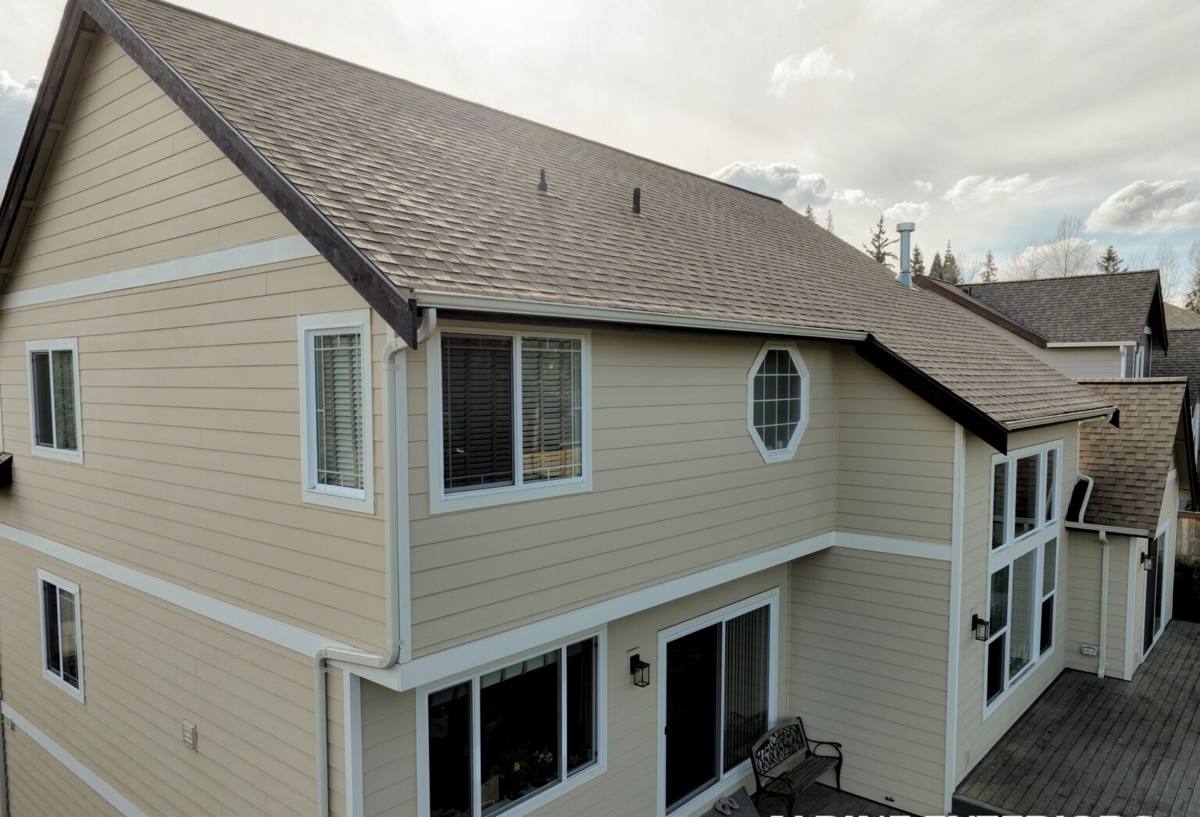
Why We Install Only James Hardie Fiber Cement
We standardized on James Hardie fiber cement for every job we do, including here in Happy Valley, because it's the one product we've found that holds up to this specific combination of salt air, sustained rain exposure, and shade-driven moisture without the maintenance headaches that come with the alternatives.
Non-combustible and dimensionally stable
Fiber cement is made from cement, sand, and cellulose fiber. It doesn't swell, cup, or rot the way wood-based sidings can when they take on repeated moisture cycles, and it's non-combustible — a real consideration given wildfire smoke seasons that now reach Western Washington some summers.
ColorPlus finish vs. field-applied paint
Hardie's ColorPlus finish is baked on at the factory under controlled conditions, which gives it better fade and moisture resistance than paint applied on-site after installation. In a salt-air environment, that factory bond matters — field-applied finishes are more prone to breaking down at the surface over time, which is when moss and mildew get a foothold.
Climate-engineered product lines
Hardie builds its HardiePlank and panel products in different formulations for different climate zones — a wetter, more humid engineering spec for the Pacific Northwest than what ships to arid climates. That's not marketing; it changes how the product performs against sustained moisture exposure, which is the exact condition Happy Valley deals with most of the year.
We don't install vinyl, LP SmartSide, cedar, or primed spruce, and we're upfront about why: each of those products has real strengths, but each also comes with a moisture-management or maintenance trade-off that we're not willing to put our name behind in this climate. That's a professional standard we hold to on every job, not a knock on any one brand.
What a Correct Fiber Cement Job Actually Involves
Fiber cement siding fails in the field far more often from installation mistakes than from the material itself. In a climate like this one, the margin for error is smaller.
Water management behind the cladding
The siding itself is the least important layer for keeping a house dry — what's behind it does the real work. That means a continuous weather-resistive barrier, correctly lapped and taped, flashed properly at every window, door, and penetration, and in higher-exposure spots, a rainscreen gap that lets any water that does get past the cladding drain and dry out instead of sitting against the sheathing.
Clearances that actually get followed
Hardie specifies minimum clearances — roughly 6 inches from grade and 2 inches from roof and deck surfaces — for a reason: siding installed too close to the ground or a roofline wicks moisture and stays wet longer. It's an easy detail to skip when a crew is moving fast, and it's one of the first things we check on any tear-off.
Fastening and joint treatment
Fiber cement needs the correct fastener type, spacing, and depth — overdriven nails crack the board's fiber cement edge and create a point where water gets in. Cut edges need to be primed and sealed before they go up, and butt joints need to be detailed correctly rather than just caulked over and hoped for.
Comparing Your Options for a Happy Valley Home
| Material | Behavior in Salt Air & Rain | Moss/Algae Resistance | Ongoing Maintenance |
|---|---|---|---|
| James Hardie fiber cement | Dimensionally stable; factory finish holds up well to salt exposure | Good, especially with periodic rinsing | Low — occasional wash, no repainting on ColorPlus finish |
| Vinyl | Can warp or become brittle with UV and temperature swings over time | Moderate; grows algae in shaded, damp spots like most claddings | Low, but seams and edges trap moisture over years |
| Cedar / wood | Absorbs moisture readily; prone to swelling and rot without diligent upkeep | Poor without regular treatment | High — refinishing and sealing on a recurring cycle |
| LP SmartSide (engineered wood) | Better than raw wood, but still an engineered wood product sensitive to sustained moisture at cut edges and joints | Moderate | Moderate — finish and joint maintenance matter more than with fiber cement |
This is a general comparison, not a claim that any of these products can't perform — it's why the trade-offs push us toward fiber cement for homes in this specific climate rather than a blanket statement that the alternatives are bad products.
How We Run a Job in Happy Valley
The process doesn't change much house to house, but the order matters, especially when the existing wall assembly has been sitting behind old siding for a couple of decades.
- Walk the exterior and check for existing moisture damage, soft sheathing, or past repair patches before quoting the job
- Confirm the drainage plane and flashing plan for windows, doors, and any deck or porch penetrations
- Remove old siding down to the sheathing and inspect what's underneath rather than siding over a problem
- Repair or replace any compromised sheathing or framing found during tear-off
- Install a continuous weather-resistive barrier, with a rainscreen gap where exposure calls for it
- Install Hardie siding to spec — correct clearances, fastener spacing, and primed/sealed cut edges
- Detail all joints, trim, and penetrations before final cleanup
- Walk the finished job with the homeowner before calling it done
Why a Crew That Already Works This Neighborhood Matters
Happy Valley has its own mix of lot conditions — tree canopy that keeps some walls shaded most of the year, slopes that affect how water sheets off a roof and down a wall, and orientation toward the water that varies from block to block. A crew that's already worked houses in this part of Bellingham has a feel for where the moisture problems tend to show up before the siding even comes off, and knows the wind and rain exposure this part of Whatcom County actually sees versus what a generic spec sheet assumes.
There's also the practical side: a local crew is the one that's still around next year if a question comes up about a warranty detail or a joint that needs a second look. That matters more with siding than with almost any other exterior trade, because problems that start small — a gap at a window flashing, a joint that wasn't sealed right — don't show up as damage until a season or two of rain and salt air have had time to work on them.
Living With Fiber Cement Siding Here
Fiber cement is low-maintenance compared to wood or vinyl, but "low-maintenance" isn't "no-maintenance" in this climate. A yearly rinse-down helps clear the salt film and moss spores that build up on shaded and north-facing walls before they get a chance to establish. Keeping gutters clear matters more here than in a drier climate — a clogged gutter sends a sheet of water straight down a wall section every time it rains hard, and that's exactly the kind of repeated soaking that stresses even a well-installed siding job. It's worth a visual check of caulking and joints every year or two given how much rain this area sees; catching a failed joint early is a five-minute fix, while ignoring it for a few wet seasons is not.
Getting Started
If you're weighing a siding project on a Happy Valley home, we're glad to come take a look, walk the exterior with you, and talk through what your specific house needs given its exposure and age — no pressure, no obligation. Use the form below to request a free estimate.