 Bellingham Siding
 Why Decks in Happy Valley Wear Differently
Happy Valley sits close enough to Bellingham Bay and the surrounding wetlands that decks here deal with a specific combination of stresses most inland neighborhoods don't see as often: salt-tinged air moving in off the water, long stretches of driving rain through fall and winter, and a moss season that can run eight months or more in shaded, north-facing yards. None of these problems are dramatic on their own. What they do is compound. Salt air accelerates corrosion on fasteners and metal hardware. Rain that never really stops keeps wood assemblies damp for days at a time instead of drying out between storms. And moss holds moisture against decking boards and structural framing long after the surface looks dry.
We've repaired enough decks in and around Bellingham to see the pattern clearly: the decks that fail early aren't usually the ones with bad lumber. They're the ones where a builder used the wrong fastener, skipped flashing at a critical joint, or didn't leave enough airflow underneath. In a drier climate those shortcuts might go unnoticed for a decade. In Whatcom County's climate, they show up in three to five years.
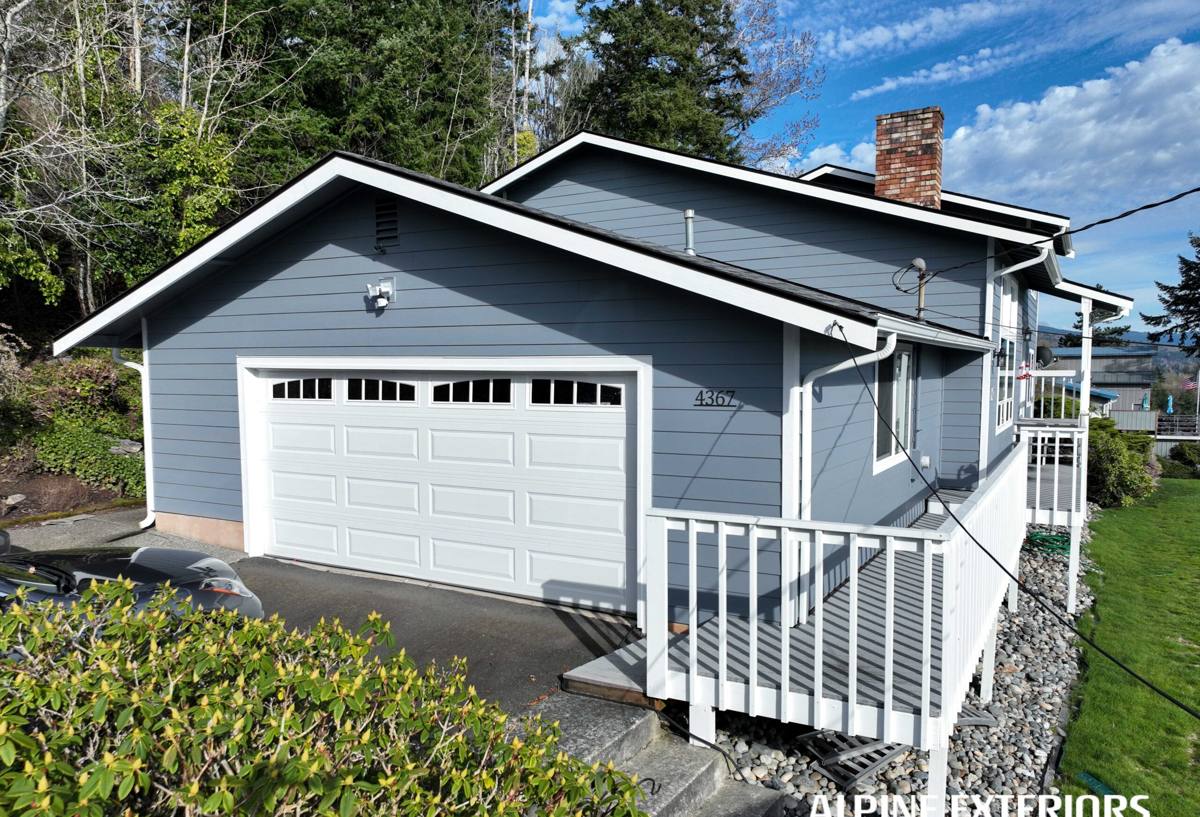
Signs Your Deck Needs Repair — Not a Full Rebuild
Most decks we're called out to in Happy Valley don't need to be torn out and rebuilt. They need targeted repair to the parts that actually fail first: connections, fasteners, and anything in direct, repeated contact with standing water. Here's what we check for on every visit:
- Soft or spongy spots in decking boards, especially near the house or in shaded corners
- Rust streaks or corroded fastener heads, particularly around joist hangers and the ledger board
- Gaps opening up where the deck ledger meets the house siding or rim joist
- Wobble or movement in the railing posts when you push on them
- Green or black film building up on boards that stay shaded most of the day
- Standing water that doesn't drain within an hour or two after rain stops
- Visible daylight or gaps between deck boards that have shrunk, cupped, or twisted
- Stair stringers that flex or feel unstable underfoot
If you're seeing one or two of these, it's usually a repair. If you're seeing several at once — especially anything involving the ledger board or the main support posts — it's worth a closer structural look before we talk about cosmetic fixes.
The Ledger Board Is the One We Check First
The ledger board — the piece that attaches the deck directly to the house — is the single most important connection on any deck, and it's also the one most exposed to the kind of wind-driven rain Bellingham gets off the Sound. If flashing behind the ledger was installed poorly or left out entirely, water gets trapped between the ledger and the house framing and rots both from the inside out, often without any visible sign from the deck surface. This is the failure that actually causes decks to collapse, so it's always the first thing we inspect, even on a job that was called in for something as simple as a squeaky board.
What a Correct Deck Repair Actually Involves
A repair that's done right works from the structure outward, not from the surface in. That means:
- Structural inspection first. We check the ledger connection, joists, beams, posts, and footings before touching anything cosmetic. A new deck board over a compromised joist just hides the problem.
- Fix the moisture path, not just the symptom. If a board is rotting because water pools against it, replacing the board without correcting the drainage or flashing means the same failure returns in a season or two.
- Match or upgrade fasteners and hardware. Old galvanized fasteners that have started to corrode get replaced with hardware rated for the actual exposure the deck sees, not just whatever was in stock when it was originally built.
- Replace framing members individually where possible. A rotted joist or a cracked post doesn't always mean the whole deck needs to come apart — sectional replacement is often structurally sound and far more cost-effective.
- Address airflow and drainage underneath. Decks built low to the ground or over poorly graded soil trap moisture. Sometimes the fix includes improving grading or venting, not just replacing wood.
Repair vs. Replacement: How We Actually Decide
Homeowners often assume a deck with visible damage needs full replacement. That's frequently not true — but sometimes it is, and the honest answer depends on where the damage is and how much of the structure it's reached.
| Factor | Usually Points to Repair | Usually Points to Replacement |
|---|---|---|
| Ledger board condition | Solid, properly flashed | Rotted, no flashing, or improperly attached |
| Support posts and footings | Sound, adequately sized for current code | Undersized, shifted, or resting on failed footings |
| Extent of surface damage | Isolated boards or sections | Widespread rot or cupping across most of the deck |
| Age of structural framing | Framing under 15–20 years, well-maintained | Original framing from an older, undersized build |
| Railing and stair safety | Solid connections, minor tightening needed | Loose posts, missing structural blocking |
| Budget priority | Extend usable life for a lower cost | Want a different layout, size, or material long-term |
As a general rule, repair costs for a deck with isolated damage tend to run in the low-to-mid hundreds for a single board or hardware fix, up into the low thousands for ledger reflashing or multiple joist replacements. Full replacement is a much bigger investment, but it's the right call when the framing itself is undersized or the damage has spread past what targeted repair can reasonably fix. We'll give you a straight answer on which category your deck falls into — we don't upsell repairs into replacements, and we don't patch a deck that genuinely needs to come down.
Our Process for a Happy Valley Deck Repair
Every job starts the same way, regardless of how big or small it looks from the surface:
- Walk-through inspection. We check the ledger, framing, posts, footings, and decking surface, and probe any soft spots with an awl rather than guessing from appearance alone.
- Written scope and estimate. You get a clear breakdown of what's structural, what's cosmetic, and what it costs — no vague line items.
- Moisture source correction. If the damage traces back to bad flashing, poor drainage, or lack of airflow, we fix that first so the repair actually lasts.
- Structural repair or replacement of affected members. Joists, posts, beams, or ledger sections are replaced with appropriately rated lumber and hardware.
- Surface repair. Decking boards, railings, and stair components are replaced or refastened to match the existing deck as closely as possible.
- Final check and cleanup. We test railings and stairs for solid connections before we call the job done, and we don't leave debris behind.
Materials and Hardware: Why We're Particular
The materials that hold up best in Whatcom County's climate aren't always the cheapest ones on the shelf, and they're not always the most expensive either. Our standard is to match the fastener and hardware spec to the actual exposure:
- Structural hardware: hot-dip galvanized or stainless steel joist hangers, ledger bolts, and post bases — standard electro-plated hardware corrodes too fast this close to salt air.
- Fasteners: coated or stainless deck screws rated for treated lumber contact, matched to whatever decking material is already on the house.
- Flashing: self-adhered or metal flashing behind every ledger board reattachment — this is non-negotiable on our repairs regardless of what was there originally.
- Decking material: pressure-treated lumber, cedar, or composite depending on what's already installed and what the homeowner wants going forward; we'll walk you through the maintenance trade-offs of each rather than pushing one option.
We're honest about the trade-offs between materials rather than steering everyone toward the same product. Composite decking resists rot and doesn't need staining, but it costs more upfront and can get slick with moss if it's not cleaned regularly. Cedar looks great and is naturally rot-resistant, but it needs periodic sealing to hold up through a Bellingham winter. Pressure-treated lumber is the most budget-friendly and durable when installed correctly, but it will need refinishing over time. None of these are wrong choices — the right one depends on your budget and how much upkeep you want to take on.
Moss, Mildew, and Keeping a Repair From Becoming a Repeat Job
A deck repair in this part of Whatcom County isn't finished the day we pack up the tools — how the deck is maintained afterward has a real effect on how long the repair lasts. Moss and mildew aren't just cosmetic problems here; they hold moisture against the wood surface for months at a stretch during the wet season, which is exactly the condition that caused the original damage. A few habits go a long way:
- Sweep or blow off leaves and debris regularly, especially in fall — trapped organic matter feeds moss growth
- Rinse or gently pressure-wash moss and algae off the surface at least once a year, before it gets a foothold
- Keep gutters and downspouts clear so runoff isn't draining directly onto or under the deck
- Reseal or restain wood decking on the manufacturer's recommended schedule, not just when it looks faded
- Trim back vegetation that's shading the deck and keeping it damp longer than the rest of the yard
None of this requires a contractor visit — it's just upkeep. But skipping it is the single most common reason we see the same type of damage return a few years after a repair, on decks we didn't originally build.
Permits and Code: What Applies to Deck Repairs
Not every deck repair requires a permit — replacing a handful of boards or swapping out hardware generally doesn't. Structural work, however, including ledger reattachment, post or footing replacement, and railing reconstruction, often falls under permitting requirements set by the City of Bellingham or Whatcom County, depending on where the property sits. Requirements can also depend on the age of the original structure and whether it was permitted when built. We'll tell you upfront whether your specific repair needs a permit and handle that process as part of the job — it's not something we skip to save time, because unpermitted structural work can create real problems if you ever sell the home.
Why Local Experience in Happy Valley Actually Matters
Deck damage patterns aren't identical across Bellingham. A deck in a wind-exposed, higher-elevation yard dries out differently than one tucked into a shaded, low-lying lot with poor drainage — and Happy Valley has both kinds within a short distance of each other. A crew that's worked the neighborhood knows which failure points to check first without guessing, understands how local soil and drainage tend to behave under a deck footing, and isn't learning the area's climate quirks on your job. That local familiarity shows up in fewer surprises during the inspection and a repair that's scoped accurately the first time, instead of turning into a series of follow-up visits.
Getting an Honest Estimate
If you're not sure whether your deck needs a repair, a rebuild, or just some maintenance, the fastest way to find out is to have it looked at. We'll give you a clear, no-pressure estimate that spells out exactly what we found, what needs to happen, and what it costs — with no obligation to move forward. Reach out through the form below to schedule a free deck inspection for your Happy Valley home.