 Bellingham Siding
 Composite Decking Built for Happy Valley's Conditions
Happy Valley sits on sloped, tree-shaded ground just south of downtown Bellingham, and that setting shapes what a deck needs to survive here. Mature tree canopy means more shade and slower drying after rain. Add Bellingham's marine climate — salt-tinged air drifting off Bellingham Bay, long stretches of driving rain from fall through spring, and a moss season that can run most of the year in shaded yards — and you get conditions that are tougher on outdoor structures than most manufacturers' marketing photos suggest. A composite deck installed correctly for this environment looks and performs differently five years out than one built to a generic spec sheet.
This page covers what we look at, build, and warn homeowners about when we install composite decking specifically in Happy Valley and similar Bellingham neighborhoods — not composite decking in general.
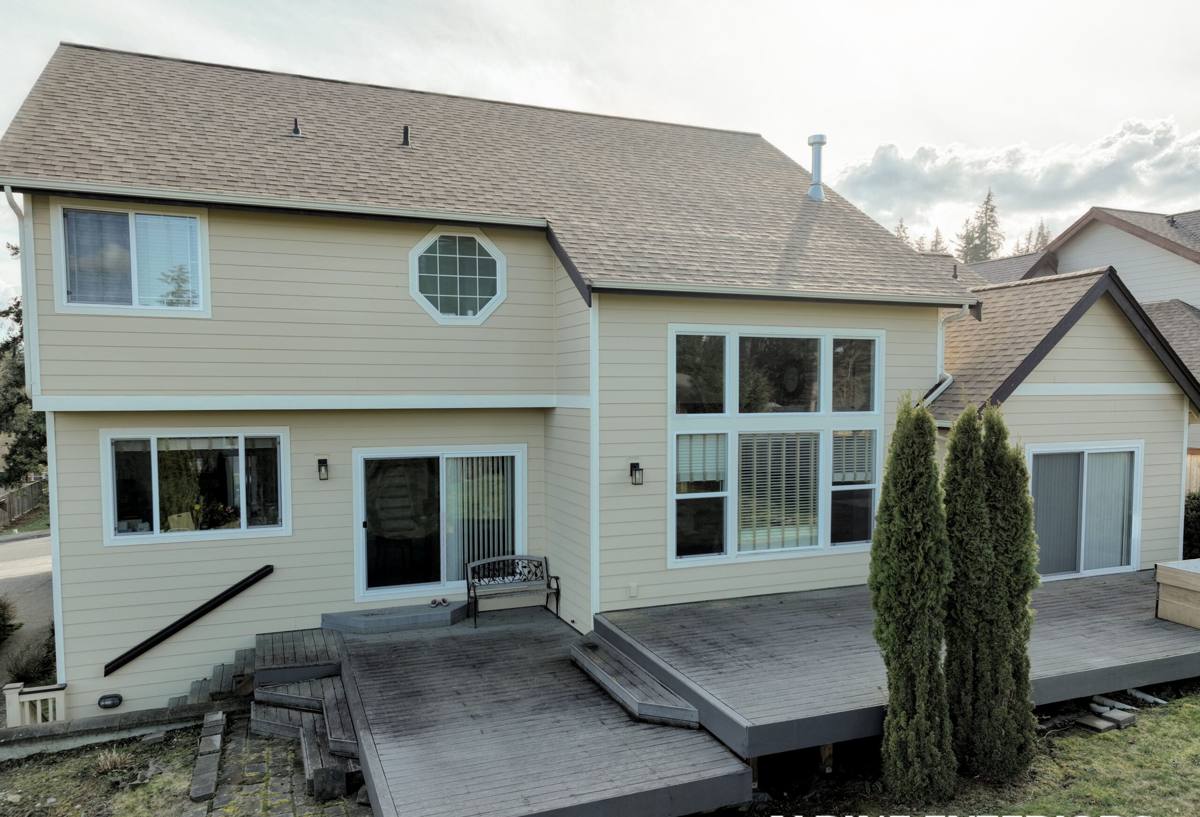
What Bellingham's Climate Actually Does to a Deck
Salt Air and Hardware
Bellingham isn't a beachfront town, but it's close enough to the water that salt-laden air reaches inland neighborhoods, including hillside areas like Happy Valley, especially on windy days. Salt air accelerates corrosion on any exposed metal — screws, joist hangers, post bases, railing brackets. Composite boards themselves don't rust, but a deck is only as good as the fasteners and framing hardware holding it together. We spec stainless or heavy hot-dip galvanized hardware rated for coastal exposure on every composite deck we build here, not the cheaper coated fasteners that show rust bleed through the decking within a couple of seasons.
Driving Rain and Water Management
Rain in this region rarely falls straight down — wind-driven rain finds its way under ledger boards, behind fascia, and into any gap in flashing. A deck attached to the house needs a properly flashed ledger connection with a water-resistant barrier between the ledger and the wall sheathing, not just lag bolts and caulk. Get this wrong and the moisture problem shows up as rot in the rim joist or sheathing behind the deck, not in the decking boards themselves — which is why so many "deck failures" are actually framing failures hiding under a nice composite surface.
Surface Traction in Wet Weather
With Bellingham's rain and Happy Valley's shade combining for a deck surface that's wet more often than dry for parts of the year, board texture matters. Most capped composite boards use a grooved or embossed wood-grain surface that sheds water and holds traction better than smooth, glossy profiles, especially on stairs. We steer homeowners away from smooth composite boards for stair treads and main walking surfaces here, regardless of how they look in a showroom.
Moss Season
Shaded, damp lots in Happy Valley grow moss on almost any horizontal surface that doesn't get airflow and periodic sun. Composite decking resists rot, but moss and algae will still colonize the surface of any deck board, composite or wood, if the deck can't breathe underneath and dry out between rain events. The fix isn't a different decking material — it's proper ground clearance, gapping, and airflow, which we'll get into below.
Composite vs. Wood vs. PVC: What Actually Holds Up Here
We install all three materials depending on budget and the homeowner's priorities. Here's how they compare specifically for a shaded, damp, salt-exposed lot like the ones common in Happy Valley:
| Factor | Wood (cedar/treated) | Capped Composite | PVC |
|---|---|---|---|
| Upfront cost | Lowest | Mid-range | Highest |
| Moisture/rot resistance | Depends on maintenance | High — capped shell resists moisture intrusion | Very high — no wood content |
| Moss/algae resistance | Low without regular cleaning | Moderate — smoother caps shed moss better than wood grain | Moderate to high |
| Maintenance | Annual staining/sealing | Occasional wash, no sealing | Occasional wash, no sealing |
| Typical lifespan here | 10–15 years with upkeep | 25–30 years | 25–30+ years |
For most Happy Valley homeowners, capped composite is the practical middle ground: it costs less than PVC, needs far less upkeep than wood in a climate that punishes unsealed wood fast, and holds up well once it's installed with real drainage and airflow underneath.
What a Correct Composite Deck Installation Involves
Framing and Joist Spacing
Composite boards flex more than solid wood over the same span, so most manufacturers require tighter joist spacing than a traditional wood deck — often 16 inches on center, and closer (12 inches) for diagonal or picture-frame board patterns. Building to wood-deck joist spacing and just swapping in composite boards is a common shortcut that leads to bounce and, over time, board fatigue. We frame to the decking manufacturer's actual span tables, not a generic spacing.
Ledger Attachment and Flashing
Any deck attached to the house gets a flashed ledger connection — proper metal flashing integrated with the house's water-resistant barrier, not surface-applied caulk. This is the single most important waterproofing detail on the whole project, and it's invisible once the deck is built, which is exactly why it's worth asking a contractor about before they start.
Footings and Frost Depth
Footings need to be sized and set to the depth required under Whatcom County's building code, and on sloped Happy Valley lots that often means stepped footings rather than a uniform depth across the deck. We pull permits and get footing inspections done before framing continues — skipping this step is a liability for the homeowner, not just a paperwork issue.
Fastening Systems
Hidden fastener clip systems give a clean, screw-free surface and are the standard on most capped composite decks today. Face-screwing is sometimes still the right call on stair treads or high-traffic picture-frame borders, where the extra grip matters more than the cosmetic finish. We'll walk through which makes sense where on your specific layout.
Manufacturer Warranty Requirements
Most capped composite brands back their boards with limited warranties running 25 to 50 years against structural defects, staining, and fading — but those warranties are conditioned on installation following the manufacturer's published specs: joist spacing, gap width, ventilation, and fastener type. An installer who cuts a corner on any of those details can quietly void coverage the homeowner is counting on, without the homeowner ever knowing until there's a problem to file a claim on.
Drainage, Airflow, and Keeping Moss From Taking Over
This is the part that gets skipped on a lot of decks and is the biggest single factor in whether a composite deck stays clean or grows moss within a year or two, especially on the shaded lots common in Happy Valley.
Ground Clearance and Venting
Composite decking needs adequate clearance between the ground (or a paved patio surface) and the underside of the joists to let air move and moisture evaporate. Low-clearance builds — decks close to grade, or enclosed on the sides with skirting and no vents — trap humid air underneath and turn the space into a moss and mildew incubator, even with premium boards on top.
Board Gapping
Composite boards need consistent gapping between boards for drainage and to allow for thermal expansion, which is more pronounced in composite material than in wood. Tight, uneven, or closed gaps trap standing water and organic debris — leaves and needles are constant in a tree-heavy neighborhood like this one — right where moss gets its start.
Routine Cleaning
Even a well-built composite deck benefits from a seasonal rinse and occasional soft-wash to clear pollen, needles, and early moss growth before it sets in, particularly on north-facing or heavily shaded sections. This takes a fraction of the effort wood decking requires, but "no maintenance" isn't quite accurate in a climate like this one.
Permits and Code Requirements in Bellingham
Most deck construction and replacement work in the City of Bellingham and unincorporated Whatcom County requires a building permit, particularly for anything attached to the house, elevated, or involving new footings. Guardrails are required above a certain deck height and must meet specific height and baluster-spacing requirements under the adopted building code. We handle the permit application and inspections as part of the job — it's not an upsell, it's what keeps the homeowner from inheriting a code problem at resale.
Our Process for a Happy Valley Deck Project
- On-site visit to assess the existing structure (if replacing a deck), lot slope, sun/shade exposure, and drainage path
- Design and material selection, including board color/profile and fastening approach
- Permit drawings and submittal to the appropriate jurisdiction
- Demo of the old deck (if applicable) and framing built to current span and footing requirements
- Ledger flashing, joist installation, and rough inspection
- Decking, fascia, and railing installation
- Final walkthrough and inspection sign-off
We build in the sequence above on every composite deck, whether it's a full replacement of a failing wood deck or new construction on a bare lot.
Why Local Experience on Happy Valley's Lots Matters
A lot of deck problems we get called out to fix started with a crew that builds mostly in flatter, drier parts of the county and treated a sloped, shaded Happy Valley lot the same as anywhere else. Sloped lots change footing depth and layout. Tree cover changes how much airflow and gapping a deck actually needs to stay clean. And the combination of salt air and long wet stretches means hardware and flashing choices that are optional elsewhere aren't optional here. A crew that already works this neighborhood knows to plan for these conditions from the design stage instead of discovering them after the deck is built.
Signs Your Deck Needs Replacing, Not Just Repair
- Soft, spongy, or visibly rotted boards, especially near the ledger or stair stringers
- Persistent moss or algae that comes back within weeks of cleaning
- Visible gaps, staining, or soft wood where the deck meets the house
- Rusted or corroded fasteners and hardware, especially near railing posts
- Noticeable bounce, movement, or squeaking underfoot
- A deck older than 15–20 years that's never had the substructure inspected
If you're seeing more than one of these, it's worth having someone look at the framing, not just the decking surface — the boards are often the last thing to fail.
If you're planning a new composite deck or replacing a tired one in Happy Valley, we're happy to walk the site, look at your slope and sun exposure, and put together a straightforward, no-pressure estimate — fill out the form below to get started.