 Bellingham Siding
 Edgemoor's Setting Is Beautiful — and Hard on Siding
Edgemoor sits close to the water on Bellingham Bay, under a heavy tree canopy that most of the neighborhood was built around rather than cleared for. That combination — salt-laden air moving off the bay, mature conifers and big-leaf maples shading large sections of most lots, and the driving, wind-pushed rain that comes through Whatcom County several months a year — is exactly the kind of environment that separates siding that lasts thirty years from siding that starts failing at year eight.
Three things work against exterior siding here specifically:
- Salt air accelerates corrosion of fasteners, trim flashing, and any metal components, and it degrades paint and coatings faster than inland exposure.
- Driving rain, often pushed sideways by wind off the water, finds gaps and seams that would stay dry on a more sheltered inland lot.
- Extended shade and moisture from tree cover keeps siding surfaces wet longer after every storm, which is the single biggest driver of moss, algae, and mildew growth on siding in this part of the state.
None of this means Edgemoor homes need something exotic. It means the siding product and the installation both have to be chosen and executed with this specific exposure in mind — not a generic Pacific Northwest spec, but one that accounts for a shaded, waterfront-adjacent lot.
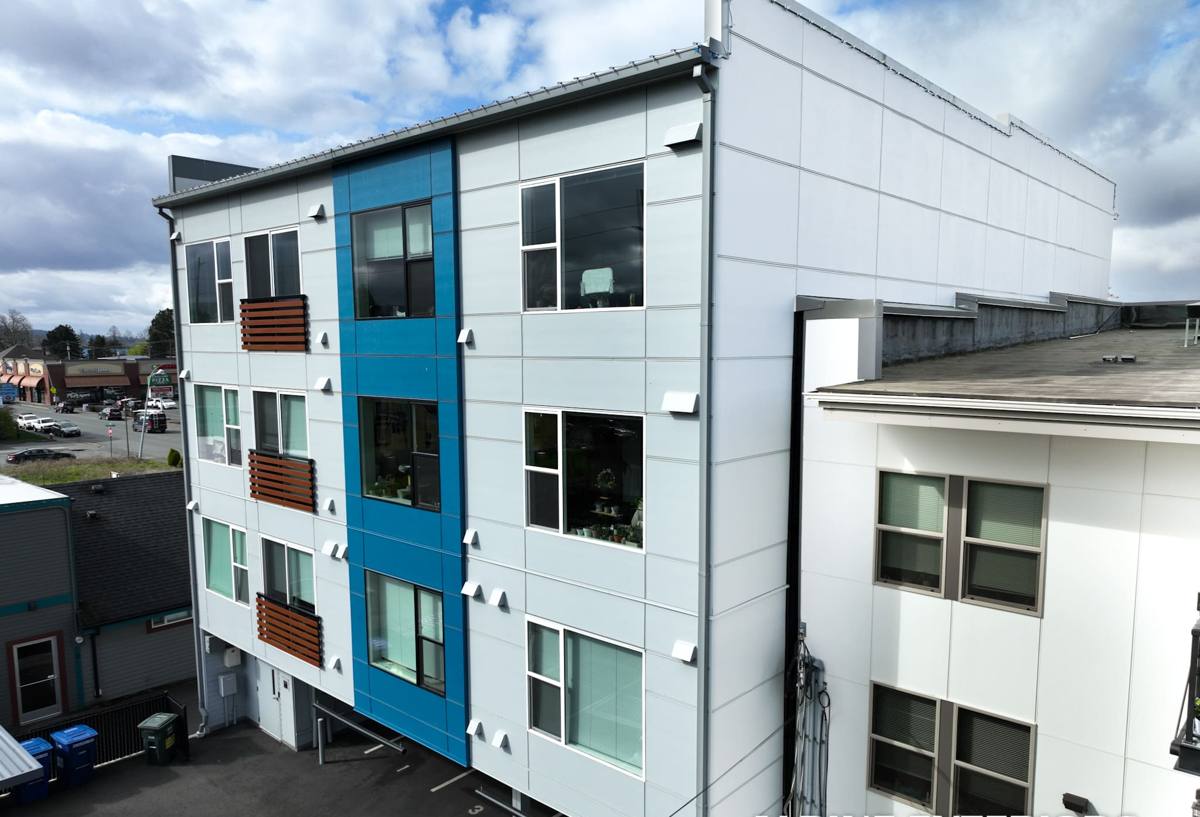
Why Fiber Cement Is the Right Category of Product Here
Fiber cement siding is a mix of cellulose fiber, sand, and Portland cement pressed and cured into planks and panels. Unlike wood-based products, it doesn't feed rot fungus or provide an organic food source for moss and algae the way bare wood or wood-fiber composite siding can. Unlike vinyl, it doesn't soften, warp, or become brittle with repeated temperature swings and UV exposure. And because it's non-combustible, it doesn't contribute fuel in a wildfire exposure scenario — a consideration that matters more each year in Western Washington.
Why We Standardized on James Hardie Specifically
Fiber cement isn't a single product — it's a category, and the manufacturing quality varies. We install James Hardie exclusively, not other fiber cement brands, for a few concrete reasons: Hardie's HardieZone system engineers specific product formulations for regional climates (HZ5 is the specification for the wetter, milder Pacific Northwest), the ColorPlus factory finish is baked on under controlled conditions rather than field-painted, and the warranty structure is transferable to a future owner if the home sells — which matters on higher-value waterfront-adjacent property where resale disclosures get scrutinized.
We don't install LP SmartSide, vinyl, Cemplank, Allura, or primed wood siding. That's a deliberate standard, not a knock on every homeowner who has one of those products already on their house — each has legitimate uses. But for a crew that wants to stand behind its own installation for decades, narrowing to one engineered, factory-finished system lets us know exactly how the product behaves, exactly what flashing details it needs, and exactly what the warranty covers if something goes wrong.
How the Common Siding Choices Compare in This Climate
| Material | Moisture behavior near the bay | Moss/algae resistance | Long-term maintenance |
|---|---|---|---|
| James Hardie fiber cement | Dimensionally stable when wet or dry; won't swell or rot | Factory finish resists growth better than bare wood; still needs periodic washing in shaded areas | Repaint typically not needed for many years; occasional caulk and wash |
| Vinyl siding | Can warp or buckle with temperature swings; seams can allow water behind panels | Moderate; growth still occurs in shaded, damp spots | Low, but damaged panels are hard to color-match years later |
| Cedar / primed wood | Absorbs moisture; prone to swelling, cupping, and rot at end grain and joints | Poor — organic surface feeds moss and mildew directly | Repainting or restaining every few years; ongoing rot inspection |
| LP SmartSide (engineered wood) | Better than solid wood but still wood-based; edge sealing is critical | Moderate; depends heavily on maintaining the factory coating | Coating maintenance and careful caulking at every cut edge |
What a Correct Installation Actually Involves
The siding material only performs as well as the installation behind it. On an Edgemoor lot with shade and driving rain to plan around, the details that separate a correct job from a problem job are almost all invisible once the siding is up:
Drainage and Rain-Screen Details
Fiber cement should go over a drainage plane — typically a weather-resistant barrier with a furring strip or engineered drainage mat behind the siding — so any water that gets past the cladding has somewhere to go besides sitting against the sheathing. This matters more on shaded, damp lots than on sun-exposed ones, because wet-behind-the-siding conditions here don't dry out quickly between rain events.
Flashing and Fastening
Every window, door, deck ledger, and roof-to-wall intersection needs flashing detailed to shed water outward, not trap it against the framing. Fasteners need to be corrosion-resistant and driven to Hardie's specified pattern and depth — over-driven or under-driven nails are one of the most common causes of premature siding failure, and it's a detail that's easy to get sloppy with if a crew doesn't install this product every day.
Joints, Caulking, and Clearances
Butt joints, trim intersections, and the gap at grade all need to be sized and sealed to spec — too tight and there's no room for expansion, too loose and wind-driven rain gets behind the board. Siding should also be held up off decks, patios, and grade with a proper clearance gap so splash-back and standing moisture don't sit against the bottom course.
Our Process, Start to Finish
- On-site assessment — we walk the exterior, check the existing wall assembly where accessible, note shade patterns, drainage paths, and any current moss or moisture staining.
- Scope and product selection — plank profile, exposure width, and ColorPlus color are chosen for the home's architecture and the amount of sun or shade each elevation actually gets.
- Written estimate — a clear scope covering removal (if applicable), house wrap or drainage plane, flashing work, siding and trim, and cleanup.
- Installation — done to Hardie's fastening and clearance specifications, with flashing details built in as we go rather than patched afterward.
- Final walkthrough — we go over the finished work with you before calling the job done.
Living With Fiber Cement Siding in a Moss-Prone, Salt-Air Neighborhood
Fiber cement is low-maintenance compared to wood, but "low-maintenance" isn't "no-maintenance," especially under tree cover. A short annual routine keeps a Hardie installation looking and performing the way it should:
- Rinse shaded and north-facing walls once or twice a year to keep moss and algae from establishing, especially where branches overhang the roofline.
- Keep gutters clear so overflow doesn't run down the siding face repeatedly in the same spot.
- Trim back vegetation that keeps a wall damp or blocks airflow along the siding.
- Inspect and refresh caulking at trim joints and penetrations every few years — caulk is the one component that wears out before the siding does.
- Walk the exterior after major windstorms to check for anything dislodged, particularly on the bay-facing elevation.
Why Local Experience in Edgemoor Specifically Matters
Every neighborhood in Bellingham has its own microclimate, and a crew that mainly works drier, more open lots elsewhere in Whatcom County will make different assumptions than one that regularly works waterfront-adjacent, tree-shaded properties like the ones in Edgemoor. Knowing which elevations of a given lot stay wet longest, how much clearance a heavily wooded yard needs at grade, and how salt air behaves on trim and fasteners over time isn't something you get from a spec sheet — it's something you get from doing the work here repeatedly. That local pattern recognition is what keeps a siding job from turning into a callback two winters later.
What Fiber Cement Siding Typically Costs
Pricing depends on the size and complexity of the home, the amount of trim and detail work, whether existing siding needs to be removed, and access constraints on a wooded lot. Rather than quote a number that doesn't apply to your house, here are the factors that move the price up or down:
| Cost factor | Why it matters |
|---|---|
| Removal of existing siding | Tear-off, disposal, and any sheathing repair add labor before new siding goes up |
| Home size and wall complexity | More corners, gables, and dormers mean more cutting, flashing, and trim labor |
| Access and lot conditions | Tree cover, slopes, and tight side yards common in Edgemoor can slow staging and material handling |
| Plank profile and color | Wider reveals, specialty trim, and certain ColorPlus finishes carry different material costs |
| Drainage plane upgrade | Adding or upgrading a rain-screen assembly during a re-side is additional labor but pays off in a damp, shaded setting |
We'll walk your specific house and give you a written number based on what's actually there, not a generic square-footage rule of thumb.
A Straightforward Next Step
If you're weighing a siding replacement or new-build siding choice for a home in Edgemoor, we're glad to come take a look and talk through what your specific lot and exposure actually need. There's no pressure and no obligation — just a straight assessment and a written estimate you can take your time with. Use the form below to request a free estimate.