 Bellingham Siding
 Ferndale sits close enough to the water and the flats around it that its homes take a different kind of beating than siding a few miles inland. Salt-tinged air off the bay, wind-driven rain that finds every gap in a wall system, and a moss season that can run eight months out of the year all add up to siding that has to work harder than the manufacturer's brochure photo suggests. If your siding is cupping, soft at the bottom courses, or growing green in the shade year-round, it's not bad luck — it's Ferndale.
We install James Hardie fiber cement siding, and only James Hardie. This page covers what a proper siding replacement looks like for a Ferndale home specifically: what the climate demands, what correct installation actually involves, and how we run the job from estimate to cleanup.
Why Ferndale Wears Out Siding Faster Than People Expect
Ferndale homes deal with three compounding stresses that don't show up the same way in drier parts of the state.
Salt Air
Proximity to Bellingham Bay means a steady low-level dose of salt-laden moisture in the air, even on days without direct rain. Salt is hygroscopic — it pulls and holds moisture against a surface. On siding, that means finishes and fasteners near the coast see more sustained dampness than the same materials would a few miles east, which accelerates corrosion on the wrong fastener and breakdown on the wrong coating.
Driving Rain
Storms coming off the Strait don't just fall straight down — wind pushes rain sideways into wall assemblies, working it into laps, seams, and any gap around trim or penetrations. Siding that isn't installed with the right clearances and flashing details will eventually let that water behind the cladding, where it causes rot in sheathing and framing long before the siding itself looks obviously damaged.
Moss and Shade
Tree cover and the Pacific Northwest's long wet season mean moss and algae get a real foothold on north-facing and shaded walls. Moss holds moisture against the surface it grows on, which is a problem for any siding material that can absorb water or swell when wet.
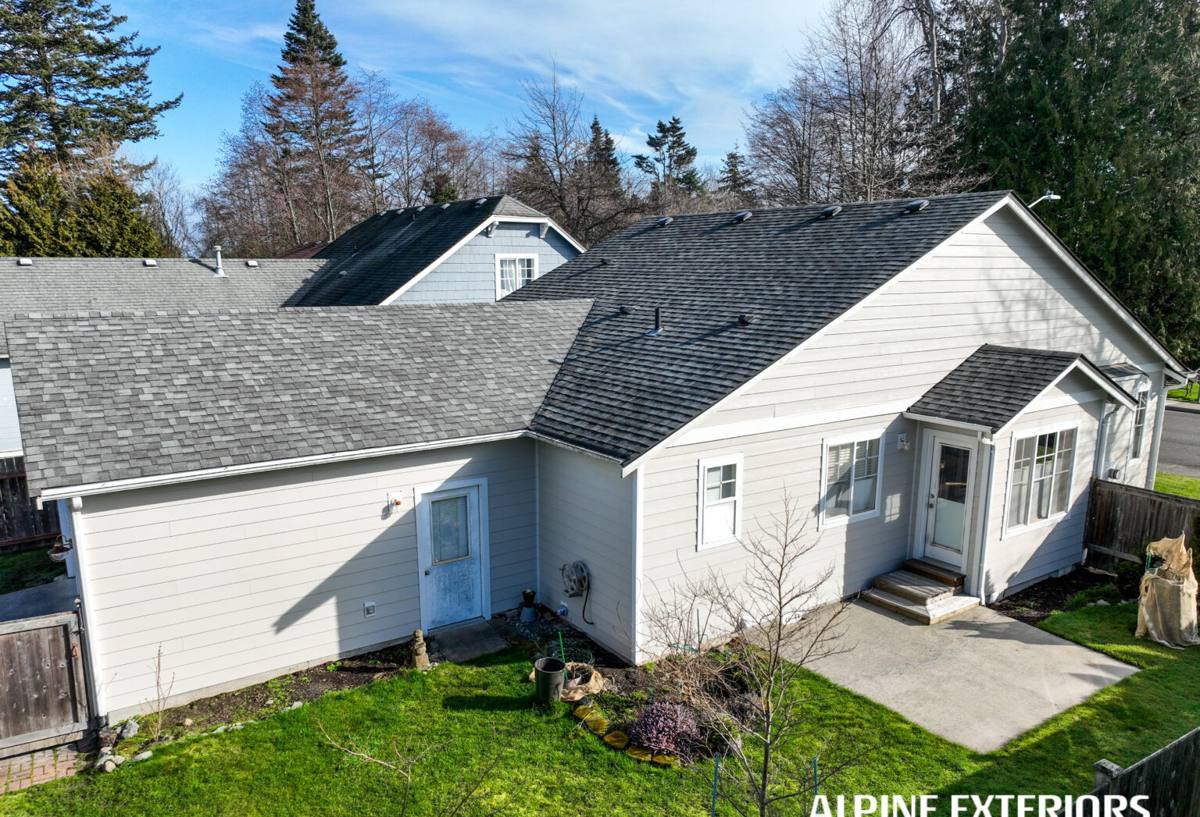
What This Means for Your Siding Choice
These three stresses — salt, driving rain, and sustained moisture from moss — all point to the same conclusion: the siding on a Ferndale home needs to be dimensionally stable when wet, resistant to rot, and finished with a coating that holds up under UV and salt exposure without chalking or fading early. Wood-based products (cedar, primed spruce) and wood-fiber composites (LP SmartSide) are more sensitive to sustained moisture than a lot of homeowners realize going in — cut edges and end grain in particular are where trouble starts. Vinyl handles moisture fine but moves with temperature and can look and perform like the budget product it is, especially on a home this close to the water where UV and salt both take a toll on the surface over time.
James Hardie fiber cement is our standard because it's dimensionally stable in wet climates, doesn't rot, and its ColorPlus factory finish is engineered to hold color and resist the kind of coastal weathering Ferndale sees. It's also non-combustible, which matters given how often the Pacific Northwest's wildfire season now brings smoke and ember exposure even to coastal communities that aren't directly in a fire's path.
What a Correct Siding Replacement Job Involves
Siding replacement isn't just pulling old boards and nailing up new ones. On a Ferndale home, the sequence matters as much as the material.
- Tear-off and inspection. Removing the old siding is when we find out what's actually happening behind it — soft sheathing, rot at window and door openings, or moisture staining that tells us where water has been getting in.
- Sheathing repair. Any compromised sheathing gets replaced before anything new goes up. Installing new siding over damaged sheathing just hides the problem for a few more years.
- Water-resistive barrier. A correctly lapped and sealed weather barrier is the layer that actually stops bulk water — the siding sheds most of it, but the barrier behind it is what protects the wall assembly from the rest.
- Flashing at every penetration. Windows, doors, hose bibs, vents, and any other penetration through the wall get flashed so water is directed out and down, not behind the cladding.
- Correct fastening and clearances. James Hardie specifies fastener type, spacing, and minimum clearances from grade, roof lines, and decks. These aren't suggestions — they're what keeps the product performing to its rated lifespan in a wet climate.
- Factory-finished siding installation. Because ColorPlus is applied and cured at the factory, we're not relying on field-applied paint to hold up against salt air and UV — the finish is already engineered for it.
- Caulking and trim detail. Joints get sealed with the right sealant in the right places — not everywhere, since some joints are designed to allow drainage and shouldn't be sealed shut.
Siding Materials: How They Actually Compare in This Climate
| Factor | James Hardie Fiber Cement | Vinyl | Wood / LP SmartSide |
|---|---|---|---|
| Moisture behavior | Dimensionally stable, won't rot | Doesn't absorb water, but seams can let it in behind | Absorbs moisture; rot risk at cut edges and grain |
| Salt air / coastal exposure | Factory finish engineered for UV and coastal weathering | Can chalk and fade over time near salt air | Finish and substrate both more sensitive to sustained moisture |
| Moss / algae resistance | Non-porous surface, easier to keep clean | Can harbor growth in seams and laps | Porous surface holds moisture, more prone to growth |
| Fire resistance | Non-combustible | Combustible, can melt/deform near heat | Combustible |
| Warranty | Long-term, transferable | Varies by product | Varies; often shorter given moisture sensitivity |
Signs a Ferndale Home Needs Siding Replacement Now
- Soft or spongy siding near the bottom courses or around windows and doors
- Persistent moss or algae growth that comes back within weeks of cleaning
- Visible cupping, warping, or separation at seams and corners
- Paint that's peeling or chalking faster than a normal repaint cycle would suggest
- Interior signs — musty smell, staining, or soft drywall near exterior walls
- Siding that's original to a home built more than 20-25 years ago and hasn't been evaluated recently
Why It Matters That We Already Work in Ferndale
A siding crew that's used to installing in a drier or more sheltered part of the state doesn't automatically know how to detail a wall for driving rain off the Strait, or where moss tends to establish on a Ferndale roofline and wall junction. Getting flashing details and clearances right in this climate isn't optional extra care — it's the difference between siding that reaches its expected lifespan and siding that starts showing problems in year eight instead of year thirty. Working regularly in Whatcom County means we're not guessing at how this weather behaves against a wall; we're building to what we've already seen it do.
Our Process
We keep the process straightforward and put the decisions in your hands, not ours.
- Free on-site estimate. We walk the exterior with you, note problem areas, and give you a clear scope and price range — no pressure, no inflated urgency.
- Material and color selection. We'll walk you through James Hardie's HZ product lines and ColorPlus color options suited to coastal exposure.
- Scheduled tear-off and install. We plan around weather windows realistically, since installing over wet sheathing or in active rain isn't good practice regardless of the product.
- Daily site cleanup. Nails, cut-offs, and old siding debris get cleared as we go, not left to pile up for the duration of the job.
- Final walkthrough. We go over the finished job with you before calling it done.
What to Expect on Cost
Siding replacement cost depends on square footage, the amount of sheathing repair needed, home shape (dormers, gables, and cutouts add labor), and trim complexity. Homes closer to the water with more accumulated moisture damage sometimes need more sheathing repair than homes further inland — which is exactly why the tear-off inspection step matters before anyone commits to a final number. We'll give you a real range at the estimate, not a guess pulled from a national average that doesn't account for Whatcom County conditions.
If your Ferndale home's siding is showing its age or you just want an honest read on its condition, we're happy to take a look. The estimate is free, there's no pressure, and you'll walk away with a clear picture of what's going on and what it would take to fix it right — just fill out the form below.