 Bellingham Siding
 Why Sunnyland Decks Take More Punishment Than the Brochures Admit
Sunnyland is a mature, tree-covered neighborhood, and that's exactly what makes decking here harder to get right than a lot of manufacturers' installation guides assume. Big conifers and mixed canopy mean shade for most of the day on many lots, and shade plus Whatcom County's long wet season is the recipe for moss, algae, and slow-drying wood — on the deck boards themselves and on everything underneath them. Add driving rain that comes in sideways off Bellingham Bay during fall and winter storms, and a faint but real edge of salt air working into fasteners and metal flashing, and you've got a climate that's tougher on outdoor structures than most of the country ever deals with.
None of this means composite decking is a bad fit for Sunnyland — it's usually the better fit. But it means the installation has to account for local conditions instead of following a generic spec sheet written for a dry climate. A deck built the same way here as it would be in eastern Washington will grow moss in the gaps, trap moisture against the framing, and start showing problems in a few wet seasons instead of holding up for decades.
The Three Things Working Against Every Deck in This Neighborhood
- Shade and slow drying: Tree cover keeps boards, joists, and ledger connections damp longer after each rain than a deck in full sun.
- Volume of rain: Whatcom County gets a lot of it, spread across many months, not a few intense storms — that's more total exposure time for water to find weak points.
- Salt-tinged air: Being close to Bellingham Bay means fasteners, brackets, and any exposed metal corrode faster than they would inland.
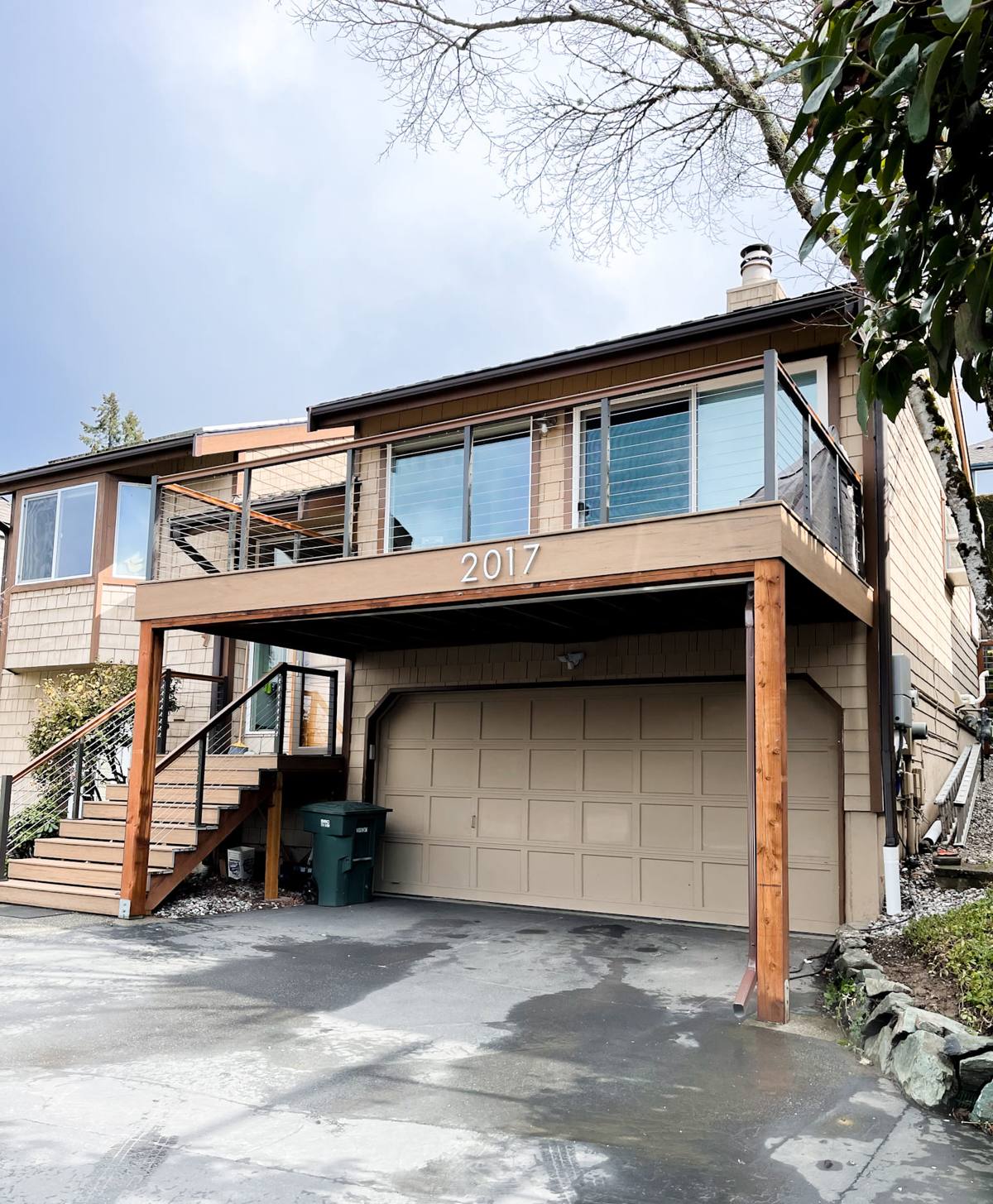
What a Correct Composite Deck Actually Requires Here
Composite boards themselves don't rot, but a composite deck is still a wood-framed structure underneath (unless you've paid for a full aluminum or steel substructure), and that framing is where problems actually start. Doing this job right in Sunnyland means treating the substructure and drainage as seriously as the decking surface.
Framing and Ledger Attachment
The ledger board — where the deck attaches to the house — is the single most common point of failure we find on older decks in this climate. It needs proper flashing that sheds water away from the house band joist, not just caulk and hope. We use joist tape or a comparable moisture barrier on every joist top, not only the ledger, so fastener penetrations don't become entry points for standing water.
Fasteners and Hardware
Given the salt air, we spec stainless steel or high-grade coated fasteners and hardware rated for coastal exposure, not the bargain hot-dip galvanized hardware that's fine 50 miles inland but corrodes visibly within a few years here. This matters more on a composite deck than people expect — composite boards last decades, so the fasteners holding them need to last that long too, or you're tearing up a "maintenance-free" deck to fix a $2 screw.
Ventilation and Drainage Under the Deck
Low decks with poor under-deck airflow are the ones we see with moss and black growth creeping onto the boards from underneath, especially on shaded Sunnyland lots. Adequate clearance to grade, gapping that lets air move, and grading that carries water away from the foundation instead of pooling under the deck all matter more here than in a drier climate.
Composite vs. the Alternatives, Honestly
We install composite decking often in this neighborhood because it holds up well to the conditions, but it's not automatically the right call for every homeowner or every budget. Here's how the common options actually compare for a shaded, wet, salt-air lot like Sunnyland.
| Material | Moisture Behavior Here | Moss/Algae Resistance | Upkeep | Typical Lifespan |
|---|---|---|---|---|
| Composite (capped) | Doesn't absorb water or rot; won't warp or splinter | Good — surface sheds growth better than wood, but still needs periodic washing in shade | Occasional cleaning, no staining/sealing | 25–30+ years |
| Pressure-treated wood | Absorbs water readily; prone to cupping and checking in wet-dry cycles | Poor in shade without regular maintenance | Annual cleaning, periodic staining/sealing | 10–15 years before major repairs |
| Cedar | Naturally rot-resistant but still absorbs moisture over time | Moderate — better than treated pine, still needs care in shade | Regular sealing to keep its look and resist moss | 15–20 years |
| PVC (all-plastic) | Fully water-resistant, won't rot | Good, similar to composite | Low, similar to composite | 25–30+ years |
PVC is a reasonable alternative to composite and we'll discuss it honestly if it fits your project — it trades a slightly more plastic appearance and higher price for marginally better moisture indifference. For most Sunnyland homeowners, capped composite hits the right balance of appearance, cost, and performance in this climate.
Our Process for a Sunnyland Composite Deck
- Site walk and drainage assessment. We look at sun exposure, tree cover, existing grading, and how water currently moves around your lot before we talk board selection.
- Framing inspection or design. On a rebuild, we inspect existing ledger, joists, and posts for rot or undersizing before building on top of them — a common issue on older Sunnyland homes with decks added decades after the house was built. On new builds, framing is spec'd to current code and to the load and span tables for the composite product chosen.
- Moisture barrier and flashing. Joist tape, proper ledger flashing, and correct fastener selection for coastal exposure — done before a single visible board goes down.
- Board installation. Hidden fastener systems where the product allows, correct expansion gapping (composite moves with temperature more than people expect), and attention to picture-framing and stair details.
- Final grading and cleanup check. We confirm water is draining away from the house and under-deck area, not pooling against the foundation or new footings.
Choosing Boards and Understanding the Real Cost Factors
Composite decking pricing varies a lot by product tier, and the differences aren't just cosmetic — they affect how well the board performs in a wet, shaded climate.
| Factor | Why It Matters in Bellingham/Whatcom County |
|---|---|
| Capping (full vs. partial vs. uncapped) | Fully capped boards resist moisture absorption and staining far better in a climate this wet; uncapped composite can wick moisture at cut ends and swell over time |
| Color/tone | Darker boards show pollen, needle debris, and mineral streaking less but run hotter in the rare sunny stretch; lighter boards show organic growth sooner in shaded areas |
| Board profile (grooved vs. square edge) | Grooved boards for hidden fasteners look cleaner but the grooves can hold moisture and debris if under-deck airflow is poor — worth discussing for heavily shaded lots |
| Substructure material | Treated wood framing costs less upfront; aluminum or composite substructure costs more but removes wood-framing moisture risk entirely |
| Square footage and layout complexity | Stairs, multiple levels, and picture-framing add labor and material beyond flat square footage |
We'll walk through real product samples and give you straight numbers for your specific project rather than a generic per-square-foot quote pulled from a national average — pricing depends heavily on the factors above, plus site access and existing structure condition.
Living With a Composite Deck Through a Whatcom County Moss Season
"Low maintenance" doesn't mean "no maintenance," especially in a shaded neighborhood like Sunnyland. A few honest points:
- Composite still needs periodic washing — a garden hose and stiff (not wire) brush, or a low-pressure wash, a couple of times a year in shaded spots, more if you're under heavy tree cover.
- Leaves, needles, and pollen should be swept off regularly rather than left to compost against the boards, which is what actually feeds moss and algae growth on any deck surface, composite included.
- Gaps between boards can collect debris over a wet season — clearing them keeps drainage working as designed.
- Composite doesn't need staining or sealing, which is the real time savings versus wood — but it isn't immune to the biology of a wet, shaded climate sitting on top of it.
Why a Crew That Already Works This Neighborhood Matters
Sunnyland's mix of older homes with additions, mature trees, and sloped or irregular lots means a lot of decks here don't match the flat, sun-exposed conditions most composite manufacturer install guides are written for. A crew that's already worked this neighborhood knows to check ledger condition on homes where the deck was clearly added after the original build, knows which lots need extra attention to under-deck airflow because of tree cover, and specs fasteners and flashing for the salt air without being asked. That's the difference between a deck that looks right on installation day and one that's still performing correctly ten wet seasons later.
We're a Bellingham-based crew working across Whatcom County, and Sunnyland is part of our regular service area — not a stretch job we're pricing high to make worth the drive.
Signs an Existing Deck Needs Attention Before a Replacement
If you're weighing a rebuild versus a repair, a few things are worth checking before you decide:
- Soft or spongy spots in wood decking, especially near the ledger or stair stringers
- Visible rust streaking from fasteners or brackets — a sign of hardware not rated for this climate
- Persistent moss or dark staining that returns quickly after cleaning, suggesting a drainage or airflow problem rather than just a surface issue
- Gaps or separation at the ledger flashing where it meets the house siding
- Visible sagging or bounce in the deck surface underfoot
Some of these are surface fixes; others point to framing or drainage problems that a new composite surface would only hide temporarily instead of solving.
If you're planning a new deck or replacing an aging one in Sunnyland, we're happy to take a look and give you a straight, no-pressure estimate based on your actual lot, sun exposure, and existing structure — just fill out the form below.